Introduction
"秋日翠微宫" (Autumn Day at the Palace of Azure Mist) is a refined landscape poem by Emperor Taizong of Tang (Tang Taizong, personal name Li Shimin, 598–649 CE). One of the most celebrated rulers in Chinese history, Taizong was not only an outstanding military strategist and statesman but also an accomplished poet and calligrapher. The poem was composed during a sojourn at the Cuivei Palace (翠微宫), a summer retreat nestled in the Zhongnan Mountains near the Tang capital Chang’an. Written from the perspective of an emperor seeking a moment of quiet reflection away from court affairs, "秋日翠微宫" exemplifies the Tang dynasty’s fusion of political power with a deep appreciation for nature. This short piece captures the crisp clarity of mountain autumn, weaving imperial grandeur with the subtle melancholy of change, and remains a cherished jewel of early Tang poetry.
The Poem: Full Text and Translation
秋光凝翠岭,
Qiū guāng níng cuì lǐng,
Autumn light congeals on the emerald ridge,
凉吹肃离宫。
Liáng chuī sù lí gōng.
A chilly breeze solemnly sweeps through the detached palace.
荷疏一盖缺,
Hé shū yī gài quē,
The lotus leaves are sparse, each canopy now incomplete,
树冷半帷空。
Shù lěng bàn wéi kōng.
Trees shiver in the cold, half their leafy curtains gone.
侧阵移鸿影,
Cè zhèn yí hóng yǐng,
In slant formation, the silhouettes of wild geese shift,
圆花钉菊丛。
Yuán huā dīng jú cóng.
Round blossoms are studded amid the chrysanthemum clusters.
摅怀俗尘外,
Shū huái sú chén wài,
I let my thoughts unfold beyond the dusty world,
高眺白云中。
Gāo tiào bái yún zhōng.
Gazing high, I lose myself in the midst of white clouds.
Line-by-Line Analysis
Autumn light congeals on the emerald ridge
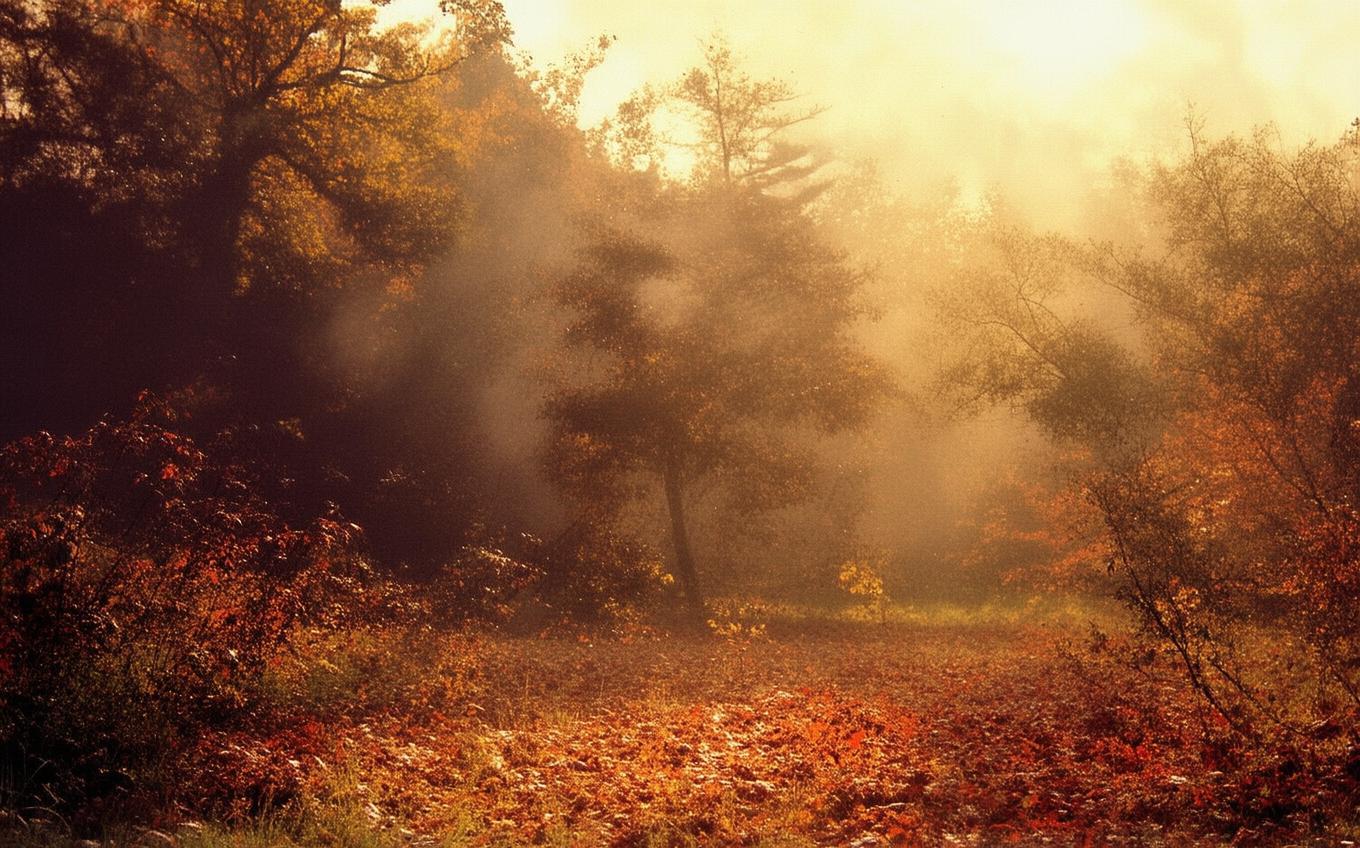
The opening line establishes the poem’s visual and tactile atmosphere. The verb "凝" (níng) — to congeal, to freeze — transforms autumn sunlight from something fleeting into a palpable, almost frost-like substance. By saying light "congeals" on the green mountains, the poet evokes the crystalline stillness of an autumn day, where the air itself seems thickened and luminous. The "emerald ridge" (翠岭) refers to the forested slopes surrounding the Cuivei Palace, whose name itself means "azure mist." This line subtly merges the palace's identity with the landscape, hinting that the imperial residence is not imposed upon nature but nestled within it.
A chilly breeze solemnly sweeps through the detached palace
"肃" (sù) carries a double meaning: solemn, respectful, and also cold, brisk. The breeze is personified as it moves through the "detached palace" (离宫, lí gōng) — a term for a secondary imperial residence away from the main court. The chill is not merely a physical sensation; it echoes the dignified quietude and the sense of separation from bustling official life. The word "离" (detached) also subtly suggests a psychological distancing, preparing the reader for the poem's eventual turn towards transcendent contemplation.
The lotus leaves are sparse, each canopy now incomplete
In classical Chinese poetry, the lotus often symbolizes purity and summer abundance. Here, the image of withering lotus pads (荷, hé) with their umbrella-like leaves broken or thinned signals the end of summer. The "一盖" (one canopy) emphasizes individual fragility, a single leaf unable to maintain its wholeness. This line quietly underscores the passage of time — nature’s beauty is transient, and even the imperial garden is subject to seasonal decay. The visual of a "deficient canopy" suggests both a real loss and a metaphorical opening, a gap through which the poet can glimpse a different order of things.
Trees shiver in the cold, half their leafy curtains gone
Following the lotus, the trees now take center stage. The phrase "半帷空" (half-veil empty) is rich with texture: leaves are imagined as curtains draping the tree; now "half" have fallen, revealing empty space. The "cold" (冷, lěng) is both external temperature and internal mood. The nakedness of the branches echoes a kind of austere honesty — as if, stripped of their lush disguise, the trees confront winter with dignity. This imagery parallels the Buddhist and Daoist notion of returning to an essential, unadorned state, a theme that will fully bloom later in the poem.
In slant formation, the silhouettes of wild geese shift
Autumn's migratory birds are a classic motif in Chinese poetry, often symbolizing separation, messages, or the passage of time. The geese fly in a "侧阵" (cè zhèn) — a sideways formation, perhaps an oblique V-shape against the wind. The word "移" (yí, to shift) portrays their movement as graceful and fluid, silhouettes sliding across the sky like ink strokes on a scroll. The geese, moving with purposeful direction, contrast with the stationary poet gazing upward. Their flight hints at a world beyond the palace, a natural rhythm unaffected by human concerns.
Round blossoms are studded amid the chrysanthemum clusters
This line brings forth the chrysanthemum, the flower of autumn in Chinese culture, symbolizing endurance, integrity, and the noble recluse. "圆花" (round flowers) refers to the tight, button-like heads of chrysanthemums dotting the dense foliage. The verb "钉" (dīng) — to nail or stud — is remarkably vivid; the flowers appear affixed like small golden nails into the green clusters. This precise, almost jewelled image of resilience amidst the season's decline embodies the Confucian ideal of the gentleman who persists in moral rectitude despite adversity. The chrysanthemum also points forward to the poem's final retreat: its presence was celebrated by Tao Yuanming, the archetypal poet-hermit.
I let my thoughts unfold beyond the dusty world
The last couplet shifts from outward observation to inner response. "摅怀" (shū huái) means to release one’s thoughts, to unburden the heart. "俗尘外" (sú chén wài) — beyond the dusty world — refers to the mundane realm of official duties, worldly affairs, and the "red dust" of cities. The emperor, who normally stands at the very center of that dusty world, here seeks liberation from it. This line is a quiet confession: the autumn scene has not merely pleased his senses but has drawn his mind toward a purer, unsullied space.
Gazing high, I lose myself in the midst of white clouds
The final image is one of complete absorption. White clouds (白云, bái yún) are a recurrent emblem of Daoist eremitism; they drift freely, tied to nothing. To gaze into them is to commune with that unbounded freedom. The verb "高眺" (high gaze) elevates both his eyes and his spirit. The poem closes not with a statement, but with a vanishing point — the poet's self merging into the distance, into the whiteness. This conclusion mirrors the ideal of wuyou (无为, non-action or effortless engagement with the flow of nature), a subtle homage to the Daoist philosophy that often provided solace to rulers burdened by statecraft.
Themes and Symbolism
Nature as a Mirror of Inner Life
Throughout the poem, external scenery reflects the poet’s emotional state. Autumn's clarity and crispness mirror a mind that has temporarily shed the confused heat of political life. The cold, emptiness, and migratory birds are not just seasonal markers but psychological states — from melancholy to release.
Transience and Impermanence
The decaying lotus and bare trees underscore the Buddhist-inflected awareness that all things — beauty, power, even imperial splendor — are ephemeral. Yet this transience is not lamented; it is accepted as the natural rhythm that opens the way to a higher, more enduring reality.
The Reclusive Ideal in the Midst of Power
The chrysanthemum and the white clouds are both traditional symbols of the recluse. For an emperor to evoke these motifs is particularly poignant. Taizong momentarily steps out of his role as the Son of Heaven and enters the mind of a hermit, finding solace in the very nature that his palaces may have tamed. This tension between worldly responsibility and spiritual withdrawal is a central theme in Chinese poetic tradition.
Harmony with the Cosmos
The poem presents no conflict between man and nature. The imperial "detached palace" is not an intrusion; it is a point from which to observe and merge with the cosmic landscape. The final dissolution of self into the white clouds embodies the supreme harmony sought by Chinese philosophy — a state where ruler, mountain, and sky become one.
Cultural Context
The Cuivei Palace (翠微宫), built in 632 CE under Taizong’s order, was part of a tradition of secondary palaces designed not for grand receptions but for imperial rest and reflection, often nestled in scenic mountains. These palaces bridged the Confucian duty of rulership with the Daoist yearning for nature. The Tang court was deeply cosmopolitan, yet its elite constantly re-engaged with the classical ideals of simplicity and retreat inherited from earlier dynasties.
Emperor Taizong’s own life was marked by intense ambition, military campaigns, and the consolidation of the Tang empire. His poetry, however, often reveals a quieter, introspective side, heavily influenced by the Six Dynasties nature poetry and the early Tang “palace style” (宫体诗, gōngtǐ shī) which emphasized refined observation. "秋日翠微宫" stands out as a mature expression of the tension between power and the desire for spiritual release — a tension that resonates throughout Chinese political and literary history.
The poem also reflects the Chinese philosophical concept of tianren heyi (天人合一), the unity of heaven and humanity. In withdrawing to the mountain to gaze upon clouds, the emperor symbolically realigns his own role as the human mediator between heaven and earth. The seasonal cycle, so perfectly observed here, mirrors the unbroken moral order the ruler must uphold.
Conclusion
"秋日翠微宫" is a small masterpiece of compressed imagery and profound understatement. In just eight lines, Emperor Taizong transforms a mountain retreat into a space of spiritual introspection. The poem’s beauty lies not in grand statements but in the delicate interplay of light, cold, falling leaves, and drifting clouds. For the modern reader, it offers a glimpse into the mind of one of China’s greatest rulers, who, amid the machinery of empire, sought — and, in his verse, found — a moment of perfect quiet. The poem continues to speak across centuries because its central longing is timeless: the desire to step beyond the "dusty world," even for an instant, and merge with something boundless and pure.
Comments (0)
No comments yet. Be the first to comment!