Introduction
Few images in Chinese poetry evoke the bittersweet passage of time as poignantly as the peach blossom. A symbol of spring, ephemeral beauty, and even a utopian paradise since the time of Tao Yuanming’s “Peach Blossom Spring,” the peach blossom has inspired countless verses. Among these, Bai Juyi’s (白居易, 772–846) short quatrain “Peach Blossoms at Dalin Temple” (大林寺桃花) stands out as a masterful “咏桃” (yǒng táo) — an ode to the peach. Written in 817 CE during the poet’s demotion to a remote post in Jiangzhou (modern Jiujiang, Jiangxi), the poem transforms a simple botanical observation into a profound reflection on loss, discovery, and the hidden persistence of joy. This blog post will guide you through the poem’s text, its vivid imagery, and the cultural layers that make it a timeless gem of Tang Dynasty literature.
The Poem: Full Text and Translation
人间四月芳菲尽,
Rén jiān sì yuè fāng fēi jìn,
In the world of men, by April, the fragrant blooms have all fallen;
山寺桃花始盛开。
Shān sì táo huā shǐ shèng kāi.
At the mountain temple, the peach blossoms are just now in full bloom.
长恨春归无觅处,
Cháng hèn chūn guī wú mì chù,
I always lamented that spring departs leaving no place to find it;
不知转入此中来。
Bù zhī zhuǎn rù cǐ zhōng lái.
Never knew it had turned and entered this place.
Line-by-Line Analysis
Line 1: 人间四月芳菲尽
The poem opens with a sweeping statement of finality: “In the world of men, by April, the fragrant blooms have all fallen.” The word “人间” (rén jiān, “the human world” or “the mortal realm”) immediately sets up a contrast between ordinary, lowland life and the elevated sanctuary of the mountain temple that follows. “四月” (April, according to the lunar calendar) is late spring; the blossoms that once colored the landscape are now gone. “芳菲” (fāng fēi) — a compound evoking fragrance and luxuriant flora — is now “尽” (jìn, exhausted, finished). The tone is one of quiet regret, a melancholy acceptance that beauty’s season is over.
Line 2: 山寺桃花始盛开
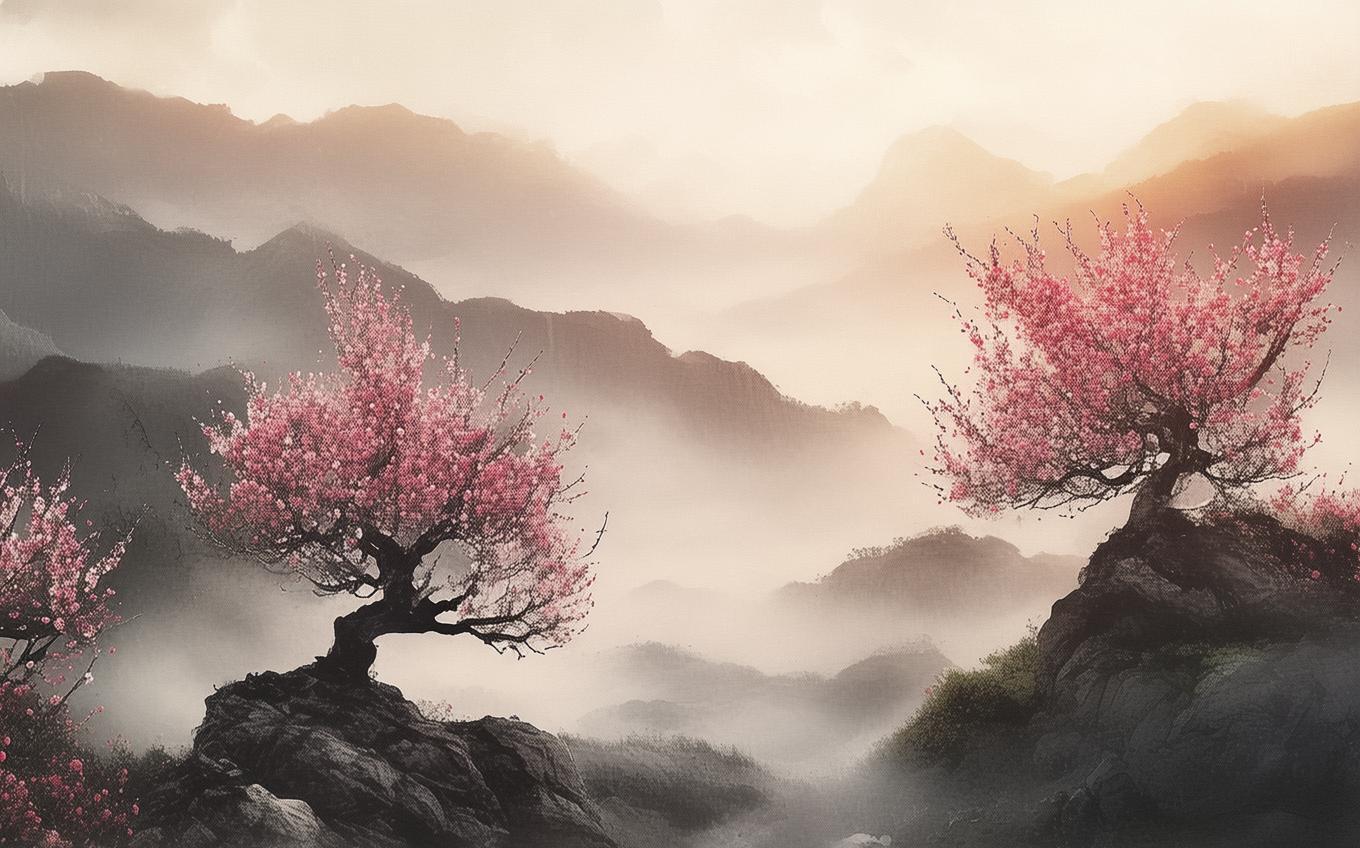
Then comes the surprise. High on Mount Lu, at Dalin Temple, the peach blossoms are “始盛开” (shǐ shèng kāi — just beginning to bloom in their full glory). The adverb “始” (just now) collides with the finality of the first line: where the world below has entered floral death, the mountain clings to spring’s birth. The image is cinematic — a sudden burst of pink against the austere temple walls — and the contrast is deliberately jarring. The poem’s “咏桃” (ode to peach) moment springs from this juxtaposition: the peach blossom is not merely a flower but a survivor, a defiant messenger from a season presumed lost.
Line 3: 长恨春归无觅处
Bai Juyi shifts to introspection. “长恨” (cháng hèn) means a deep, prolonged regret or resentment — the poet had always hated that spring’s retreat left no trace behind. “春归” (chūn guī) personifies spring as a traveler who goes away; “无觅处” (wú mì chù) means “no place to seek it.” This line articulates a universal human sorrow: the passing of beautiful things without the possibility of retrieval. The emotion is one of helpless nostalgia.
Line 4: 不知转入此中来
The solution is both simple and philosophically profound. Spring, the poet now realizes, didn’t vanish — it merely “转入” (zhuǎn rù, turned and entered) “此中来” (cǐ zhōng lái, into this place). The peach blossoms are the evidence. Where the third line had “无觅处” (nowhere to find), the fourth gives “此中” (right here). This twist reframes the experience: what was lost is found, not through pursuit but through an accidental encounter. The “turning” suggests a natural cycle, perhaps even a Daoist notion of transformation — spring hid, rather than ended.
Themes and Symbolism
The Rediscovery of Joy
The poem’s central theme is the unexpected renewal of beauty. Bai Juyi pushes back against the finality of loss, suggesting that what we mourn as gone may simply have moved beyond our familiar reach. The peach blossoms serve as emblems of hope — they bloom late, away from the “human world,” but they bloom nonetheless.
Nature’s Altitude and Human Perspective
The contrast between “人间” (human world) and “山寺” (mountain temple) is a spatial metaphor for spiritual elevation. Mountains in Chinese culture have long been dwelling places of Daoist immortals and Buddhist monks. The temple, perched above the mundane, preserves a purer, slower rhythm of time. Peach blossoms here are not just flowers; they embody a realm uncorrupted by the haste of everyday life, recalling the utopian “Peach Blossom Spring” (桃花源) where people lived unaware of the dynastic changes below.
Impermanence and Attachment
Though the poem ends with delight, it is haunted by the Buddhist concept of impermanence (无常, wú cháng). Bai Juyi, a lay Buddhist, knows that these mountain blossoms, too, will fade. The real transformation is in the poet’s perception: the “长恨” (long regret) is replaced by the recognition that beauty circulates rather than ceases. The peach blossom, then, is a lesson in letting go of linear expectations.
Cultural Context
Bai Juyi wrote this poem in 817, during a low point in his political career. Banished from the imperial court for outspoken criticism, he served as a minor official in Jiangzhou. The visit to Dalin Temple on Mount Lu was a local excursion, recorded in his travel essay “A Record of Dalin Temple” (《游大林寺序》), where he marvels that the mountain’s elevation kept peach trees in bloom while the plains had already entered summer. This observation, so simple on the surface, resonated with a literati culture steeped in both Confucian duty and Daoist-Buddhist retreat. The “咏桃” tradition was well-established: peach blossoms symbolized feminine beauty, spring vitality, and the elusive paradise described by Tao Yuanming. By locating his blossoms at a Buddhist temple, Bai Juyi fuses these associations with a Zen-like epiphany — truth hides in plain sight, waiting for the mind that is still enough to notice.
Furthermore, the Tang Dynasty was a high point of Chinese poetry, where short regulated verses (绝句, jué jù) like this four-line masterpiece were prized for their ability to compress vast emotional landscapes into twenty or twenty-eight characters. Bai Juyi’s language is deceptively plain; his poem uses no obscure allusions, yet its simplicity carries the weight of profound philosophical insight, making it accessible to common readers and scholars alike.
Conclusion
Bai Juyi’s “Peach Blossoms at Dalin Temple” remains beloved because it offers a quiet corrective to despair. The poet’s original lament — that spring leaves nothing behind — is overturned by a cluster of blush-pink petals on a mountain slope. This “咏桃” poem does more than sing the beauty of a flower; it teaches a way of seeing. In our own lives, when we feel that something precious has irreversibly ended, perhaps it has only “turned and entered another place,” waiting to be found with fresh eyes. For English-speaking readers encountering Chinese poetry, this little quatrain opens a door into an entire world: where a peach blossom is never just a flower, but a messenger of time, hope, and the hidden continuities of the world.


Comments (0)
No comments yet. Be the first to comment!