Analysis of "赋帘" - Classical Chinese Poetry
Introduction
The poem “赋帘” (Fù lián, “On the Curtain”) is a delicate gem from the Southern Dynasties period (5th–6th century), attributed to Liu Xiaochuo (481–539), an accomplished poet of the Liang court. Known for his refined palace‑style verse, Liu often explored the secluded world of women’s quarters, turning everyday objects into mirrors of inner emotion. “赋帘” appears in the celebrated anthology Yutai Xinyong (New Songs from a Jade Terrace), a collection devoted to themes of love, beauty, and feminine sensibility. In this tightly woven work, a simple curtain becomes a lens through which the poet contemplates solitude, longing, and the fragile boundary between public splendor and private melancholy.
The Poem: Full Text and Translation
赋帘
Fù lián
On the Curtain
青軒明月詩,
Qīng xuān míng yuè shī,
Green balcony in a poem of bright moonlight,
紫殿秋風日。
Zǐ diàn qiū fēng rì,
A purple hall on an autumn‑wind day.
朣朧引光輝,
Tóng lóng yǐn guāng huī,
Hazy dawn draws forth its radiance,
晻曖映容質。
Ǎn ài yìng róng zhì,
Dim shadows reflect her form and grace.
清露依檐垂,
Qīng lù yī yán chuí,
Clear dew clings and drips from the eaves,
蛸絲當戶密。
Xiāo sī dāng hù mì,
Spider webs screen the doorway thickly.
褰開誰共臨,
Qiān kāi shuí gòng lín,
Lifted open—who will share the view?
掩晦獨如失。
Yǎn huì dú rú shī,
Drawn shut in darkness—lost as if alone.
Line-by-Line Analysis
The poem opens not with the curtain itself but with two contrasting scenes: a “green balcony” bathed in moonlight and a “purple hall” swept by autumn wind. The adjectives “green” (qīng) and “purple” (zǐ) evoke the elegant colors of aristocratic architecture, while “bright moon poem” and “autumn wind day” hint at literary gatherings and the passing of seasons. The curtain is absent, yet already the reader senses changing light and mood—key traits of the thing to be described.
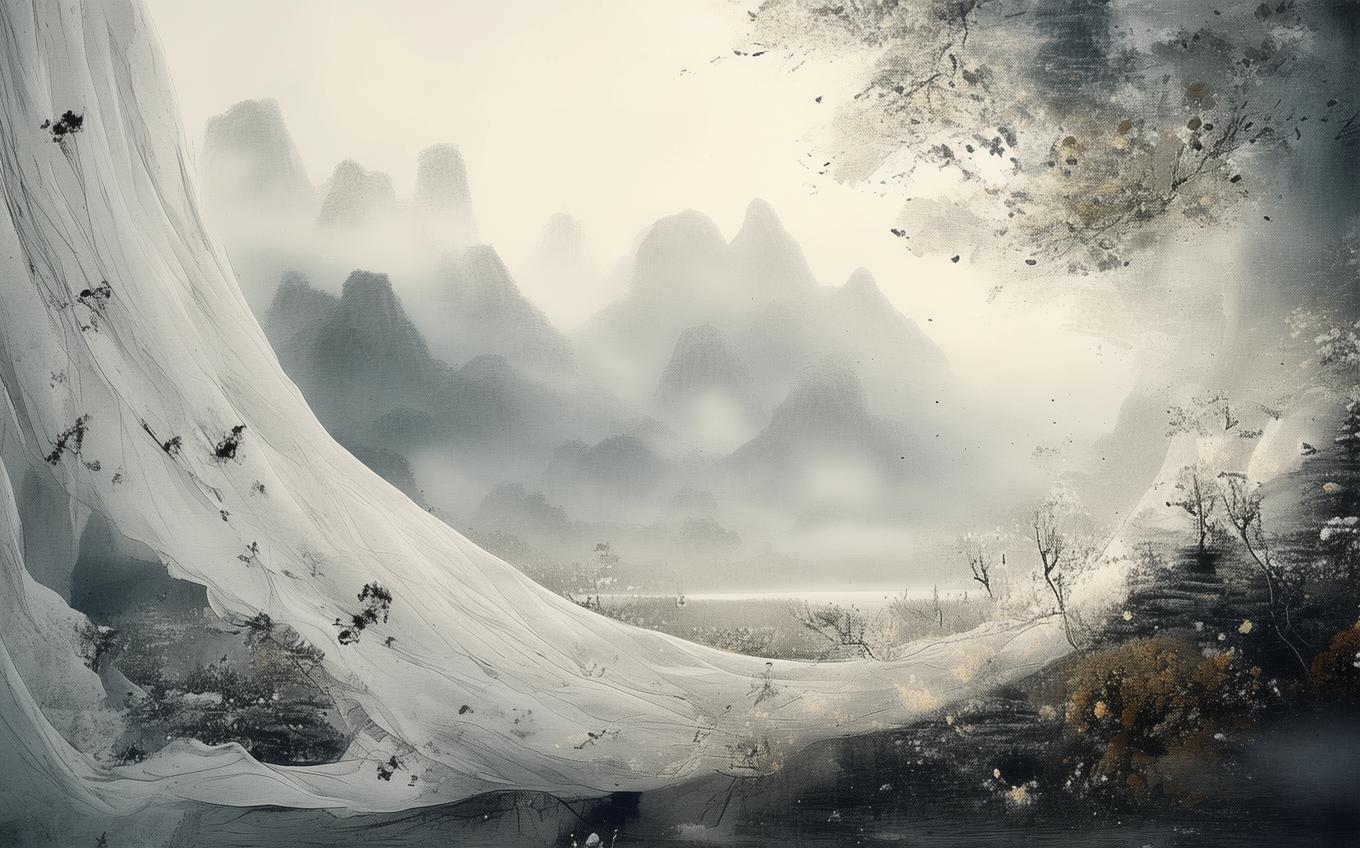
In the third and fourth lines, the curtain appears through its effects. “朣朧” (tóng lóng), a rare binome for the murky light of early dawn, is personified as it “draws forth radiance.” “晻曖” (ǎn ài), meaning gloom or obscurity, “reflects her form and grace” (róng zhì). The curtain is never named, but its translucent presence filters light, transforming harshness into softness and revealing a woman’s silhouette. This indirect description is typical of Six Dynasties poetry: the object is defined by how it shapes perception.
Lines five and six shift to tactile and visual details. The “clear dew” dropping from the eaves suggests early morning and a sense of quiet lingering; it hangs as if on the edge of the curtain. “Spider webs…thickly” at the door intensify the atmosphere of seclusion. The curtain, even when not drawn, is surrounded by signs of stillness and neglect—a space rarely entered, a woman rarely visited.
The final couplet brings forward the human longing. “Lifted open—who will share the view?” The act of raising the curtain offers a glimpse outside, but the rhetorical question underscores loneliness: no one stands beside her. “Drawn shut in darkness—lost as if alone” completes the emotion. The word “独” (dú, alone) seals the poem’s heart: the curtain is both a physical barrier and a symbol of the solitude that defines the inner chambers.
Themes and Symbolism
The central theme is loneliness within elegance. The curtain embodies a paradox—it adorns the lady’s world yet also encloses her, separating her from genuine human connection. Through the interplay of light and shadow, Liu Xiaochuo paints a picture of beauty tinged with melancholy.
Key symbols include:
- The curtain itself: A boundary between the brilliant outside (moonlight, palaces) and the dim interior. It protects but also isolates.
- Moonlight and autumn wind: Classic Chinese motifs of transience and emotional sensitivity; they suggest the passage of time and unfulfilled desire.
- Dew and cobwebs: Signs of neglect and the slow passage of hours, emphasizing the stillness of the lady’s life.
- Lifting and closing: Acts of hope and despair. The raised curtain expresses a wish for companionship; the lowered one accepts a sorrowful solitude.
Cultural Context
During the Southern Dynasties, court poetry flourished in an atmosphere of luxury and aesthetic refinement. Poets like Liu Xiaochuo often wrote about “palace‑style” (gongti) subjects, focusing on the lives of noblewomen, their possessions, and their emotions. Yutai Xinyong, compiled by Xu Ling around 545, collected such poems and celebrated the delicacy of feminine experience.
“赋帘” reflects several Chinese cultural values: the appreciation of subtle, indirect expression (hánxù); the notion that inanimate objects can reveal human feelings; and the traditional view of a woman’s quarters as a secluded, protected space that also breeds sorrow. The curtain becomes a sentiment object—an everyday item saturated with the emotions of its owner. This approach would later influence Tang and Song poetry, where landscape and small details often carry intense personal meaning.
Conclusion
Though only eight lines, “赋帘” encapsulates a world. Liu Xiaochuo transforms a piece of fabric into a stage for light, shadow, and solitary yearning. English readers can find echoes of the Victorian conceit—the window curtain as a threshold between the self and the world—but with a specifically Chinese gentleness. The poem’s beauty endures because it asks a timeless question: when we open the curtain of our own lives, who stands on the other side? In its quiet elegance, this ancient poem still whispers about longing, presence, and the spaces we inhabit, offering a glimpse into the soul of classical Chinese verse.

Comments (0)
No comments yet. Be the first to comment!