Introduction
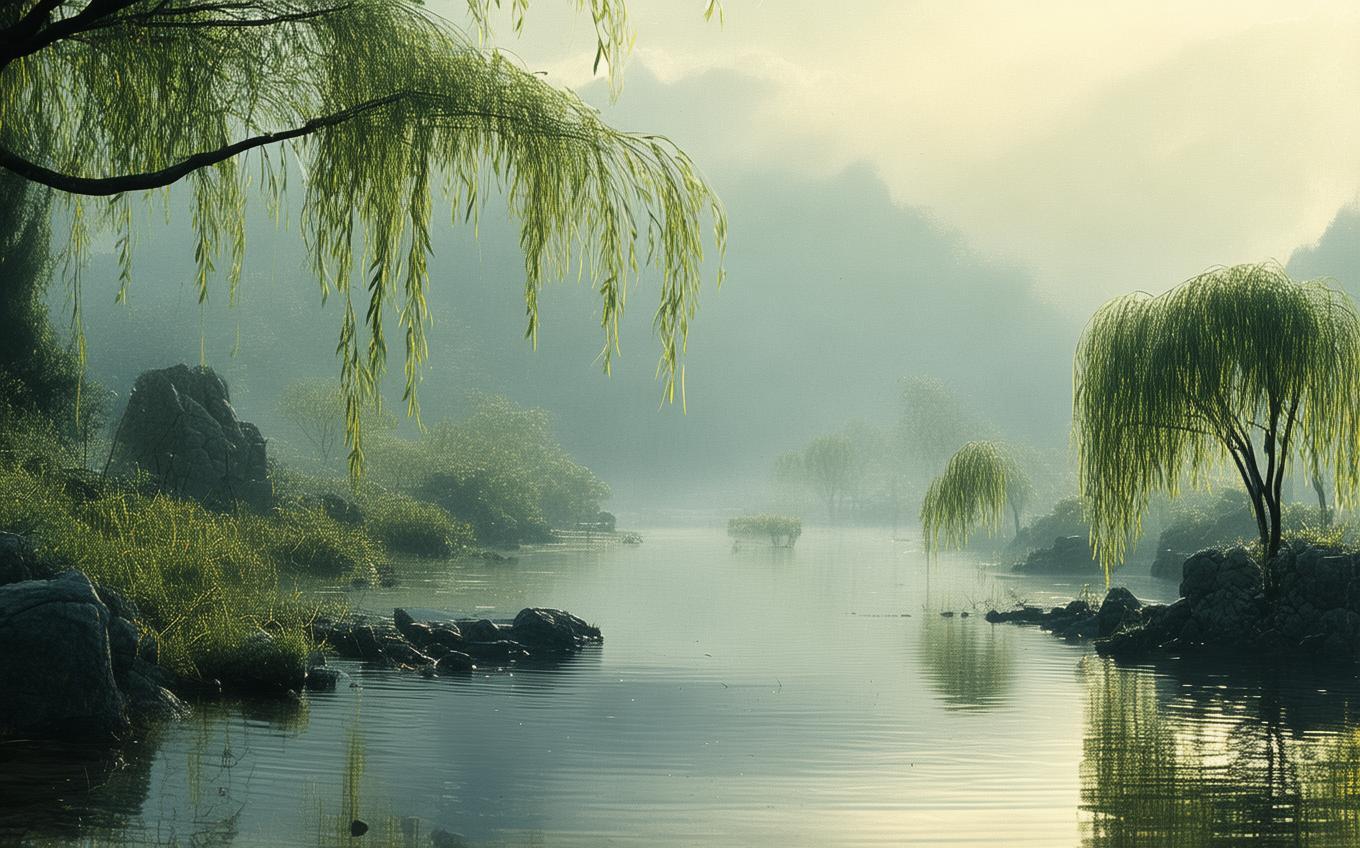
The poem “春池柳” (Chūn chí liǔ, “Spring Pond Willows”) was written by Li Shimin (李世民), better known as Emperor Taizong of Tang (reigned 626–649). As one of the most celebrated rulers in Chinese history, Taizong was also a sensitive poet who used refined language to capture the elegant tranquility of the imperial gardens. His court poems often reflect a vision of harmony between human order and the natural world—an aesthetic that would later become a hallmark of High Tang poetry. “春池柳” is a delicate lǜshī (regulated verse) that paints a vivid picture of aged willows by a spring pond, their silken branches dancing with wind and water, and their catkins mingling with early plum blossoms. This poem exemplifies the early Tang fascination with precise natural imagery and the quiet joy of observing seasonal change.
The Poem: Full Text and Translation
年柳变池台,
nián liǔ biàn chí tái,
Aged willows transform by the pond terrace,
隋堤曲直回。
suí dī qū zhí huí.
along the Sui dike, winding and winding back.
逐浪丝阴去,
zhú làng sī yīn qù,
Chasing the ripples, their silken shadows drift away;
迎风带影来。
yíng fēng dài yǐng lái.
greeting the breeze, ribbon-like silhouettes return.
疏黄一鸟弄,
shū huáng yī niǎo nòng,
Amid sparse yellow, a single bird frolics;
半翠几眉开。
bàn cuì jǐ méi kāi.
halfway emerald, like several brows just lifted.
萦雪临春岸,
yíng xuě lín chūn àn,
Entwining snow comes to the springtime bank,
参差间早梅。
cēn cī jiàn zǎo méi.
uneven, interspersed with early plum blossoms.
Line-by-Line Analysis
Opening Couplet: Setting the Scene
The poem begins with a timeless image: “年柳变池台,隋堤曲直回。”
Here, “年柳” (nián liǔ) means “aged willows”—trees that have stood for years—and “变池台” suggests that their reflection transforms the look of the pond and the terrace beside it. The second line anchors the scene in history: the “隋堤” (Suí dike) refers to a famous dike originally built during the Sui Dynasty (581–618), lined with willows. By mentioning this dike, Taizong evokes an enduring landscape, one that has witnessed the passage of dynasties. The phrase “曲直回” describes how the dike zigzags and doubles back, mirroring the willows’ own sinuous forms and adding a sense of gentle, lingering movement.
Second Couplet: The Dance of Shadows
“逐浪丝阴去,迎风带影来。”
These lines depict the willow branches as “丝” (silk threads) and “带” (ribbons). As the water ripples, the silken shadows of the branches appear to chase the tiny waves and drift away. When the wind blows, the ribbons of shadow seem to sweep back towards the observer. The verbs “逐” (chase) and “迎” (greet) personify the willow, giving it a graceful, almost coquettish liveliness. This interplay of light, water, and air creates an ephemeral double image—the physical tree and its ever-changing reflection—that lies at the heart of the poem’s charm.
Third Couplet: Details of Color and Life
“疏黄一鸟弄,半翠几眉开。”
The poet zooms in for a closer look. “疏黄” (sparse yellow) refers to the tender, yellowish-green leaves that appear in early spring before the willow turns full green. Amid this fresh foliage, a single bird plays (弄) —the verb nòng implies playful frolicking, a tiny explosion of joy in the still scene. “半翠” (half emerald) continues the color study: the leaves are not yet deep green, but halfway there. Then Taizong uses a striking metaphor: “几眉开,” “like several brows just lifted.” In classical Chinese poetry, delicate willow leaves are often compared to a beauty’s eyebrows (liǔ yè méi, “willow-leaf eyebrows”). Here, the half-opened leaves suggest a young woman just beginning to open her eyes in the morning—an image of fresh, awakening beauty.
Final Couplet: Catkins as Snow
“萦雪临春岸,参差间早梅。”
The closing lines introduce the willow’s most poetic feature: its catkins. “萦雪” (entwining snow) compares the drifting white catkins to swirling snowflakes, a classical trope (for instance, the famous line by Xie Daoyun: “未若柳絮因风起” — “not unlike willow catkins rising on the wind”). These catkins gather on the spring bank, forming a soft white layer. But they are not alone: “参差间早梅” — they are irregularly intermingled with early plum blossoms, which are also white and bloom in late winter/early spring. The juxtaposition of willow catkins and plum blossoms blurs the boundary between two iconic spring messengers, leaving the reader with a dreamy, fragrant picture of an imperial garden at its most delicate moment.
Themes and Symbolism
Nature and Harmonious Order
Like many early Tang court poems, “春池柳” celebrates a well-ordered natural world that mirrors the emperor’s idealized realm. Every element—the ancient dike, the pond, the wind, the bird, the willows, and the plum blossoms—coexists in perfect balance. There is no conflict, only subtle transformation. This reflects the Confucian notion of 天人合一 (tiān rén hé yī, “unity of heaven and humanity”), where a virtuous ruler presides over a harmonious cosmos.
Transience and Renewal
While the poem is tranquil, it is suffused with the gentle awareness of time. The “aged willows” remind us of the years gone by, yet they put forth fresh leaves each spring. Willow catkins, symbols of late spring, are fleeting; they will soon be blown away. The plum blossoms will fade as well. Thus, the poem captures a fleeting moment of perfect beauty, a core aesthetic principle in classical Chinese poetry known as “物哀” (wù āi, “the pathos of things”).
The Willow as Cultural Symbol
Willows in Chinese literature often symbolize parting (due to the pun on liǔ “willow” and liú “stay”) or feminine grace. Taizong sidesteps parting sorrow and focuses on the tree’s elegant vitality. The “willow-leaf eyebrows” metaphor connects the landscape directly to human beauty, suggesting that nature itself is a refined work of art.
Cultural Context
Li Shimin (Emperor Taizong) was not only a brilliant military strategist and statesman but also a patron of the arts. He established a literary institute and encouraged poetry at court. His own poems, though sometimes overshadowed by the giants of the High Tang, are valuable for their elegant simplicity and their role in shaping the “palace style” (gōngtǐ shī) that would later evolve into the mature lǜshī (regulated verse). The Sui dike mentioned in the poem was a grand engineering project built along the Bian River, famous for its willow-lined banks. For a Tang emperor to invoke this Sui landmark carries a subtle political resonance: the Tang dynasty had supplanted the Sui, yet the emperor can appreciate the beauty inherited from the past. This reflects the Tang’s self-confidence in absorbing and transcending previous cultural achievements.
The poem’s setting by a pond (chí) in an imperial garden underscores the importance of the garden aesthetic in classical Chinese culture. Gardens were microcosms where the learned elite could commune with nature, compose poems, and reflect on philosophical principles. Here, Taizong acts not as a formidable ruler but as a contemplative observer, blending the roles of poet and connoisseur.
Conclusion
“春池柳” is a jewel of early Tang nature poetry. Through eight perfectly balanced lines, Emperor Taizong transforms a simple spring scene into a meditation on beauty, time, and the delicate interplay between permanence and change. The willows, with their silken shadows, half-opened leaves like brows, and snowy catkins alongside plum blossoms, remain vivid in the reader’s imagination over thirteen centuries later. For the modern English-speaking audience, this poem offers a window into a world where poetry was a living art practiced even by emperors, and where a quiet moment beside a pond could become a testament to the harmony of the universe. It reminds us to pause, observe, and find the sublime in the ordinary rhythms of the natural world.


Comments (0)
No comments yet. Be the first to comment!