Introduction
Li Bai (701–762), one of China’s most celebrated poets of the Tang dynasty, is renowned for his romantic spirit, love of nature, and poignant expressions of solitude. The poem "初秋夜坐" (Early Autumn Night Sitting) captures a moment of quiet reflection as the season shifts from summer to autumn. Composed during a period of wandering and political uncertainty in Li Bai’s life, the poem uses the stillness of night and subtle autumnal changes to convey a deep sense of homesickness and existential restlessness. This work exemplifies the Tang poetic tradition of blending landscape imagery with profound personal emotion, and it remains beloved for its quiet beauty and universal themes.
The Poem: Full Text and Translation
夜静群动息,
Yè jìng qún dòng xī,
The night is still; all creatures’ movements cease.
蟪蛄声悠悠。
Huìgū shēng yōuyōu.
The cicadas drone on, faint and lingering.
庭前落叶满,
Tíng qián luòyè mǎn,
Before the courtyard, fallen leaves are thickly spread.
窗外细雨流。
Chuāng wài xìyǔ liú.
Outside the window, a fine rain trickles down.
竹深喧鸟宿,
Zhú shēn xuān niǎo sù,
Deep in the bamboo grove, birds settle noisily for the night.
风急卷沙洲。
Fēng jí juǎn shā zhōu.
A sudden wind sweeps across the sandy islet.
念我何留滞,
Niàn wǒ hé liúzhì,
I wonder why I still linger here,
归期不可求。
Guīqī bù kě qiú.
The date of my return is beyond all reckoning.
Line-by-Line Analysis
The opening couplet sets the tone of tranquil isolation. “夜静群动息” emphasizes the cessation of daytime bustle, creating an atmosphere of absolute silence—except for the “蟪蛄” (huìgū), a type of cicada known for its long, drawn-out buzz that is especially associated with autumn in Chinese poetry. The sound is described as “悠悠” (yōuyōu), meaning distant, continuous, and slightly melancholy. This aural detail counterpoints the stillness, suggesting that even in quietude, reminders of mutability persist.
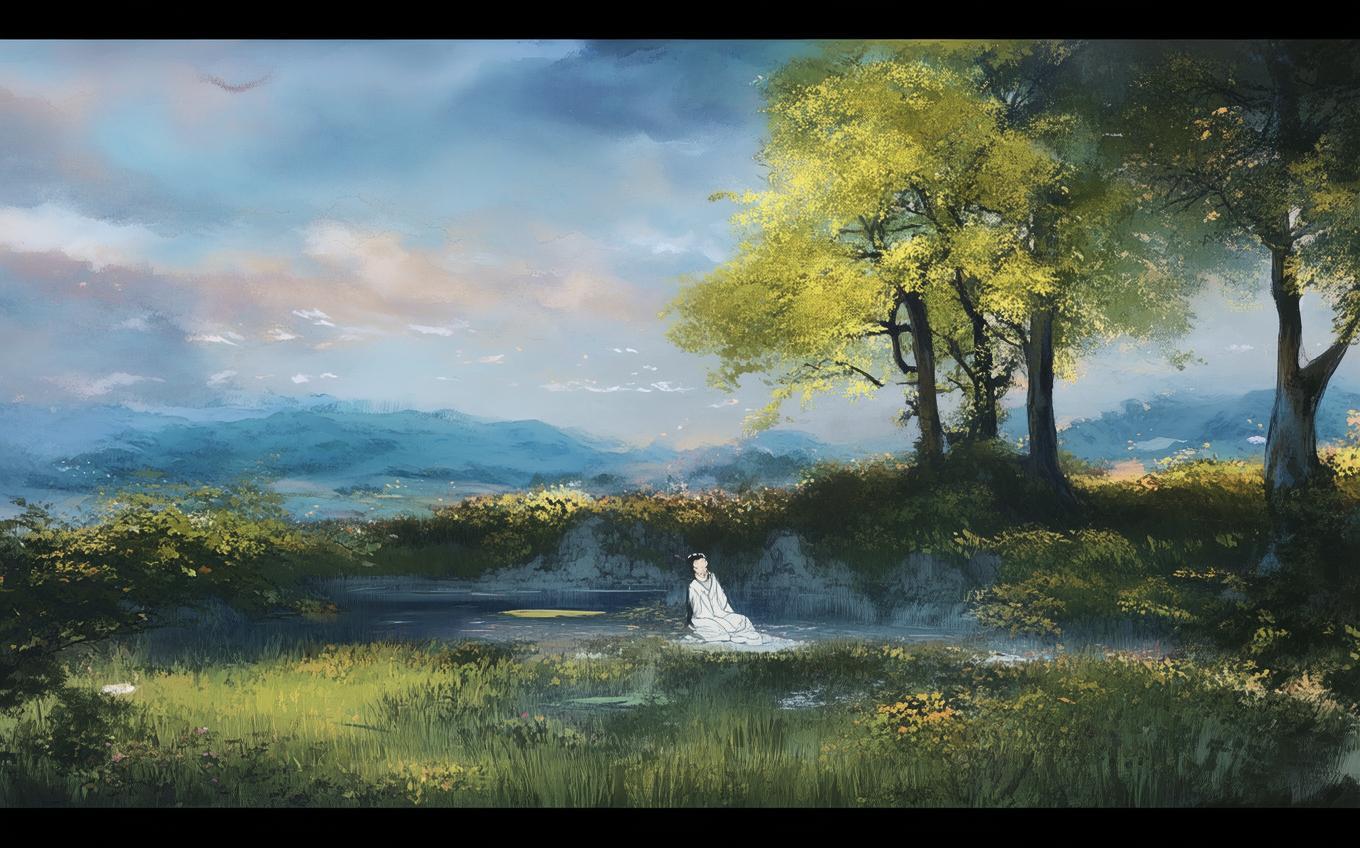
The next two lines shift to visual imagery. “庭前落叶满” uses the courtyard as a microcosm of the season’s change; fallen leaves blanket the ground, a classic symbol of decline and the passage of time. “窗外细雨流” introduces a gentle rain—not a storm, but a fine, persistent drizzle that flows down the window, blurring the boundary between inside and outside, self and world. Together, these lines ground the poet’s solitude in a specific, tangible space, intensifying the mood of introspection.
Lines five and six expand the view outward. “竹深喧鸟宿” depicts birds noisily finding their roosts deep within a bamboo grove. The word “喧” (xuān) suggests a clamor that contrasts with the earlier silence; the birds’ social settling highlights the poet’s own separateness. “风急卷沙洲” introduces sudden movement: a gust of wind scours a sandbar, possibly by a riverside, carrying a sense of restlessness and instability. The juxtaposition of the birds’ communal shelter and the wind’s erratic force deepens the poet’s feeling of being unmoored.
The final couplet directly voices the poet’s inner turmoil. “念我何留滞” is a rhetorical question expressing self-frustration—why is he still stranded here, unable to leave? “归期不可求” answers with resignation: the time to return home is not something he can even seek, let alone know. The word “不可求” implies a fate beyond human control. This closing is powerfully understated, transforming the preceding natural scenes into mirrors of the poet’s emotional and spiritual impasse.
Themes and Symbolism
The central theme is transience and longing for home. Autumn itself is a perennial symbol in Chinese poetry of decline, aging, and the inevitable passage of time. The cicada, which emerges in summer and dies in autumn, embodies life’s brevity and the inevitability of change. Fallen leaves and drifting rain reinforce this sense of decay and flow, while the empty courtyard becomes a metaphor for the poet’s unfulfilled life away from his native place.
Another theme is solitude versus community. The birds settling together for the night underscore the poet’s isolation; he belongs to no companionable flock. The wind sweeping the sandy islet suggests the chaotic forces that keep him adrift. The poet’s inability to determine his “归期” (return date) hints at a broader existential uncertainty—not simply a literal homecoming, but a yearning for stability and belonging in a disordered world.
Cultural Context
The Tang dynasty (618–907) was a golden age of Chinese poetry, where literati elite often traveled for official posts or were exiled due to political upheavals. Li Bai himself spent much of his life as a wanderer, never tied to one place, and his poetry frequently expresses both the exhilaration of freedom and the pain of displacement. The concept of “归” (return) is a leitmotif in Chinese letters, tied to Confucian ideals of familial duty and Daoist notions of returning to a primal, harmonious state. In Daoist philosophy, autumn is the season of gathering and contraction, a natural time to retreat inward—making the poet’s restlessness all the more poignant. The poem’s quiet night scene also evokes the Chan (Zen) Buddhist appreciation for stillness as a space for self-reflection.
Conclusion
“初秋夜坐” endures because it transmutes a single, hushed moment into a profound meditation on human yearning. Li Bai’s genius lies not in grand declarations, but in the delicate interplay of sound, sight, and silence, inviting readers to feel the weight of unvoiced sorrow. Modern audiences, even across cultures, can relate to the ache of being far from home—whether that home is a place, a time, or an inner peace. In a world of constant motion, the poem whispers a timeless truth: sometimes in the deepest quiet, we hear most clearly what the heart truly longs for.
Comments (0)
No comments yet. Be the first to comment!