Introduction
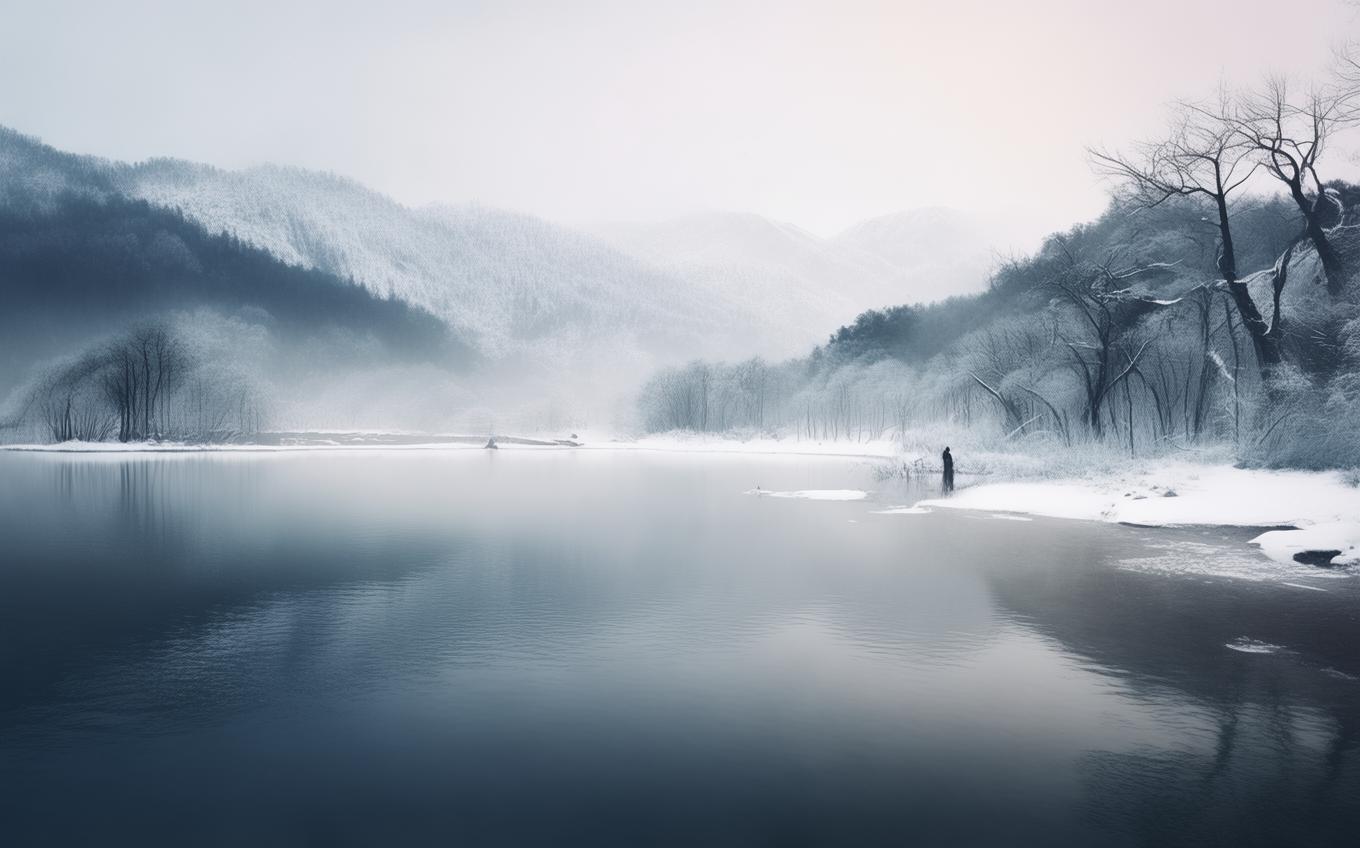
Emperor Taizong of Tang (Li Shimin, 598–649) is celebrated not only as one of China’s greatest rulers but also as a poet whose verses reflect the refined elegance and philosophical depth of the early Tang dynasty. His poem “冬日临昆明池” (Winter Day Visiting Kunming Pool) offers a rare imperial perspective on a winter landscape, combining rich natural imagery with a subtle meditation on the fleeting nature of joy. Kunming Pool, an artificial lake built near the capital Chang’an, served as a pleasure garden for the court and symbolized both imperial power and a longing for harmony with nature. This poem captures a moment of solitary appreciation, where the emperor pauses to drink in the severe beauty of winter and hints at the melancholy that even supreme authority cannot escape the passage of time.
The Poem: Full Text and Translation
石鲸分玉溜,
Shí jīng fēn yù liū,
A stone whale divides the jade-like stream,
劫烬隐平沙。
Jié jìn yǐn píng shā.
Traces of catastrophe lie hidden in the level sands.
柳影冰无叶,
Liǔ yǐng bīng wú yè,
Willow shadows on ice — without leaves,
梅心冻有花。
Méi xīn dòng yǒu huā.
The heart of a plum tree, though frozen, still bears blossoms.
寒野凝朝雾,
Hán yě níng zhāo wù,
Cold fields congeal the morning mist,
霜天散夕霞。
Shuāng tiān sàn xī xiá.
Frosty skies scatter the evening glow.
欢情犹未极,
Huān qíng yóu wèi jí,
The joy within my heart is not yet at its peak,
落景遽西斜。
Luò jǐng jù xī xié.
While the setting sun hastens westward, sinking fast.
Line-by-Line Analysis
The poem opens with a striking artificial detail: “石鲸分玉溜” — a stone whale statue cuts through a stream so clear it is likened to jade. This image sets a scene of cultivated imperial grandeur, yet the whale, motionless and sculpted, suggests a frozen, unchanging beauty. The word “玉” (jade) connotes purity and value, implying that the waters of Kunming Pool are as precious as the empire itself.
The second line, “劫烬隐平沙”, shifts abruptly to a darker tone. “劫烬” refers to the ashes or remnants left after a great disaster — likely an allusion to the decline of the previous Sui dynasty. These ashes lie hidden flat on the sand, unseen but present, like history’s wounds healed over. Emperor Taizong, who came to power after a period of turmoil, writes with the awareness that peace and prosperity are fragile treasures built upon past ruins.
In the next couplet, the focus narrows to two classic winter plants: willow and plum. “柳影冰无叶” paints a desolate picture — the willow’s silhouette on the ice, stripped of all leaves. Willows usually symbolize parting or gentle beauty, but here they stand ghostly and bare. In contrast, “梅心冻有花” introduces a note of resilience: the plum tree’s heartwood is frozen, yet it still pushes out blossoms. In Chinese culture, the plum blossom is an emblem of perseverance through hardship, often associated with nobility of spirit. The emperor subtly compares his own virtue to the plum: flourishing amid harsh conditions.
The scenery broadens again with “寒野凝朝雾” and “霜天散夕霞”. Morning mist clings heavily to the cold fields, locking the land in a static, gray moment. By evening, the frosty sky disperses the afterglow of sunset in a final, brilliant display of color. This progression from frozen dawn to fiery dusk mirrors the passage of an entire day, compressing time into a few visual strokes. The verbs “凝” (congeal) and “散” (scatter) create a sense of natural rhythm that is both beautiful and impermanent.
The closing couplet introduces the poet’s subjective emotion directly: “欢情犹未极,落景遽西斜”. The speaker admits his delight is not yet fully savored, yet the sun has already plunged toward the west. This is a universal lament — the moment of deepest happiness is forever cut short. For an emperor who commands vast armies and wealth, the inability to pause time underscores human limitation. The word “遽” (hurriedly) gives the sunset an almost willful urgency, as though nature itself rushes the observer toward dark.
Themes and Symbolism
The central theme is the transience of beauty and the impossibility of holding onto joy. The poem moves through a winter day’s transformations, revealing that even the most splendid sights — jade streams, plum blossoms, glowing sunsets — are fleeting. A secondary theme is resilience: the plum branch that blooms in freezing cold symbolizes inner strength amidst adversity, a quality the emperor admires and implicitly claims for himself.
Key symbols include the stone whale, representing eternal but lifeless imperial achievement; the hidden ashes, signifying the buried past that underlies present stability; the leafless willow, embodying loss and the stark reality of winter; and the frozen plum, a badge of unwavering virtue. The setting sun is the poem’s dominant metaphor for time’s relentless passage, a force even the Son of Heaven cannot control.
Cultural Context
The Kunming Pool, excavated during the Han dynasty and maintained through the Tang, was a site of imperial leisure and a microcosm of empire — an artificial lake designed to mimic nature’s grandeur for the ruler’s contemplation. Emperor Taizong’s visit in winter transforms the usual touristic gaze into a philosophical one. In Chinese literary tradition, writing about the seasons often served as a means to express moral or political reflections. By choosing winter, a season associated with hardship and latent potential, Taizong aligns his reign with the promise of spring following cold, yet he also confronts the melancholy of dusk. The poem reflects the Confucian ideal of a ruler cultivating virtue through observation of nature, as well as the Daoist acceptance of nature’s cycles. The juxtaposition of “disaster’s embers” with a peaceful scene might be read as a subtle commentary on the Mandate of Heaven: the stolen joy of the present must always be mindful of the ashes from which it rose.
Conclusion
“冬日临昆明池” endures not because of political allegory, but because it gives voice to a quiet, universal sorrow — the sadness of a perfect moment slipping away. Taizong’s poetical voice is measured and restrained, never letting imperial ego overshadow the simple wonder of a winter’s day. The poem’s beauty lies in its balance between vivid outer scenes and a gentle inner yearning. Centuries later, readers can still stand beside the emperor at the frozen lake, watching the last light vanish, and recognize that the weight of the falling sun is something no amount of power can lighten. It is a reminder that to fully appreciate life’s brief flashes of joy, we must accept their inevitable end.
Comments (0)
No comments yet. Be the first to comment!