Introduction
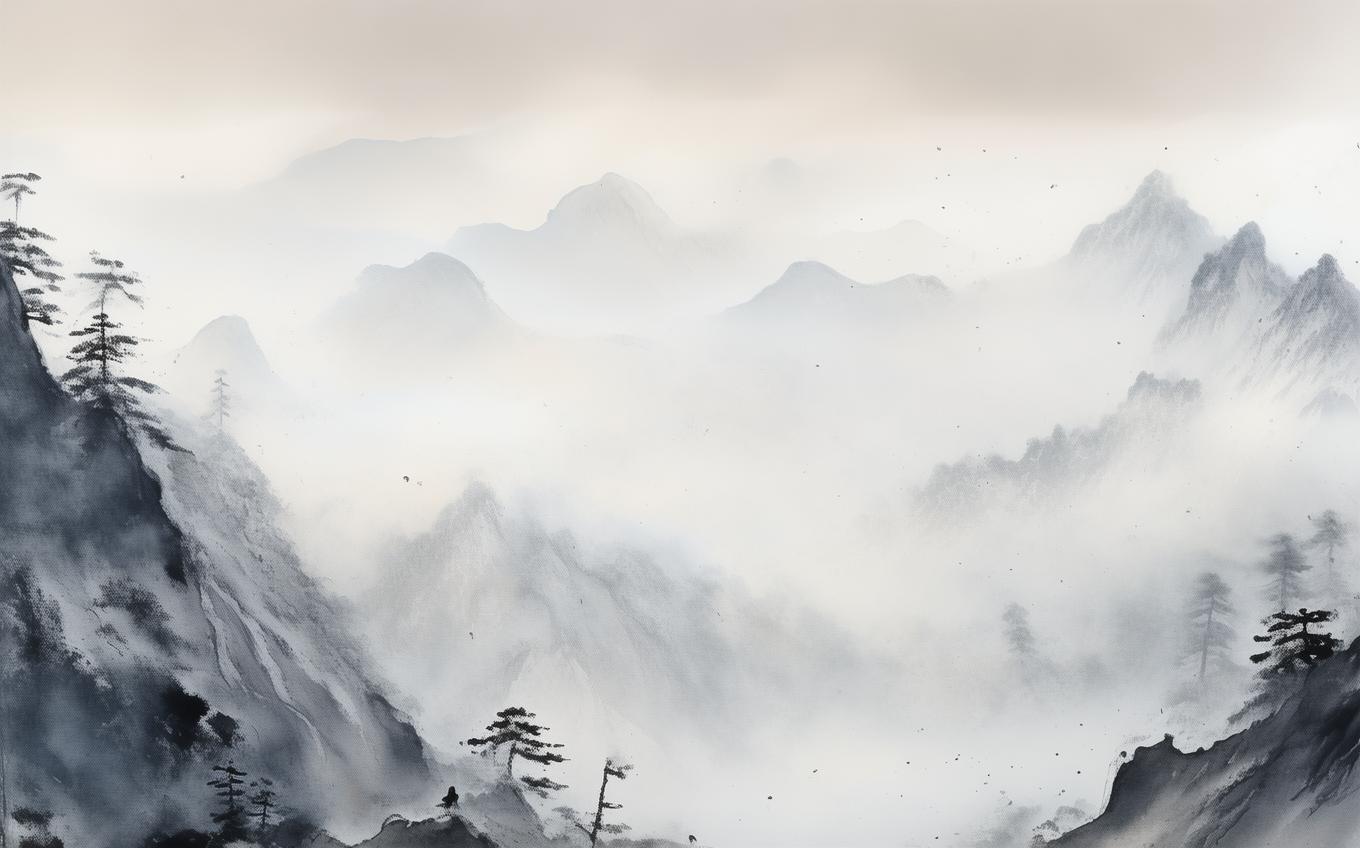
Emperor Taizong of Tang (598–649), personal name Li Shimin, is remembered not only as one of China’s greatest rulers—who laid the foundation for the glorious Tang Dynasty—but also as a man of deep literary and artistic sensitivity. His poem “望雪” (Wàng Xuě, “Viewing the Snow”) captures a quiet, almost painterly moment of watching falling snow, transforming a common winter scene into a meditation on purity, transience, and the fleeting beauty of nature. Composed in the regulated verse style typical of the early Tang, this eight-line poem distills the emperor’s refined aesthetic and his philosophical appreciation of the natural world.
The Poem: Full Text and Translation
冻云宵遍岭
Dòng yún xiāo biàn lǐng
Frozen clouds at night spread over the ridge;素雪晓凝华
Sù xuě xiǎo níng huá
White snow at dawn congeals into sparkling beauty.入牖千重碎
Rù yǒu qiān chóng suì
Entering the window, it shatters into a thousand layers;迎风一半斜
Yíng fēng yī bàn xié
Facing the wind, half of it slants awry.不妆空散粉
Bù zhuāng kōng sàn fěn
Unadorned, it scatters powder through the air;无树独飘花
Wú shù dú piāo huā
With no tree to hold it, it alone drifts like blossoms.萦空惭夕照
Yíng kōng cán xī zhào
Swirling in the sky, it shames the evening glow;破彩谢晨霞
Pò cǎi xiè chén xiá
Breaking through colored hues, it bids farewell to the morning dawn.
Line-by-Line Analysis
The poem opens with a pair of lines that establish time and atmosphere. “冻云宵遍岭” evokes the heavy, frozen clouds that fill the night sky, rolling over the mountain ridges—a prelude to snow. The second line, “素雪晓凝华”, moves to daybreak: the pure white snow now gleams, its crystals catching the first light. The contrast between the dark, restless night clouds and the still, luminous morning snow mirrors the transformation from expectation to revelation, a theme that runs through the entire piece.
The next couplet focuses on the snow’s delicate interaction with the human world. “入牖千重碎” imagines snowflakes drifting through a window lattice, breaking visually into innumerable fragments—each one a tiny, intricate shard. “迎风一半斜” observes how the wind tilts the falling snow, giving it a slanted, dynamic grace. Here, the poet is not simply describing snow; he is watching its behavior with the meticulous eye of a painter, noting how solid forms dissolve into fragmented beauty and how nature’s geometry shifts with the breeze.
The third couplet employs two classic metaphors for snow: powder and blossoms. “不妆空散粉” says the snow needs no cosmetic powder to adorn itself—it is its own adornment, scattering whiteness through the air. “无树独飘花” adds the surreal image of blossoms drifting without any tree, suggesting that the snowflakes themselves are flowers born of the sky. Both lines emphasize naturalness, spontaneity, and the snow’s ability to transcend ordinary comparisons.
The final couplet elevates the scene to a cosmic scale. “萦空惭夕照” personifies the snow: as it swirls in the sky, it makes the evening sunset feel ashamed of its own brilliance—the snow’s pure white surpasses even the warm colors of twilight. “破彩谢晨霞” continues this competition, as the snow outshines the rosy morning clouds and gently dismisses them. This is not mere poetic exaggeration; it reflects the Daoist-influenced idea that simplicity and emptiness (the white of snow) can be more powerful than the most vivid displays.
Themes and Symbolism
- Purity and Transformation: Snow is an enduring symbol of cleanliness and spiritual purity in Chinese culture. The poem traces its transformation from cloud to crystal, from night to day, mirroring the process of inner cultivation—turning the turbid into the lucid.
- Transience of Beauty: The snow’s fleeting nature—it shatters, slants, and eventually melts—reminds the reader that all beautiful things are ephemeral. There is a melancholy undertone beneath the visual splendor.
- Harmony with Nature: The emperor-poet observes nature with reverence, not as a ruler dominating the landscape but as a reflective mind seeking oneness with the seasons. The snow becomes a teacher of humility and wonder.
- Cosmic Rivalry: By making the snow “shame” the sunset and “decline” the dawn clouds, the poem playfully sets up a rivalry between white and color, between simplicity and decoration. Ultimately, the unadorned snow wins, a statement about the power of restraint and understated elegance—a core value in classical Chinese aesthetics.
Cultural Context
The Tang Dynasty (618–907) is often considered the golden age of Chinese poetry. Emperor Taizong himself was a patron of the arts and an accomplished poet, calligrapher, and literary critic. Writing about snow was not merely an aesthetic pastime; it was a cultured act that demonstrated one’s refinement and moral character. Snow, in particular, carried Confucian and Daoist undertones: it was a metaphor for the virtuous person whose integrity remains untainted in a corrupt world, and it evoked the Daoist ideal of pu (朴), the uncarved block—simplicity as the highest form of sophistication.
Additionally, regulated verse (律诗) was becoming the dominant poetic form, demanding strict tonal patterns and parallelism. “望雪” adheres to these rules, with balanced couplets and a tight eight-line structure. This formal precision, combined with the emperor’s personal engagement with the landscape, exemplifies the Tang cultural ideal of shanshui (山水, “mountains and water”), where nature becomes a mirror of the human spirit.
Conclusion
“望雪” endures as a gem of early Tang poetry, not because it tells a dramatic story, but because it pauses to look carefully at an ordinary snowfall and reveals its quiet magnificence. Emperor Taizong, ruler of a vast empire, humbly attends to the way snow shatters at a window and tilts in the wind, and in doing so, he invites us to see the world anew. For modern readers, the poem is a gentle reminder to slow down and observe the transient beauty that surrounds us—even the simplest winter morning can contain a universe of meaning if we, like the poet, have the eyes to truly see it.

Comments (0)
No comments yet. Be the first to comment!