Introduction
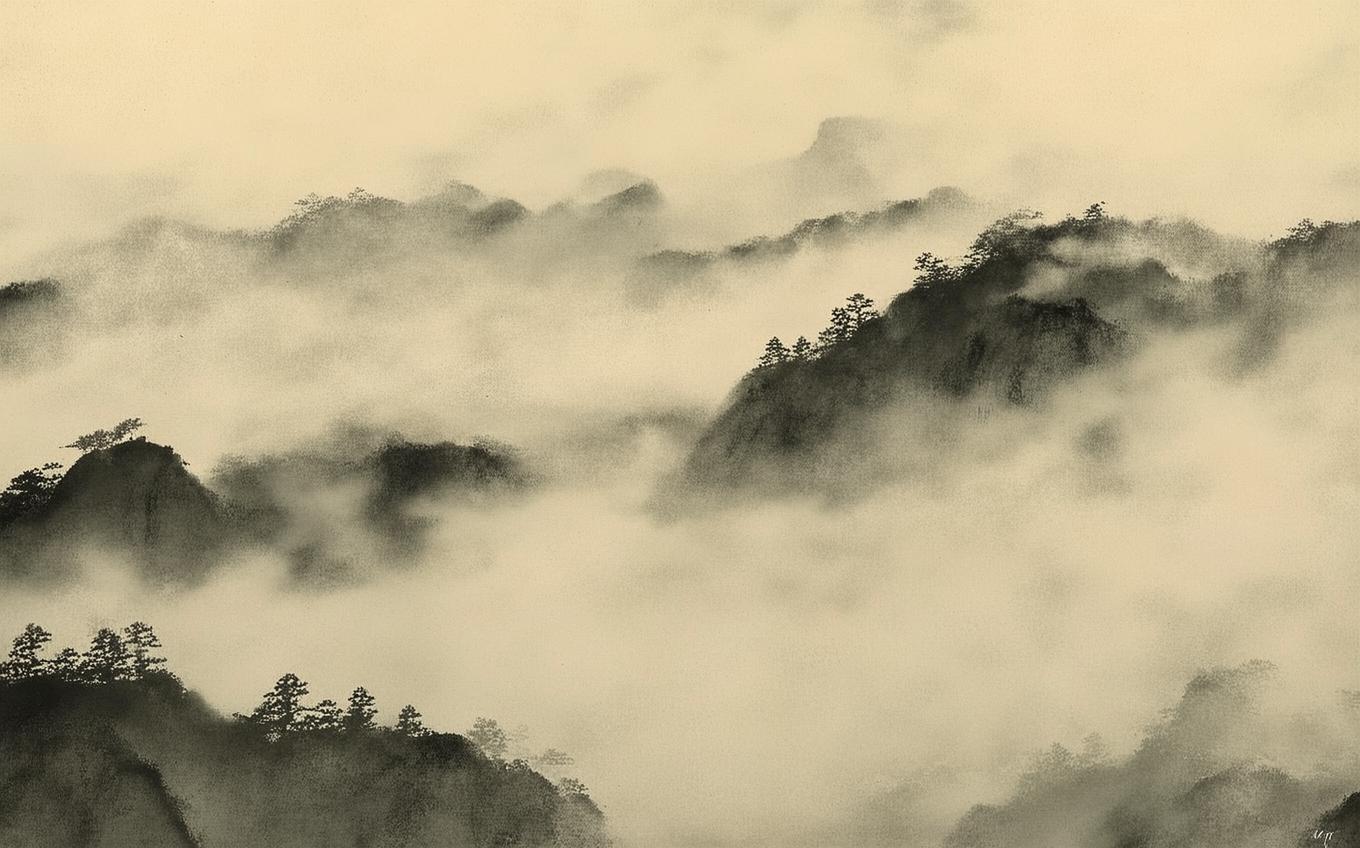
Composed by Emperor Taizong of the Tang Dynasty (唐太宗, Táng Tàizōng), born Li Shimin (李世民, Lǐ Shìmín, 598–649), "赋得含峰云" (Fù dé hán fēng yún) — literally “Composed on the Theme ‘Clouds Embracing the Peak’” — is a remarkable example of early Tang court poetry. As the second emperor of one of China’s most culturally brilliant dynasties, Taizong was not only a statesman and military strategist but also an accomplished poet and calligrapher. He actively promoted literature, gathering scholars at his court and often composing poems on set themes during imperial banquets or outings. The title prefix “赋得” indicates that the poem was written to a prescribed topic, a common practice among literati of the time that tested their ability to imbue a chosen image with fresh meaning.
This short regulated verse (律诗, lǜshī) takes the spectacle of clouds wrapping around a mountain peak and turns it into a miniature journey through natural beauty, myth, and the poet’s own clear-sighted worldview. For the modern English reader, it offers a window into the Tang aristocracy’s aesthetic sensibilities and the subtle interplay between reality and ancient legend.
The Poem: Full Text and Translation
翠楼含晓雾,
cuì lóu hán xiǎo wù,
An emerald tower holds the morning mist;
莲峰带晚云。
lián fēng dài wǎn yún.
a lotus peak is girdled with evening clouds.
玉叶依岩聚,
yù yè yī yán jù,
Jade leaves cluster against the cliff,
金枝触石分。
jīn zhī chù shí fēn.
golden branches part where they touch the rock.
横天结阵影,
héng tiān jié zhèn yǐng,
Spanning the sky they form battle‑array shadows,
逐吹起罗文。
zhú chuī qǐ luó wén.
chasing the wind they raise patterns of gossamer silk.
非复阳台下,
fēi fù yáng tái xià,
No longer beneath the Sun Terrace,
空将惑楚君。
kōng jiāng huò chǔ jūn.
vainly would they bewilder the Lord of Chu.
Line‑by‑Line Analysis
First couplet – 翠楼含晓雾,莲峰带晚云。
The poem opens with a double scene that gently blends human artistry and natural grandeur. An “emerald tower” (翠楼, cuì lóu), likely a palace pavilion, tenderly “holds” the morning mist, as if cradling something precious. In the same breath, we are transported to evening, where a distant “lotus peak” (莲峰, lián fēng) — named for its resemblance to a blooming lotus — is wrapped by a sash of clouds. The parallel structure (翠楼 ↔ 莲峰, 晓雾 ↔ 晚云) creates a time‑spanning diptych: from dawn’s delicate haze to dusk’s luminous wrappings. Already the reader senses that clouds are not mere weather; they are ornaments, garments bestowed on the landscape.
Second couplet – 玉叶依岩聚,金枝触石分。
Here the poet’s eye dives into the very texture of the cloud‑enveloped peak. The cloud formations are imagined as “jade leaves” (玉叶, yù yè) clinging to the cliff and “golden branches” (金枝, jīn zhī) that split open when they strike the rock. This is jewel‑studded language typical of court poetry: the vaporous cloud is transmuted into a precious, almost solid garden growing on stone. The verbs “聚” (gather) and “分” (part, divide) emphasize a dynamic intimacy — the cloud both embraces the mountain and is shaped by its harsh contours. In Tang aesthetics, such metaphors elevate a transient meteorological event into a timeless mineral tableau, suggesting that nature itself wears imperial treasure.
Third couplet – 横天结阵影,逐吹起罗文。
From the close‑up we pull back to the full sky. Now the clouds “span the heavens” and arrange themselves like the shadows of a battle formation (结阵影, jié zhèn yǐng). Emperor Taizong, the warrior‑ruler who unified the empire, naturally perceived military order in the drifting vapors. But war quickly yields to elegance: when the wind stirs, the same clouds ripple into patterns of sheer silk gauze (罗文, luó wén). The couplet thus marries the emperor’s dual identities — general and patron of refinement — and illustrates the Chinese poetic ideal that one image can contain both strength and delicacy.
Final couplet – 非复阳台下,空将惑楚君。
With masterful understatement, the poem turns to myth. “Sun Terrace” (阳台, Yángtái) alludes to the famous story of the Goddess of Wushan (巫山神女, Wūshān shénnǚ), who appeared in a dream to King Huai of Chu, describing herself as “morning cloud, evening rain,” and then vanishing after their tryst beneath the Sun Terrace. For centuries, “cloud and rain” became a euphemism for romantic encounter, and a cloud clinging to a peak could easily be read as a seductive goddess. Taizong explicitly severs that link: his cloud is “no longer beneath the Sun Terrace” and would only “vainly” try to enchant the Chu king. The cloud here is pure phenomenon — observed, admired, but firmly planted in the real world. It is a confident, rationalist closure that quietly celebrates the emperor’s disenchantment with superstitious longing.
Themes and Symbolism
Nature as Regalia
From “emerald tower” to “jade leaves” to “gossamer silk,” the poem treats the natural world as if it were an extension of the imperial wardrobe. Clouds are not simply moisture but precious ornaments — a perspective that reflects the Tang court’s lavish material culture and the idea that the Son of Heaven presides over a landscape inherently worthy of adornment.
Reality Over Myth
The pivot in the final couplet is the poem’s intellectual heart. The cloud‑wrapped peak could easily be a doorway to the supernatural, yet Taizong chooses to see it as an earthly masterpiece. This rejection of the “cloud as goddess” can be read as an assertion of rational sovereignty: the emperor needs no phantom lovers; the real mountain is spectacle enough.
Impermanence and Transformation
Though written in lapidary couplets, the poem never lets us forget the cloud’s mutability. It clusters, parts, forms battle arrays, becomes silk — a series of verbs that track constant movement. The Tang mind valued the ability to capture the fleeting (the “writing brush of wind and cloud”) and this piece does so by building a gallery of momentary, exquisite shapes.
Cultural Context
During the Tang Dynasty, poetry was an essential social grace at court. The phrase “赋得” (fù dé, literally “to compose on a given [theme]”) signals that this poem was likely created at a literary gathering where each participant received a topic and had to improvise regulated verse, often in a set time. Emperor Taizong, by contributing his own compositions, demonstrated his personal engagement with the arts and set a standard of elegance for his officials. His choice of a natural theme — clouds embracing a peak — also resonated with the broader Tang love of landscape, which was simultaneously celebrated in the flourishing schools of landscape painting.
The final line’s allusion to “阳台” (Sun Terrace) and “楚君” (Lord of Chu) taps into a shared literary memory. The story of King Huai’s dream encounter with the Wushan Goddess, recorded in the ancient Rhapsody on Gaotang (高唐赋, Gāotáng fù), was a beloved motif for poets exploring desire and illusion. By specifically denying the dream, Taizong places his poem within a vivid tradition while declaring his own pragmatic vision — a gesture that might also carry a political subtext, suggesting that the ruler should not be seduced by fantasies but stay awake to the world he governs.
Conclusion
Emperor Taizong’s “赋得含峰云” is a jewel of court poetry that moves in merely forty characters from a mist‑held tower to a myth‑shattering horizon. Its delight lies in the ease with which it transforms a casual observation into a layered meditation on beauty, power, and the choice to live in reality rather than legend. For English‑speaking readers, the poem opens a clear window into the Tang aesthetic — where nature is both imperial ornament and a field for intellectual play, and where a cloud around a peak can be worth more than a goddess’s embrace. Even today, the piece reminds us that the world, when looked at closely enough, needs no extra magic to shine.
Comments (0)
No comments yet. Be the first to comment!