Introduction
The poem 远山澄碧雾 (Distant Mountains, Clear Blue-Green Mist) comes from an unexpected source: Tang Taizong (Emperor Taizong of Tang), born Li Shimin (598–649). He is far better known as one of China’s greatest emperors—his reign ushered in the golden age of the Tang Dynasty—but he was also a cultured poet who composed subtle landscape verse. This poem, drawn from his brush, opens a window onto the mind of a ruler who found peace not in conquest but in the quiet beauty of nature. It is a meditative ramble through a pristine, mist-shrouded world, blending imperial vision with a deep Daoist longing for simplicity. Written at the height of early Tang confidence, the poem embodies the era’s belief that harmony with nature reflected a well-ordered state and a tranquil soul.
The Poem: Full Text and Translation
远山澄碧雾
yuǎn shān chéng bì wù
Distant mountains settle into clear, blue-green mist,
高树落轻飔
gāo shù luò qīng sī
Tall trees let down a gentle, cool breeze.
虚涧静闻鸟
xū jiàn jìng wén niǎo
A hollow ravine, still—one hears birds;
幽林寒见麋
yōu lín hán jiàn mí
In the deep, cold woods a muntjac appears.
披襟眺沧海
pī jīn tiào cāng hǎi
I throw open my collar to gaze at the blue-green sea,
凭轼玩春芝
píng shì wán chūn zhī
Lean on the carriage rail and admire the spring herbs.
形胜得仙室
xíng shèng dé xiān shì
This fine landscape makes a dwelling for immortals,
气象若神池
qì xiàng ruò shén chí
Its aura resembles a divine pool.
已载神功洽
yǐ zài shén gōng qià
Already imbued with harmonious spiritual power,
仍敷圣泽滋
réng fū shèng zé zī
Still spreading the moisture of sagely grace.
花林多掩映
huā lín duō yǎn yìng
Flowering groves half-conceal, half-reveal each other;
云岫漫逶迤
yún xiù màn wēi yí
Cloud-wrapped peaks stretch endlessly winding away.
对此恬千虑
duì cǐ tián qiān lǜ
Facing this, a thousand worries grow calm,
无劳访九嶷
wú láo fǎng jiǔ yí
No need to trouble myself visiting Mount Jiuyi.
Line-by-Line Analysis
Couplet 1 – “远山澄碧雾,高树落轻飔”
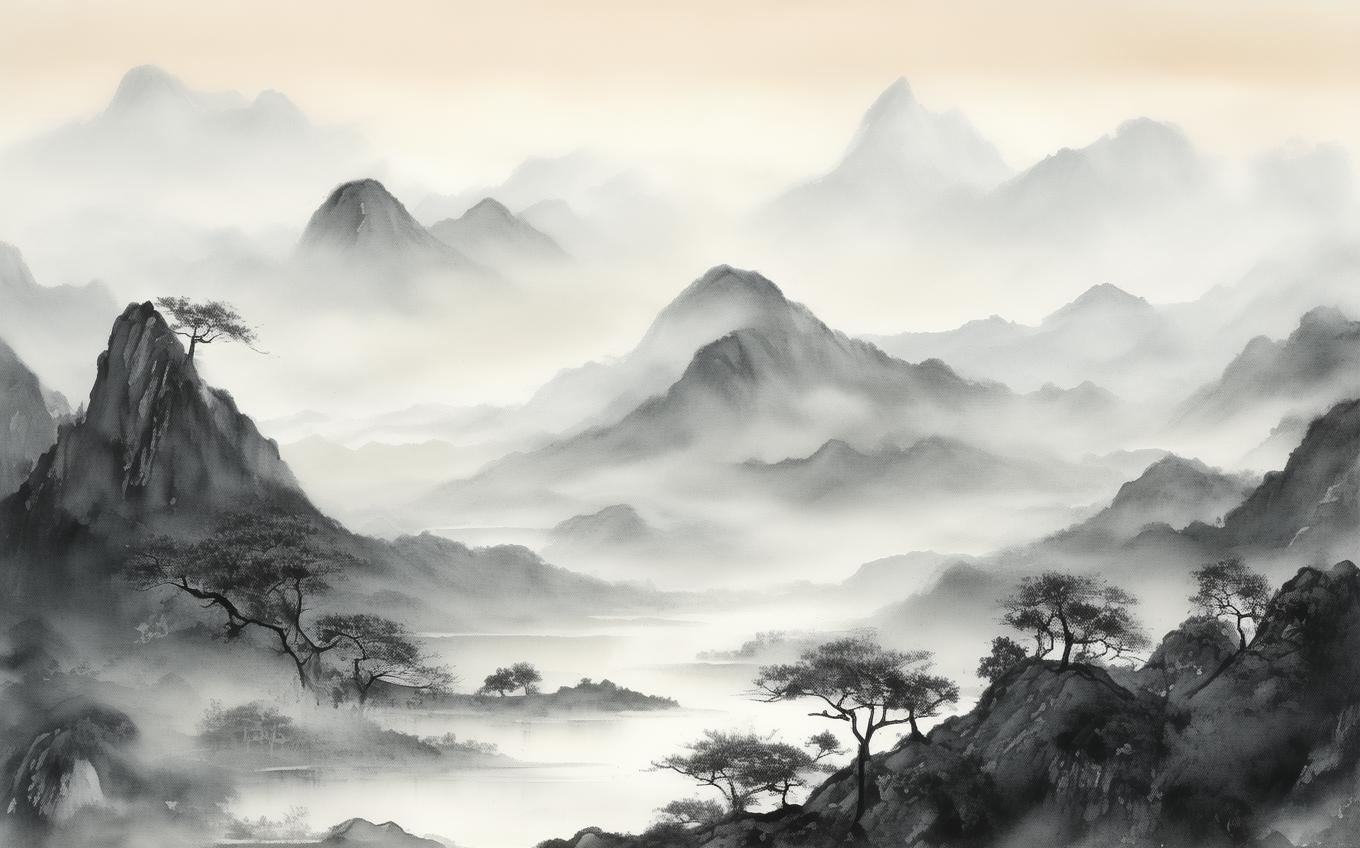
The opening sets the stage with a panoramic sweep: distant peaks settled in a “clear blue-green mist” (bì wù 碧雾). The colour 碧 is not just blue or green but a luminous, mineral jade-like hue—a word pregnant with purity. The mist “clears” (chéng 澄) implies stillness, as if the mountains themselves have distilled the haze. The parallel line introduces motion: tall trees release a “light, cool breeze” (qīng sī 轻飔). The verb “落” (to drop, to let fall) suggests the breeze descends from the treetops like a gift, blending vertical space with sensory refreshment. Together they paint a scene both untouched and welcoming.
Couplet 2 – “虚涧静闻鸟,幽林寒见麋”
Here the focus narrows to the ravine and forest. The “hollow ravine” (xū jiàn 虚涧) is so profoundly quiet that birdsong becomes an event—“one hears birds” only because silence first reigned. In the “deep, cold woods” (yōu lín 幽林), a muntjac (mí 麋), a small forest deer, suddenly appears. The coldness is not harsh but bracing, emphasising the pristine wildness. The quiet observation of these living things tells us the poet is not just a distant viewer but present, receptive, blending into the scene.
Couplet 3 – “披襟眺沧海,凭轼玩春芝”
The poet becomes physically involved. “披襟” (pī jīn)—throwing open one’s collar—is a gesture of letting the world in, of informal ease, even symbolic abandonment of formal imperial robes. From this high vantage he gazes out at the “blue-green sea” (cāng hǎi 沧海), a colour parallel to the misty mountains, linking earth and ocean. Leaning on the carriage rail (“凭轼”, using the horizontal wooden bar), he “plays with” or admires the spring herbs (chūn zhī 春芝). “玩” (wán) implies delighted, unhurried contemplation—the Daoist ideal of wuwei (无为) applied to seeing. Spring herbs, especially lingzhi-like fungi, also carry overtones of longevity and the immortals’ diet.
Couplet 4 – “形胜得仙室,气象若神池”
The scene is so perfect that the poet declares it a “dwelling for immortals” (xiān shì 仙室). “形胜” (xíng shèng) means “fine terrain,” a term often used to praise strategically vital or aesthetically supreme landscape. Its “aura” or “atmosphere” (qì xiàng 气象) is like a “divine pool” (shén chí 神池)—an enchanted pond from myth, probably evoking the crystalline waters of Kunlun or Penglai, the island abode of the Eight Immortals. This is the poem’s pivot: the landscape is not just beautiful, it is numinous; Daoist paradise is immanent in the here and now.
Couplet 5 – “已载神功洽,仍敷圣泽滋”
Here the imperial voice becomes audible. The place is “already imbued with harmonious spiritual power” (shén gōng qià 神功洽) and “still spreading the moisture of sagely grace” (shèng zé 圣泽). The “spiritual power” may be nature’s creative force or a subtle reference to the emperor’s own benevolent influence, which, like rain and dew, nourishes the land. The language harmonises Daoist nature mysticism with Confucian ideals of a ruler’s
Comments (0)
No comments yet. Be the first to comment!