Introduction
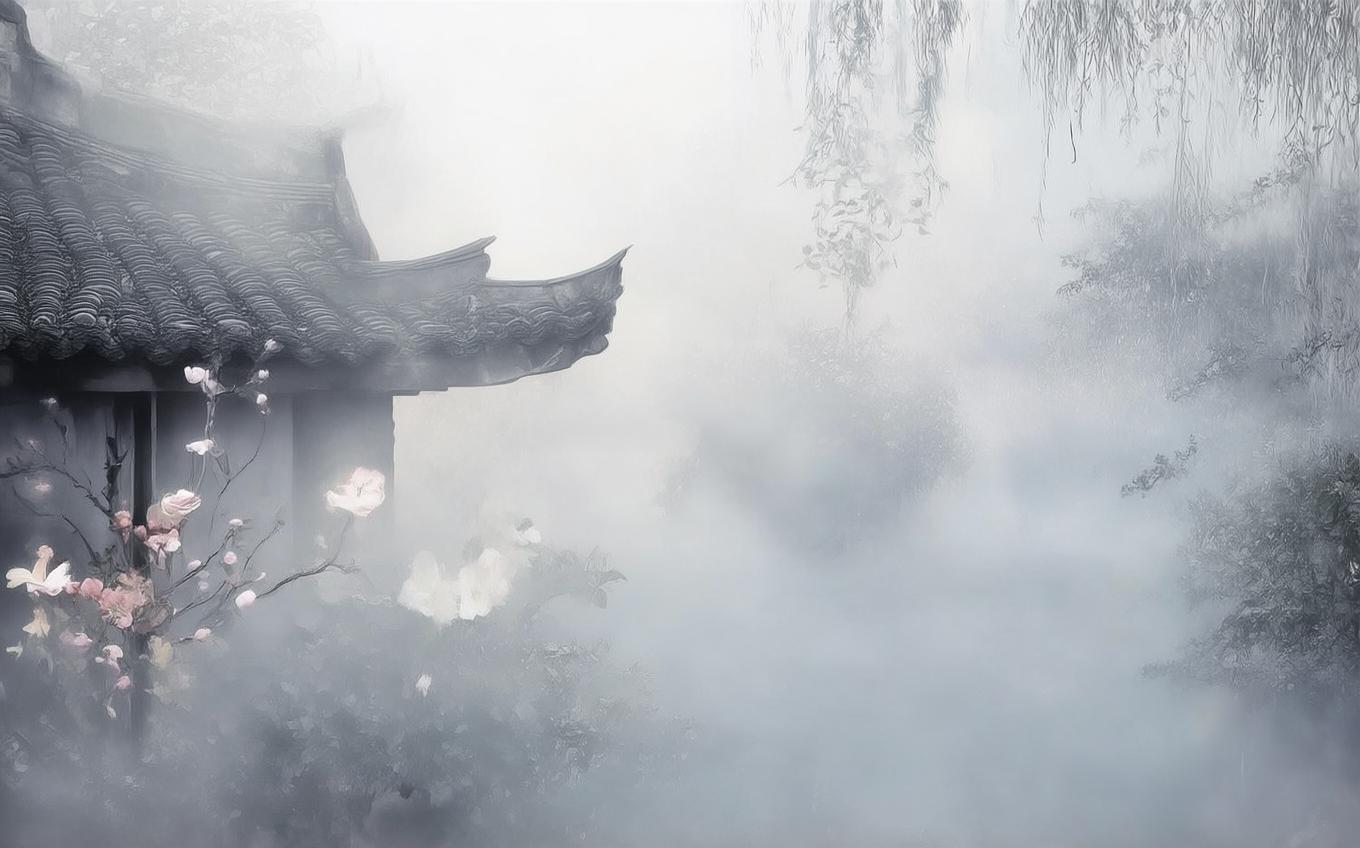
The poem 赋得花庭雾 (Fù dé huā tíng wù, "On the Theme of Mist in the Flower Courtyard") comes from the brush of Emperor Taizong of Tang, Li Shimin (598–649), one of China’s most revered rulers and a cultured poet in his own right. Written in the early Tang dynasty—a golden age of political consolidation and literary refinement—this poem exemplifies the courtly tradition of composing verse on set topics (赋得). While the emperor is known for military prowess and statecraft, his poetry reveals a sensitive observer of nature, capturing transient beauty with polish and restraint. This piece, a five-character regulated verse, invites readers into an imperial garden veiled in mist, blending fragrance, light, and elusive shapes into a meditation on presence and absence.
The Poem: Full Text and Translation
兰气已熏宫,
Lán qì yǐ xūn gōng,
The orchid breath has already steeped the palace;
新蕊半妆丛。
Xīn ruǐ bàn zhuāng cóng.
Fresh buds half adorn the clustered shrubs.
色含轻重雾,
Sè hán qīng zhòng wù,
Their hues hold mist now light, now dense;
香引去来风。
Xiāng yǐn qù lái fēng.
Their fragrance lures the wind that comes and goes.
拂树浓舒叶,
Fú shù nóng shū yè,
Brushing trees, thickly unfurl the leaves;
萦花薄隐容。
Yíng huā bó yǐn róng.
Twining flowers, thinly veiled, their faces hide.
还当杂行雨,
Hái dāng zá xíng yǔ,
It even blends with drifting rain
仿佛隐遥空。
Fǎng fú yǐn yáo kōng.
As if receding into the distant sky.
Line-by-Line Analysis
The poem opens not with the mist itself but with its sensory prelude. “兰气已熏宫” announces an orchid fragrance so pervasive it has already saturated the palace. The aroma is lush, courtly, and suggests an enclosed, privileged space. The second line, “新蕊半妆丛”, zooms in on the flowers: their petals are only half open, like a woman’s makeup still in progress. This half-finished adornment creates suspense—the garden is poised on the edge of full bloom, much as the mist hovers between revelation and concealment.
In the third and fourth couplets, the poet directly addresses the assigned topic. “色含轻重雾” is a masterstroke of visual ambiguity. Color “contains” mist, making the mist seem to emerge from within the blossoms rather than enshrouding them from without. The pairing of “轻” (light) and “重” (heavy) suggests the mist shifts continually, now thin, now thick, erasing clear outlines. The fourth line, “香引去来风”, pivots to scent and movement: fragrance becomes an active force that beckons the wind. The phrase “去来” (comings and goings) echoes the Buddhist and Daoist sense of impermanence; beauty is inseparable from constant flux.
Lines five and six explore the mist’s interaction with the garden’s solid forms. “拂树浓舒叶” describes the mist brushing the trees so that the leaves unfurl—an intimate, almost intentional touch. The adverb “浓” (thickly) reveals the mist’s density, here used as a fabric that clothes the branches. In “萦花薄隐容”, the mist twines around flowers, but now it is “薄” (thin), merely a translucent veil that hides their faces without erasing them. The poet alternates heavy and light, revelation and concealment, creating a rhythm of visual suspense.
The final couplet elevates the scene toward the sublime. “还当杂行雨” suggests the mist mingles with passing rain, blurring the boundary between vapor and droplet. The imagery dissolves solidity entirely: the mist-figure “仿佛隐遥空”—seems to vanish into the remote sky. The compound “仿佛” (as if, seemingly) introduces an element of illusion. What was a tangible presence in the courtyard now diffuses into infinite distance, leaving the reader with an afterimage more than a picture. This closure mirrors the poem’s theme: the mist is never fully grasped, only felt and half-seen.
Themes and Symbolism
Impermanence and Transience – The shifting mist, the half-open buds, the wind that arrives and departs: all symbolize the Buddhist-informed acceptance of life’s fleeting nature. The garden becomes a microcosm of a world in constant transformation, beautiful precisely because it cannot be held.
Veiling and Unveiling – The mist acts as both a concealing veil and a revelatory medium. It softens contours, creates mystery, and invites longing. This aesthetic of suggestive restraint (含蓄, hánxù) is a hallmark of classical Chinese poetry; meaning lies in what is half-hidden.
The Imperial Gaze – Writing from the imperial palace, the poet’s eye is both ruler and connoisseur. The garden is an artifact of order, yet the mist subverts full control. Li Shimin’s choice to celebrate the ephemeral, rather than eternal monuments of power, reflects a Daoist-influenced humility before nature’s rhythms.
Fragrance as Connection – Scent pervades the poem: orchids, flowers, mist tinged with rain. Smell binds the visible (palace, blossoms) to the invisible (wind, distant sky), suggesting that the deepest experiences transcend sight.
Cultural Context
The early Tang dynasty (618–907) saw the consolidation of a vast empire and the flourishing of poetry at court. “赋得” poems were set topics assigned to poets, often during banquets or scholarly gatherings, to test their skill in conventional themes. Writing on “flower courtyard mist” was an exercise in yongwu (詠物, “poems on objects”), a genre that sought to capture an object’s essence while embedding personal or philosophical sentiment.
Emperor Taizong was both patron and practitioner. His poems are less introspective than those of later Tang masters, but they set a standard of elegance and tonal balance. This piece embodies the courtly ideal: the imagery is refined, the mood serene, and the technique impeccable—balanced parallelism, controlled tonal patterns, and an ending that floats beyond the immediate scene. In Chinese literary history, it reflects the transition from the ornate palace-style poetry of the Six Dynasties to the more expansive nature lyricism of the High Tang.
Conclusion
Li Shimin’s 赋得花庭雾 endures as a quiet marvel of sensory nuance. It asks little of the reader but attention to the world’s fragile textures. The mist that half-conceals and half-reveals the flowers becomes a metaphor for the poetic experience itself: meaning coalesces, lingers, then dissolves. More than a millennium later, the poem still breathes with the cool, scented air of an ancient garden, reminding us that the most profound beauty often lies in what is on the verge of vanishing—a whisper, a veil, a distant sky.
Comments (0)
No comments yet. Be the first to comment!