Introduction
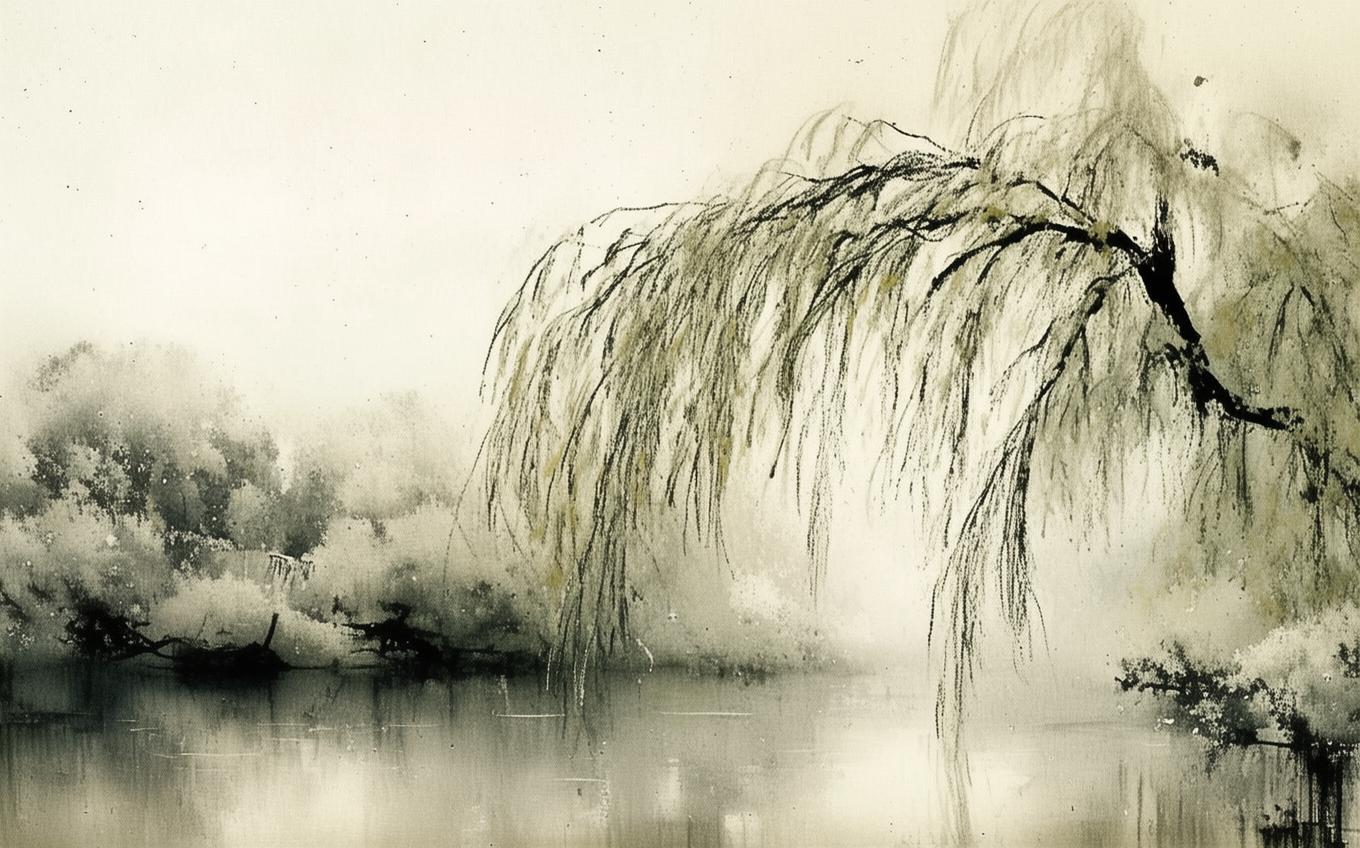
Composed by Li Shimin (李世民, 598–649), better known as Emperor Taizong of the Tang Dynasty, "赋得临池柳" (Fù Dé Lín Chí Liǔ, “Composed on the Topic ‘Willows by the Pond’”) is a delicate quatrain that blends imperial authority with lyrical grace. Tang Taizong was not merely one of China’s greatest rulers, he was also an accomplished poet who actively promoted literature at court. The phrase “赋得” indicates that this poem was a prescribed topic—likely composed at a literary gathering where participants improvised verses on a set theme. Simple in language yet rich in visual imagination, this short poem exemplifies how Tang court poetry could fuse human elegance with the natural world.
The Poem: Full Text and Translation
岸曲丝阴聚,
Àn qū sī yīn jù,
Along the winding bank, silken shadows gather;
波移带影疏。
Bō yí dài yǐng shū,
As ripples drift, ribbon-like reflections thin out.
还将眉里翠,
Hái jiāng méi lǐ cuì,
Then, taking the emerald from within painted brows,
来就镜中舒。
Lái jiù jìng zhōng shū,
It comes to stretch out leisurely within the mirror.
Line-by-Line Analysis
Line 1:
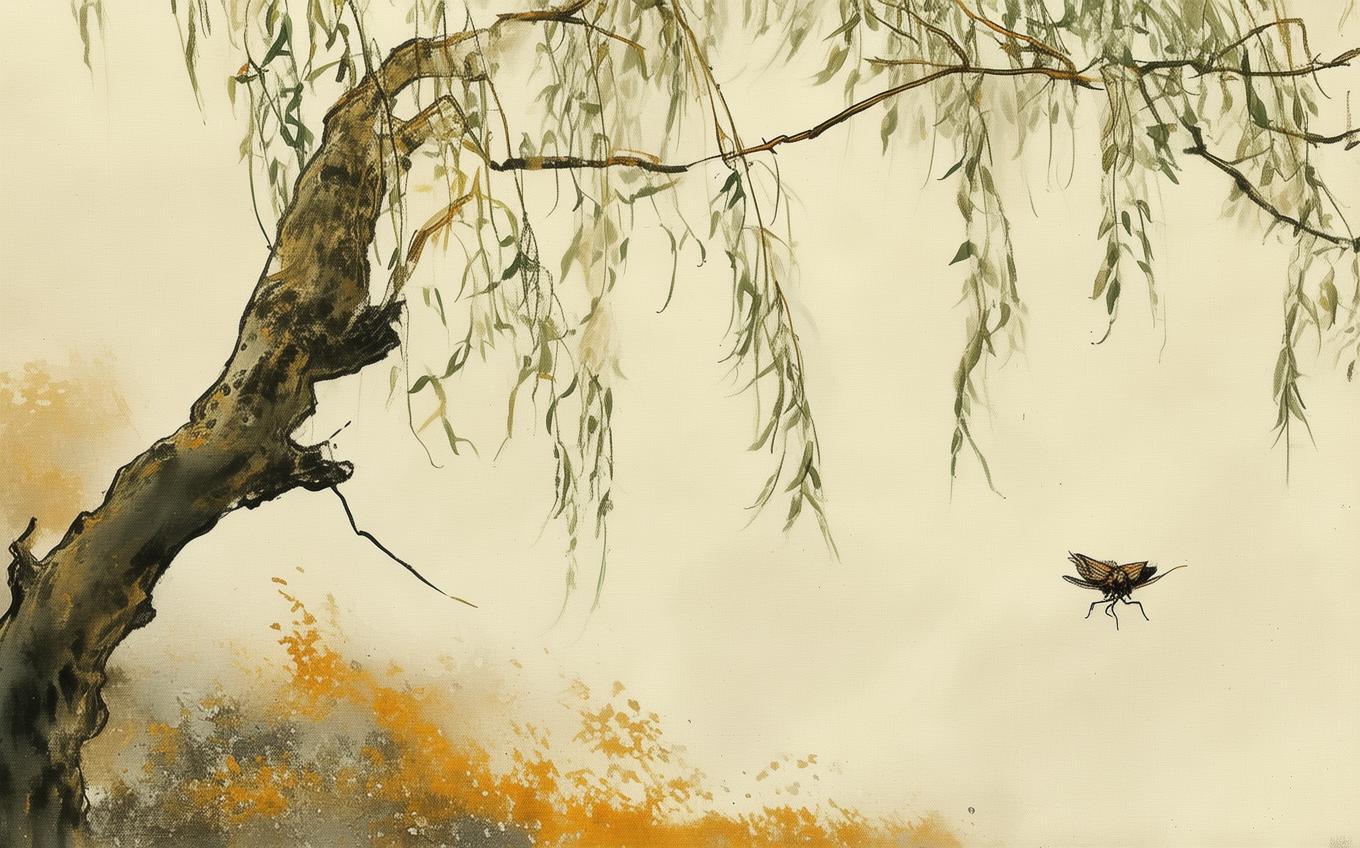
Àn qū sī yīn jù — The verse opens with a curving bank, immediately suggesting a meandering pond edge and a sense of gentle movement. “丝阴” (sī yīn, “silken shade”) describes the willow’s thin, thread-like branches and their dense shadows, evoking both the texture of silk and the cool darkness cast by the tree. The verb “聚” (jù, “gather”) gives the shadows an almost intentional quality, as if they were hesitating together along the shore.
Line 2:
Bō yí dài yǐng shū — Attention shifts to the water’s surface. Ripples animate the reflection, causing the willow’s vertical forms to sway and scatter. The word “带” (dài, “ribbon” or “sash”) continues the silk imagery, now transformed into flowing garments. Where line 1 offered density and gathering, line 2 provides movement and dispersal (“疏”, shū, “sparse, thinning”). Together they paint a picture of perpetual transformation between solid tree and liquid mirror.
Line 3:
Hái jiāng méi lǐ cuì — This line introduces a refined human metaphor. In classical Chinese poetry, willow leaves are often compared to the delicate eyebrows of a beautiful woman. Here the poet imagines borrowing the vibrant green (“翠”, cuì) from a lady’s painted brows, linking the natural willow to the artful world of the court. The phrase “还将” (hái jiāng, “then taking”) implies a playful, almost conversational gesture: the willow is not merely a plant but a conscious, coquettish presence.
Line 4:
Lái jiù jìng zhōng shū — The pond becomes a mirror (“镜”, jìng), a common trope in Chinese poetry for still water. The willow “comes to” the mirror and leisurely stretches itself out (“舒”, shū). The verb “舒” suggests both physical unfurling and emotional ease. Read together with line 3, the final image is that of a lady admiring her own emerald brows in a looking glass—except the lady is the willow, and the glass is the pond. The boundary between human and nature dissolves into a single, elegant tableau.
Themes and Symbolism
Reflection and Illusion
The poem is built on the interplay between reality and reflection. The willow exists on the bank, but its deeper, more graceful life plays out on the water’s surface. This duality hints at the Daoist and Buddhist fascination with illusion—a quiet suggestion that what we see is always shifting and impermanent.
Feminine Beauty and Nature
By comparing willow leaves to a woman’s eyebrows, the poet invokes a long tradition of equating female elegance with natural forms. The willow itself was a classic symbol of graceful femininity, suppleness, and sometimes parting (as a pun on “留”, liú, “to stay”). Here, however, the mood is not one of sorrowful farewell but of serene self-adornment.
Harmony Between Humanity and Nature
Rather than describing nature as wild or separate, Li Shimin presents it as an intimate participant in human culture. The willow “knows” how to use the mirror; it possesses an innate sense of beauty that mirrors the courtly ideal. This reflects the Tang dynasty ideal of a cosmos ordered by the emperor’s virtue, where nature willingly joins in civilized pursuits.
Cultural Context
“赋得临池柳” belongs to the tradition of “赋得” (fù dé) poetry, in which a poet receives a set phrase and must compose an impromptu piece. Such compositions were regular entertainment at the Tang court, testing not only technical skill but also the ability to imbue a prescribed topic with fresh meaning. The willow itself was a beloved subject, appearing in countless poems as a symbol of spring, nostalgia, and the capital city Chang’an, whose avenues were famously lined with these trees.
Tang Taizong’s rule (626–649) ushered in a golden age of Chinese civilization. His own poetry, though sometimes overshadowed by the giants who followed (Li Bai, Du Fu), played a crucial role in setting the tone for Tang verse: clear, balanced, and deeply attentive to the natural world. This short poem reflects the emperor’s conviction that literary refinement and effective governance were twin pillars of a prosperous reign.
Conclusion
In just twenty characters, Li Shimin’s “赋得临池柳” transforms a simple pond-side willow into a meditation on beauty, identity, and reflection. The poem’s charm lies in its perfect simplicity: a tree, a bank, water, a mirror. Yet beneath this simplicity hums a sophisticated cultural awareness where nature and humanity are elegant partners. For the modern reader, the poem offers a moment of stillness—a reminder that sometimes the truest image of ourselves is the one that gently trembles on the surface of the world around us.
Comments (0)
No comments yet. Be the first to comment!