Introduction
Tang Xuanzong (唐玄宗, 685–762), also known as Emperor Minghuang, was not only one of the most powerful rulers of the Tang dynasty but also a cultivated poet and a fervent patron of Daoism. His reign marked a golden age of Chinese culture, and his own literary works often reflect the spiritual ideals of his time. The poem "送道士薛季昌还山" (Seeing Off Daoist Priest Xue Jichang Returning to the Mountain) is a short but richly layered farewell verse. It was composed when the emperor bade farewell to the respected Daoist master Xue Jichang, who was leaving the imperial court to return to his mountain hermitage. This poem beautifully encapsulates the Tang court’s deep reverence for Daoist adepts and the eternal human longing for transcendence and immortal wisdom.
The Poem: Full Text and Translation
洞府修真客,衡阳念旧居。
Dòng fǔ xiū zhēn kè, Héngyáng niàn jiù jū.
A cultivator of the True Way in his grotto abode, at Hengyang he longs for his former dwelling.将成金阙要,愿奉玉清书。
Jiāng chéng jīn què yào, yuàn fèng yù qīng shū.
About to fulfill the secret of the Golden Portals, he wishes to reverently present the Jade Clarity scriptures.云路三天近,松溪万籁虚。
Yún lù sān tiān jìn, sōng xī wàn lài xū.
The cloudy path draws near to the Three Heavens; by the pine stream, the myriad sounds become void.犹期传秘诀,来往候仙舆。
Yóu qī chuán mì jué, lái wǎng hòu xiān yú.
Still I look forward to the transmission of secret formulas; come and go, awaiting the immortal carriage.
Line-by-Line Analysis
洞府修真客,衡阳念旧居。
The opening line immediately sets a mystical tone. The “洞府” (grotto abode) is not a mere cave but a sacred space where a Daoist adept pursues spiritual refinement. The term “修真客” (cultivator of the True Way) identifies Xue Jichang as a seeker of the Dao’s ultimate reality. The poet then notes that at Hengyang—a real place in modern Hunan, long associated with sacred mountains and Daoist retreats—the priest longs for his “旧居” (former dwelling). This longing is not simply nostalgia; it reflects a sage’s detachment from the worldly court and a pull back to the purity of nature and solitude. The emperor, by mentioning this, shows a gentle understanding of the priest’s spiritual calling.
将成金阙要,愿奉玉清书。
“金阙” (Golden Portals) refers to the celestial gates of the highest heavens in Daoist cosmology, the abode of primordial deities. “要” here can mean the essential secret or oral instruction needed to ascend. The poet suggests the priest is on the verge of attaining this supreme knowledge. “玉清” is the highest of the Three Pure Realms (Sanqing) in Daoist heaven, and its “书” (scriptures) are the most sacred texts. The emperor imagines the priest humbly offering these scriptures upward—a sign of completed cultivation. There is a deep reverence here: the mortal ruler stands in awe of a man close to divine attainment, and the act of “奉” (reverently presenting) underscores the sacred exchange between humanity and the celestial.
云路三天近,松溪万籁虚。
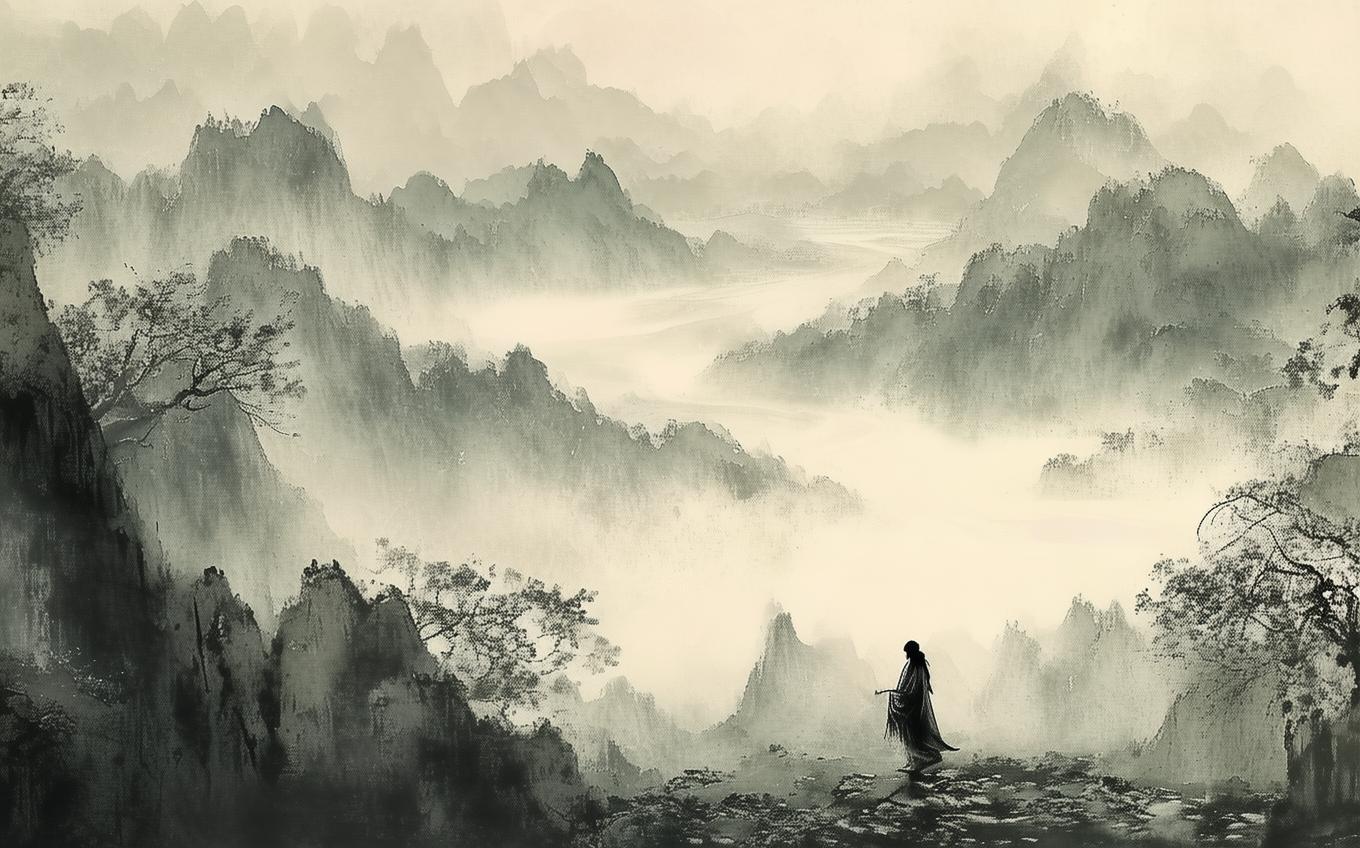
This couplet is the aesthetic heart of the poem. “云路” (cloudy path) is the path through mist and sky that leads to the “三天” (Three Heavens), the layered Daoist paradises. The priest’s journey back to the mountain parallels a spiritual ascent; the clouds draw the heavens near. Then the image shifts to the mountain landscape: a “松溪” (pine stream), a classic emblem of eremitism, where all “万籁” (myriad sounds) become “虚” (void, vacant, still). This is not emptiness in a negative sense, but the profound silence of the Dao, a state beyond mundane noise. The line captures the very essence of returning to the mountain—a merging with the quiet, resonant emptiness from which all things arise. The contrast between the celestial ascent and earthy silence powerfully unites macrocosm and microcosm.
犹期传秘诀,来往候仙舆。
The final couplet reveals the emperor’s personal hope. Despite the farewell, Xuanzong does not see this as a permanent separation. “犹期” (still I look forward to) conveys a patient, faithful expectation. The “秘诀” (secret formulas) are the oral teachings that only a realized master can pass on, the ultimate gift of the Daoist path. The “仙舆” (immortal carriage) is the cloud chariot on which transcendents travel between heavens and earth. The emperor imagines the priest going back and forth in this divine vehicle, maintaining a connection. This reflects the Tang belief that a sovereign with true virtue could summon and communicate with immortals. The tone is intimate yet majestic—the ruler of the Middle Kingdom speaks like a humble disciple awaiting the master’s return.
Themes and Symbolism
The poem intertwines several key themes:
-
The Sacred Return to Nature: The mountain is not a place of exile but a sacred origin. Leaving the court for the wilderness is presented as a spiritual ascent, not a retreat from responsibility. The “pine stream” and “cloudy path” are symbols of the pure, uncorrupted world where the Dao is most present.
-
Daoist Immortality and Celestial Hierarchy: The poem is drenched in Daoist cosmology—the Three Heavens, the Golden Portals, the Jade Clarity texts, and the immortal carriage. These are not mere metaphors; they represent a living reality in Tang Daoism. The emperor takes seriously the idea that a perfected person can move freely between worlds.
-
Reciprocity between Sovereign and Sage: Unlike the typical Confucian model where the ruler stands supreme, here the emperor adopts a posture of respect and hopeful waiting. There is a subtle recognition that spiritual authority transcends political power. The “secret formulas” represent the wisdom that the throne, for all its glory, cannot command—it can only be received as a gift.
-
Silence and Emptiness: The phrase “万籁虚” (myriad sounds become void) is a profound Daoist gesture. It points to the ineffable ground of being, beyond words and sensory clamor. This is the ultimate destination of the priest’s journey.
Cultural Context
To appreciate this poem fully, one must understand the religious landscape of High Tang. Emperor Xuanzong was a devoted patron of Daoism, elevating it to almost the status of a state religion. He officially recognized Laozi as a divine ancestor, sponsored the construction of temples, and sought out famed Daoist masters. Xue Jichang was a prominent priest of the Shangqing (Supreme Clarity) school, which emphasized meditation, visualization, and the transmission of secret registers. The imperial court frequently invited such figures to perform rituals and bestow teachings. When they returned to their mountains, it was an occasion of both ceremony and genuine spiritual sentiment.
The poem is also embedded in the tradition of “farewell poetry” (送别诗), but it transforms the genre. Rather than lamenting separation, it celebrates a homecoming to a higher reality. The emperor’s vision of a future reunion via immortal carriage reflects the Daoist ideal of “wandering freely beyond the world” (逍遥游), while subtly reinforcing the emperor’s own connection to the divine.
Conclusion
“送道士薛季昌还山” is a gem of Tang poetry that bridges the temporal and the eternal. In just twenty characters per line, Emperor Xuanzong paints a vivid portrait of a departing sage, the celestial realms that await him, and the silent, transformative beauty of the mountain wilderness. The poem’s enduring appeal lies in its serene acceptance of parting as a threshold to greater union, and its vision of wisdom that no earthly crown can bestow. For modern readers, it opens a window into a world where poetry, power, and spirituality were intimately entwined—a world where a farewell was also a prayer for transmission and transcendence. It reminds us that sometimes, letting go with reverence is the most profound form of connection.
Comments (0)
No comments yet. Be the first to comment!