Introduction
陈叔达 (Chén Shūdá) was a notable poet and statesman of the early Tang Dynasty. Born into the imperial lineage of the Chen Dynasty (557–589), he witnessed the fall of his family's rule and subsequently served the Sui and then the Tang courts. His life bridged a period of political fragmentation and the reunification of China under the Tang, an era often celebrated as a golden age of Chinese poetry and culture. As a court official, 陈叔达 was frequently called upon to compose verses for imperial occasions, and "早春桂林殿应诏" (Zǎochūn Guìlín Diàn Yìngzhào) — "Written at Imperial Command on an Early Spring Day at the Guilin Hall" — is precisely such a poem.
The title reveals its nature: "应诏" (yìngzhào) means "responding to an imperial command," indicating that the poem was composed at the request of the emperor himself. This was a common practice among literate courtiers, who were expected to demonstrate their wit, erudition, and loyalty through extemporaneous verse. The "桂林殿" (Guìlín Diàn), or "Osmanthus Grove Hall," was a palace building whose name evokes fragrant blossoming trees and suggests a setting of refined beauty. The poem is significant not only for its exquisite craftsmanship but also for what it reveals about the cultural life of the Tang court — a world where poetry was not merely an art form but a vital currency of social and political exchange.
The Poem: Full Text and Translation
金铺照春色,玉律动年华。
Jīn pū zhào chūnsè, yù lǜ dòng niánhuá.
The gilded door-knockers shine with the colors of spring; the jade pitch-pipes stir the passing of the year.
朱楼云似盖,丹桂雪如花。
Zhū lóu yún sì gài, dān guì xuě rú huā.
Above the vermilion tower, clouds spread like a canopy; on the crimson osmanthus, snow rests like blossoms.
水岸衔阶转,风条出柳斜。
Shuǐ'àn xián jiē zhuǎn, fēng tiáo chū liǔ xié.
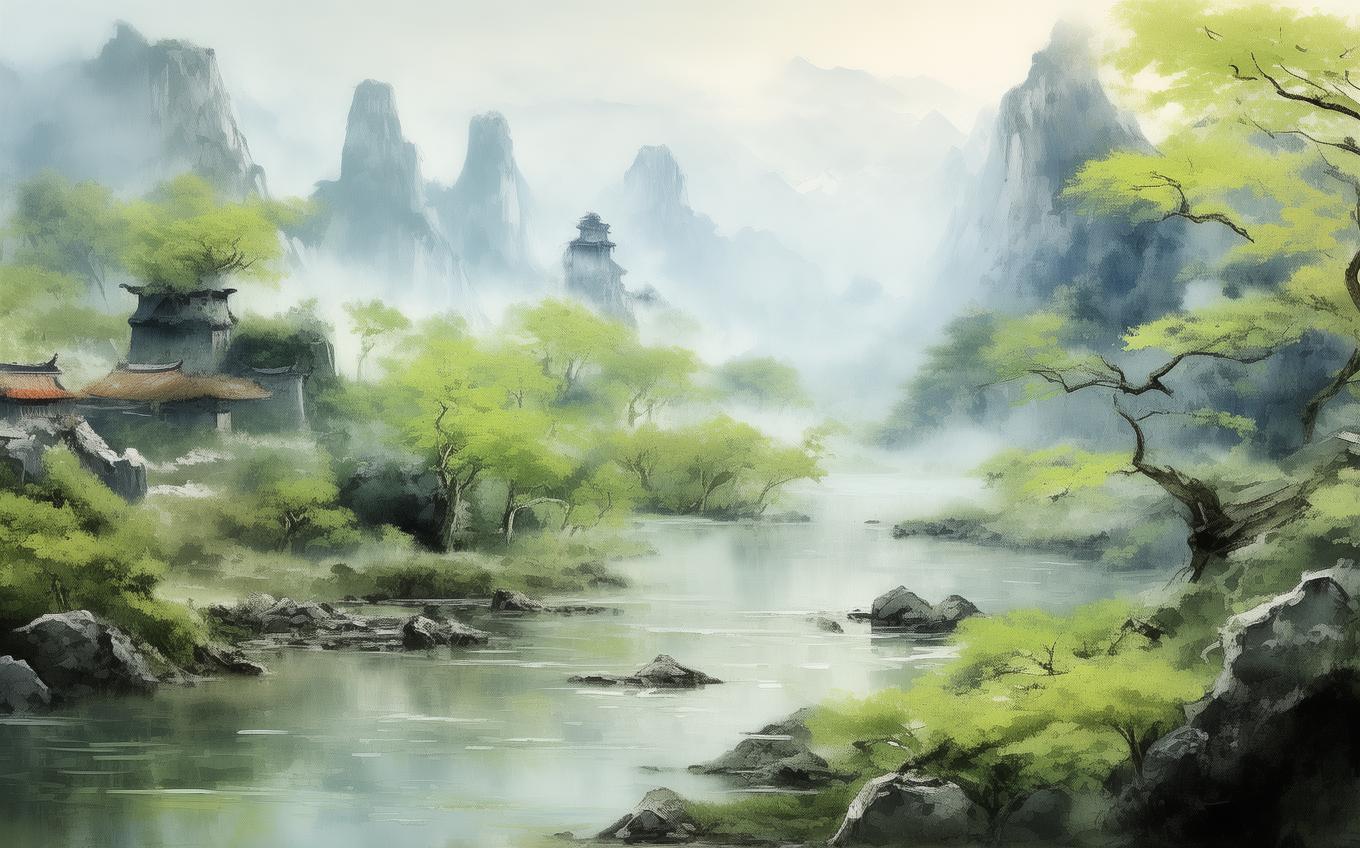
The water's edge curls around the turning steps; wind-blown branches emerge from the willows, slanting.
轻舆临太液,湛露酌流霞。
Qīng yú lín Tàiyè, zhàn lù zhuó liúxiá.
A light carriage approaches the Taiye Pool; with deep dew, we pour the drifting rosy clouds as wine.
Line-by-Line Analysis
Line 1: 金铺照春色,玉律动年华。
The poem opens with a masterful fusion of the human and the cosmic. "金铺" (jīn pū) refers to the ornamental gilded knockers or metal fittings on palace doors — a detail of architectural luxury that immediately establishes the imperial setting. These golden fixtures "照" (zhào), or "illuminate/reflect," the spring scenery, suggesting that even the palace's man-made splendor participates in the season's radiance. The second half of the couplet introduces "玉律" (yù lǜ), the "jade pitch-pipes." In ancient China, twelve pitch-pipes of varying lengths were used not only for music but also as a calendrical instrument, each pipe corresponding to a different month of the year. The phrase "动年华" (dòng niánhuá) — "stirring the passing of the year" — implies that the music of these jade pipes sets time itself in motion. This line thus establishes a grand theme: the harmony between human artistry (gold, jade) and the natural cycle of seasons.
Line 2: 朱楼云似盖,丹桂雪如花。
This couplet presents two parallel images of ethereal beauty. The "朱楼" (zhū lóu), or "vermilion tower," is a palace building painted in auspicious red. Above it, clouds "似盖" (sì gài) — "resemble a canopy" — suggesting both the protective covering of heaven and the ceremonial umbrellas that shaded royalty. The second image is more delicate: "丹桂" (dān guì), the "crimson osmanthus," a tree prized in Chinese culture for its fragrant autumn blossoms and its association with the moon palace. Here, in early spring, snow rests upon the osmanthus branches, and the poet sees the snow "如花" (rú huā) — "like blossoms." This is a striking inversion: the snow mimics the flowers that have not yet bloomed, creating a dreamlike confusion of seasons. The poet perceives beauty not in what is present but in what is suggested — the snow becomes a promise of the spring to come.
Line 3: 水岸衔阶转,风条出柳斜。
The third couplet shifts from static imagery to dynamic movement. "水岸衔阶转" (shuǐ'àn xián jiē zhuǎn) describes the shoreline "holding in its mouth" (衔, xián) the palace steps as it curves around them. The verb 衔 is particularly evocative — it suggests a gentle, almost affectionate relationship between water and stone, as if the lake were tenderly embracing the architecture. The second image, "风条出柳斜" (fēng tiáo chū liǔ xié), captures the willows' branches stirred by the wind, emerging "slanting" (斜, xié) from the trees. The character 斜 is a favorite in classical Chinese poetry, conveying a sense of graceful, natural asymmetry that contrasts with the rigid formality of palace architecture. Here, the wind animates the scene, introducing an element of spontaneity and freedom.
Line 4: 轻舆临太液,湛露酌流霞。
The final couplet brings the poem to a ceremonial and transcendent close. "轻舆" (qīng yú) — a "light carriage" — approaches "太液" (Tàiyè), the "Taiye Pool," a famous artificial lake in the imperial gardens of Chang'an, the Tang capital. The Taiye Pool was a place of leisure and beauty, where the emperor and his courtiers would gather to enjoy the scenery. The image of the light carriage arriving suggests the emperor's presence, or perhaps the collective arrival of the court. The final line is the most mystical: "湛露酌流霞" (zhàn lù zhuó liúxiá) — "with deep dew, we pour the drifting rosy clouds." "湛露" (zhàn lù) refers to the heavy, clear dew of early morning, but it is also the title of a poem in the Book of Songs (《诗经》) celebrating a royal feast. "流霞" (liúxiá) — "drifting rosy clouds" — was, according to Daoist legend, a celestial wine drunk by immortals. The poet thus transforms a court banquet into a gathering of transcendent beings, where dew becomes wine and the rosy clouds of dawn are poured into cups. The line elevates the mundane act of drinking into a communion with the divine.
Themes and Symbolism
The Harmony of Nature and Human Artifice
The poem's most prominent theme is the seamless integration of human construction and natural beauty. The gilded door-knockers do not compete with the spring; they "illuminate" it. The vermilion tower does not obscure the clouds; the clouds become its canopy. The water does not erode the steps; it "holds" them gently. Throughout the poem, 陈叔达 presents a vision of the imperial palace not as an imposition upon nature but as a participant in its beauty. This reflects a fundamental Chinese aesthetic principle: the ideal human creation harmonizes with, rather than dominates, the natural world.
The Fluidity of Time and Season
The poem is set in early spring, yet it contains images of snow, osmanthus blossoms (which typically bloom in autumn), and dew. This temporal fluidity is deliberate. The "jade pitch-pipes" of the first line explicitly reference the measurement of time, and the snow that "resembles blossoms" blurs the boundary between winter and spring, or spring and autumn. The poet suggests that in the realm of the palace — and perhaps in the realm of poetry itself — time is not a linear progression but a simultaneous presence of all seasons. This is reinforced by the final image of "流霞" (drifting rosy clouds), which belong to no particular time but to the eternal realm of the immortals.
The Elevation of the Mundane
The poem transforms ordinary court activities — arriving at a palace, drinking wine — into acts of cosmic significance. The dew becomes a sacred substance, the wine becomes the drink of immortals, the carriage becomes a vehicle approaching paradise. This elevation reflects the Confucian ideal of ritual (礼, lǐ): when performed with proper reverence and aesthetic sensibility, even the most routine actions become meaningful and beautiful. It also reflects the Daoist aspiration to transcendence, the belief that the world of the senses can be a gateway to the world of the spirit.
Key Symbols
- Jade (玉, yù): In Chinese culture, jade symbolizes purity, nobility, and immortality. The "jade pitch-pipes" represent not only musical and calendrical precision but also the moral refinement of the ruler.
- Osmanthus (桂, guì): The osmanthus tree is associated with the moon, literary success (折桂, "plucking the osmanthus," meant passing the imperial examinations), and the fragrance of virtue. Its presence here adds a layer of scholarly and moral significance.
- Taiye Pool (太液, Tàiyè): The name literally means "Grand Liquid" or "Great Essence," and the pool was designed as a microcosm of the immortal realms, with artificial mountains representing the mythical islands of the immortals. Approaching it thus symbolizes approaching transcendence.
- Drifting Rosy Clouds (流霞, liúxiá): A Daoist term for the wine of the immortals, symbolizing the aspiration to transcend the mortal world while still enjoying its pleasures.
Cultural Context
The early Tang Dynasty (618–907) was a period of extraordinary cultural confidence and synthesis. The empire had been reunified after centuries of division, and the Tang court actively patronized the arts, literature, and religion. Poetry was not a private pursuit but a public performance, an essential skill for any aspiring official. The imperial examination system, which tested candidates on their ability to compose poetry, ensured that literary talent was a path to political power.
"应诏" (yìngzhào) poems — those written at imperial command — were a specific genre with specific expectations. The poet was required to demonstrate technical mastery, cultural erudition, and political loyalty, all while making the emperor and his court appear in the best possible light. Yet within these constraints, great poets like 陈叔达 found room for genuine artistry. The poem is not merely flattery; it is a sincere attempt to capture a moment of beauty and to express the ideal of a harmonious world.
The poem also reflects the syncretic religious culture of the Tang. The reference to "流霞" (drifting rosy clouds) draws on Daoist traditions of immortality and transcendence, while the emphasis on ritual and the proper order of the court reflects Confucian values. The Tang court was a place where Confucianism, Daoism, and Buddhism coexisted and interpenetrated, and this poem's blend of worldly elegance and otherworldly aspiration is characteristic of the period.
Furthermore, the poem exemplifies the Chinese aesthetic principle of "情景交融" (qíng jǐng jiāo róng) — the fusion of emotion and scenery. The poet does not explicitly state his feelings; instead, he presents a series of images that, taken together, evoke a mood of serene joy and quiet wonder. The reader is invited to inhabit the scene and to feel what the poet felt, without being told what to feel. This indirectness, this trust in the power of imagery, is one of the hallmarks of classical Chinese poetry.
Conclusion
"早春桂林殿应诏" is a small masterpiece of court poetry, a poem that transforms an occasion of political obligation into an expression of timeless beauty. Through its carefully chosen images — gilded door-knockers and jade pitch-pipes, vermilion towers and snow-covered osmanthus, curving shorelines and wind-blown willows, light carriages and celestial wine — 陈叔达 creates a world in which the imperial palace becomes a paradise, and the early spring becomes a moment of eternal significance.
The poem's enduring appeal lies in its ability to evoke a sense of harmony — between nature and human artistry, between the passing seasons and the eternal realm, between the pleasures of the senses and the aspirations of the spirit. In our own age, when the relationship between humanity and nature often seems fractured and adversarial, this vision of gentle integration offers a compelling alternative. It reminds us that beauty is not something we impose upon the world but something we discover when we learn to see with the eyes of a poet — when we learn to see snow as blossoms, dew as wine, and the drifting clouds as a drink for the soul.
For English-speaking readers, poems like this one open a window into a world that is at once distant and deeply familiar — a world where the arrival of spring was an occasion for imperial celebration, where poetry was a form of political service, and where the boundary between the human and the divine was as thin as a veil of morning mist. In reading 陈叔达's words, we too can stand at the edge of the Taiye Pool, raise our cups to the drifting rosy clouds, and taste, for a moment, the wine of the immortals.
Sources and Verification
- Verified text and attribution: 陈叔达, “早春桂林殿应诏” (Tang dynasty).
- Primary dataset: Chinese Poetry open corpus.
- Source record:
0d0056af-ad39-4df9-adf3-aed70b2c3ac0.
The Chinese source text and attribution are supplied from the verified record above. The English translation and commentary are educational explanations.
Comments (0)
No comments yet. Be the first to comment!