Introduction
Chen Shuda (陈叔达) was a poet and statesman of the early Tang Dynasty, living through one of the most turbulent and transformative periods in Chinese history. Born into the Chen imperial family of the Southern Dynasties, he witnessed the fall of his own dynasty, served under the Sui Dynasty, and eventually found favor at the court of the founding Tang emperor, Gaozu. His life thus bridged the chaotic transition from the period of division to the reunified and culturally brilliant Tang era.
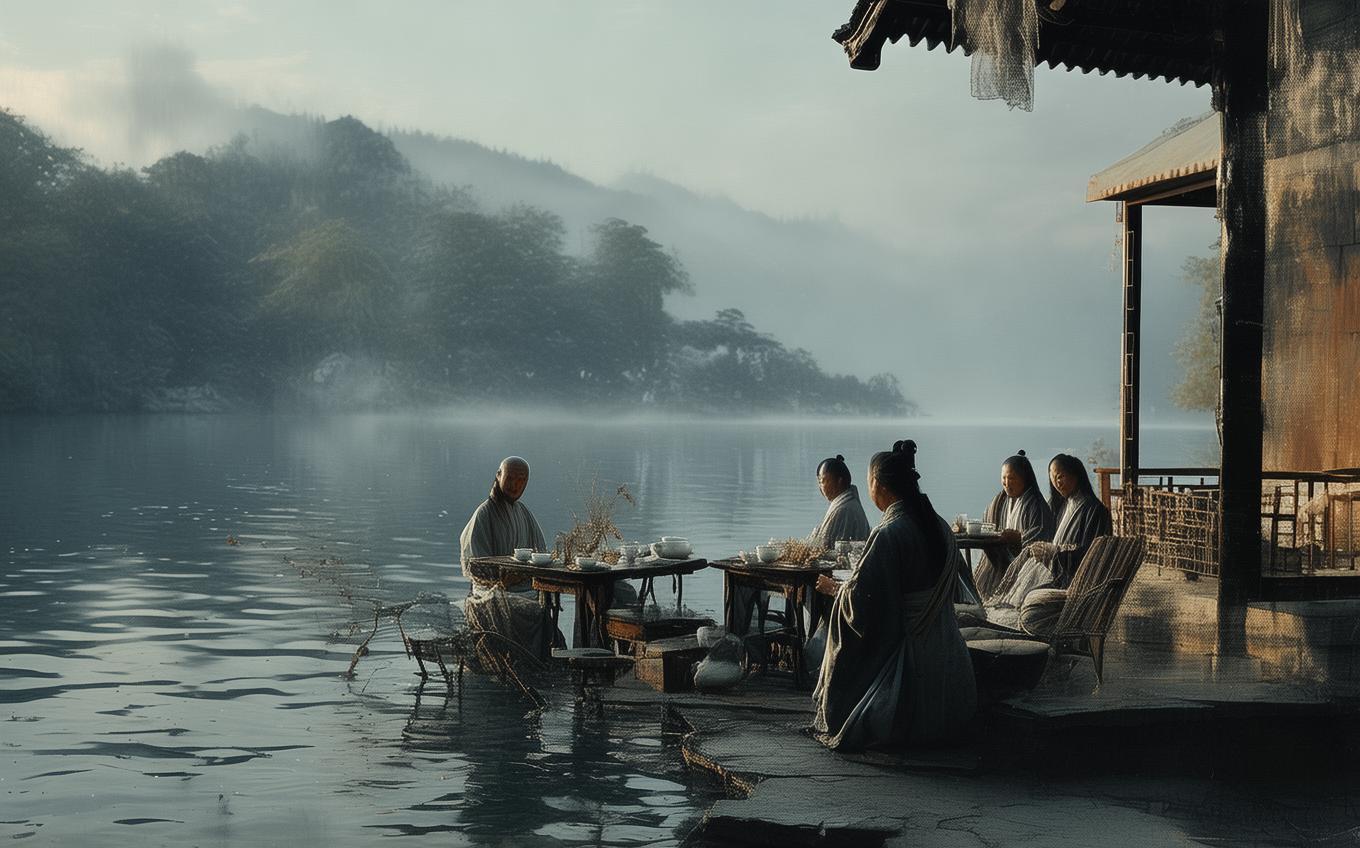
"后渚置酒" ("Setting Out Wine at Houzhu") is a poem that captures a moment of quiet tension and reflection at a riverside outpost. The title suggests a social occasion—wine has been laid out—yet the poem itself is far from festive. Instead, it evokes a landscape shrouded in darkness, mist, and the distant sounds of war drums, creating an atmosphere of anticipation and unease. The poem is significant for its masterful use of landscape imagery to convey psychological states, a hallmark of classical Chinese poetry, and for its subtle reflection of the anxieties of an age when borders and frontiers were never entirely secure.
The Poem: Full Text and Translation
大渚初惊夜
Dà zhǔ chū jīng yè
The great islet is startled by the onset of night
中流沸鼓鼙
Zhōng liú fèi gǔ pí
Midstream, war drums and battle drums seethe and boil
寒沙满曲浦
Hán shā mǎn qū pǔ
Cold sand spreads over the winding riverbanks
夕雾上邪谿
Xī wù shàng xié xī
Evening mist climbs up the slanting mountain stream
岸广凫飞急
Àn guǎng fú fēi jí
The banks are wide, wild ducks fly in haste
云深鴈度低
Yún shēn yàn dù dī
The clouds are deep, wild geese cross low in the sky
严关犹未遂
Yán guān yóu wèi suì
The stern pass has not yet been secured
此夕待晨鸡
Cǐ xī dài chén jī
This night, we await the cock's crow at dawn
Line-by-Line Analysis
Lines 1–2: 大渚初惊夜,中流沸鼓鼙
The poem opens with a striking personification: the great islet (大渚) is "startled" (惊) by the arrival of night. This is not a gentle dusk but a sudden, almost violent transition from day to darkness. The word 惊 (jīng, "to startle," "to alarm") immediately sets an anxious tone. The natural world itself seems on edge.
The second line introduces the source of this unease: the sound of war drums (鼓鼙) boiling (沸) in the middle of the river. The verb 沸 (fèi, "to boil," "to seethe") is particularly vivid—it suggests not just sound but a churning, turbulent energy. The drums are not distant; they are midstream, close enough to be felt as much as heard. Together, these two lines establish a landscape at once natural and militarized, where the boundary between peaceful nature and human conflict has blurred.
Lines 3–4: 寒沙满曲浦,夕雾上邪谿
Here the poet shifts to visual imagery of the surrounding terrain. The "cold sand" (寒沙) that fills the winding riverbanks evokes a sense of desolation and barrenness. Sand is inherently cold and lifeless; by calling it "cold," the poet emphasizes the absence of warmth and comfort. The "winding riverbanks" (曲浦) suggest a landscape that is convoluted, difficult to navigate, perhaps mirroring the complexity of the political or military situation.
The fourth line continues the vertical movement: evening mist (夕雾) "climbs" (上) the slanting mountain stream (邪谿). The word 邪 (xié) means "slanting," "oblique," or even "askew"—it carries a subtle connotation of something not quite right, not straight or proper. The mist rising against the slant of the mountain creates an image of the world tilting, of natural order subtly disturbed.
Lines 5–6: 岸广凫飞急,云深鴈度低
These two lines form a parallel couplet, a common technique in classical Chinese poetry where two lines mirror each other in structure and meaning. The first describes wild ducks (凫) flying urgently (急) over wide banks; the second describes wild geese (鴈) crossing low (低) beneath deep clouds. Both birds are in flight, but their movement is not graceful or free—it is hurried, constrained, pressed down by the weight of the atmosphere.
The wide banks (岸广) emphasize the vastness of the space, while the deep clouds (云深) emphasize the oppressive height of the sky. The birds are caught between these extremes, just as humans are caught between the earth and the heavens, between safety and danger. The urgency of the ducks and the low flight of the geese suggest an instinctive response to threat—animals sensing what humans may not yet fully understand.
Lines 7–8: 严关犹未遂,此夕待晨鸡
The final couplet brings the poem to its emotional and thematic climax. The "stern pass" (严关) refers to a strategic mountain pass or border checkpoint that has "not yet been secured" (犹未遂). The phrase 未遂 (wèi suì) means "unfulfilled," "not accomplished"—it carries a sense of incompleteness, of a goal not yet reached. This is the source of the poem's tension: the night has fallen, but the pass remains vulnerable.
The final line is one of the most poignant in the poem: "This night, we await the cock's crow at dawn" (此夕待晨鸡). The cock's crow at dawn was, in ancient China, a signal of the approaching day, a time when the dangers of night would recede. To "await the cock's crow" is to endure the darkness in hope of light, to hold on through fear in anticipation of resolution. It is a line of quiet endurance, of patient vigilance—not despair, but not triumph either. It is simply the determination to make it through the night.
Themes and Symbolism
The Anxious Landscape
The dominant theme of the poem is anxiety in the face of uncertainty. Every element of the natural world—the startled islet, the boiling drums, the cold sand, the climbing mist, the hurrying birds—reflects a state of agitation and unease. This technique, known in Chinese poetics as "the fusion of feeling and scene" (情景交融, qíng jǐng jiāo róng), is one of the hallmarks of classical Chinese poetry. The landscape is not merely a backdrop; it is a mirror of the poet's inner state.
The Symbolism of Birds
The wild ducks and wild geese are rich in symbolic meaning. In Chinese poetry, wild geese (鴈 or 雁) are traditionally associated with migration, separation, and messages from afar—they are birds that travel great distances and are often seen as symbols of the traveler or the exile. Their low flight beneath deep clouds suggests a journey made difficult by adverse conditions. The wild ducks (凫), meanwhile, are more associated with freedom and the natural world, yet here they fly "in haste," suggesting that even the freest of creatures are affected by the prevailing atmosphere of danger.
The Symbolism of Night and Dawn
The poem is structured around the opposition of night and dawn. Night represents danger, uncertainty, and vulnerability—the time when enemies might attack, when the pass cannot be secured. Dawn, signaled by the cock's crow, represents hope, resolution, and the return of order. The poem does not describe the dawn; it only describes the waiting for dawn. This makes the poem an exploration of endurance—the human capacity to hold on through the darkest hours.
The Frontier and the Pass
The "stern pass" (严关) is a symbol of boundaries and defense. In Chinese culture, mountain passes and border fortifications have long been symbols of the state's ability to protect its people. An unsecured pass is a source of deep anxiety, representing vulnerability to external threats. The poem thus touches on themes of patriotism and duty—the obligation to defend the realm, even through a long and frightening night.
Cultural Context
The Early Tang Period
Chen Shuda lived during the late sixth and early seventh centuries, a period of dramatic transition. The Sui Dynasty (581–618) had briefly reunified China after centuries of division, but its collapse led to a period of civil war before the Tang Dynasty (618–907) established its rule. The early Tang was a time of consolidation, when the new dynasty was still securing its borders and establishing its authority.
This historical context is crucial to understanding the poem. The "stern pass" that has "not yet been secured" may refer to an actual military situation—a frontier outpost awaiting reinforcement or a strategic position still contested. The early Tang emperors, particularly Taizong, devoted significant resources to securing the northern and western frontiers against Turkic and other nomadic peoples. The anxiety of the poem reflects the very real dangers of this period.
The Poet's Background
Chen Shuda's personal history adds another layer of meaning. As a member of the fallen Chen imperial family, he knew what it meant to lose a kingdom. He had witnessed the collapse of his own dynasty and the violence that accompanied regime change. This experience of loss and displacement may inform the poem's atmosphere of vulnerability and its focus on endurance through darkness.
The Poetic Tradition
The poem belongs to the tradition of frontier poetry (边塞诗, biānsài shī), which flourished during the Tang Dynasty. Frontier poems typically depict the harsh conditions of military life on the borders, the longing of soldiers for home, and the grandeur of the landscape. However, Chen Shuda's poem is distinctive for its focus on a single night of waiting rather than on battle or travel. It is a poem of suspense rather than action, of psychological tension rather than physical conflict.
Chinese Values and Philosophy
The poem reflects several important Chinese cultural values:
-
Vigilance and duty: The poem's speaker remains awake through the night, watching and waiting. This reflects the Confucian virtue of zhōng (忠, "loyalty" or "devotion to duty"), the obligation to fulfill one's responsibilities even in difficult circumstances.
-
Harmony with nature: The poem's use of natural imagery to express human emotion reflects the Chinese philosophical view that humans and nature are interconnected. The landscape is not separate from human experience but an expression of it.
-
Endurance: The final line's quiet determination to "await the cock's crow" embodies the Chinese cultural value of rěn (忍, "endurance" or "perseverance")—the ability to bear hardship with patience and dignity.
Conclusion
"后渚置酒" is a poem of remarkable restraint and power. In just eight lines, Chen Shuda creates a world suspended between day and night, safety and danger, hope and fear. The poem's genius lies in what it does not say: it does not describe a battle, an enemy, or a specific threat. Instead, it evokes a mood—the mood of a night when the world seems to hold its breath.
The poem's enduring appeal lies in its universality. While its specific context is the military frontier of early Tang China, its emotional core—the experience of waiting through darkness for a dawn that has not yet come—resonates across time and culture. We have all known nights like this, whether literal or metaphorical: nights of uncertainty, of vigilance, of hoping that the morning will bring resolution.
Chen Shuda's poem reminds us that such nights are part of the human experience, and that there is dignity in enduring them. The final image—waiting for the cock's crow—is not one of despair but of quiet hope. It is a reminder that even the longest night must eventually give way to dawn, and that the act of waiting, of remaining awake and vigilant, is itself a form of courage.
For English-speaking readers encountering this poem for the first time, "后渚置酒" offers a window into the Chinese poetic tradition's profound ability to find universal human meaning in specific, concrete images. It is a poem that rewards slow reading and reflection, revealing new depths with each encounter—a true classic of Chinese literature.
Sources and Verification
- Verified text and attribution: 陈叔达, “后渚置酒” (Tang dynasty).
- Primary dataset: Chinese Poetry open corpus.
- Source record:
1ce59dfc-a30e-4e52-a9c7-f2e77552e7d8.
The Chinese source text and attribution are supplied from the verified record above. The English translation and commentary are educational explanations.
Comments (0)
No comments yet. Be the first to comment!