Introduction
Chen Shuda (陈叔达, Chén Shūdá, c. 572–635) was a poet and statesman who lived through one of the most turbulent and transformative periods in Chinese history. Born into the royal family of the Chen dynasty (557–589), he witnessed the fall of his family's kingdom to the Sui dynasty, and later served under the Tang dynasty as a high-ranking official. This remarkable trajectory — from deposed prince to respected Tang courtier — gives his poetry a unique depth and poignancy.
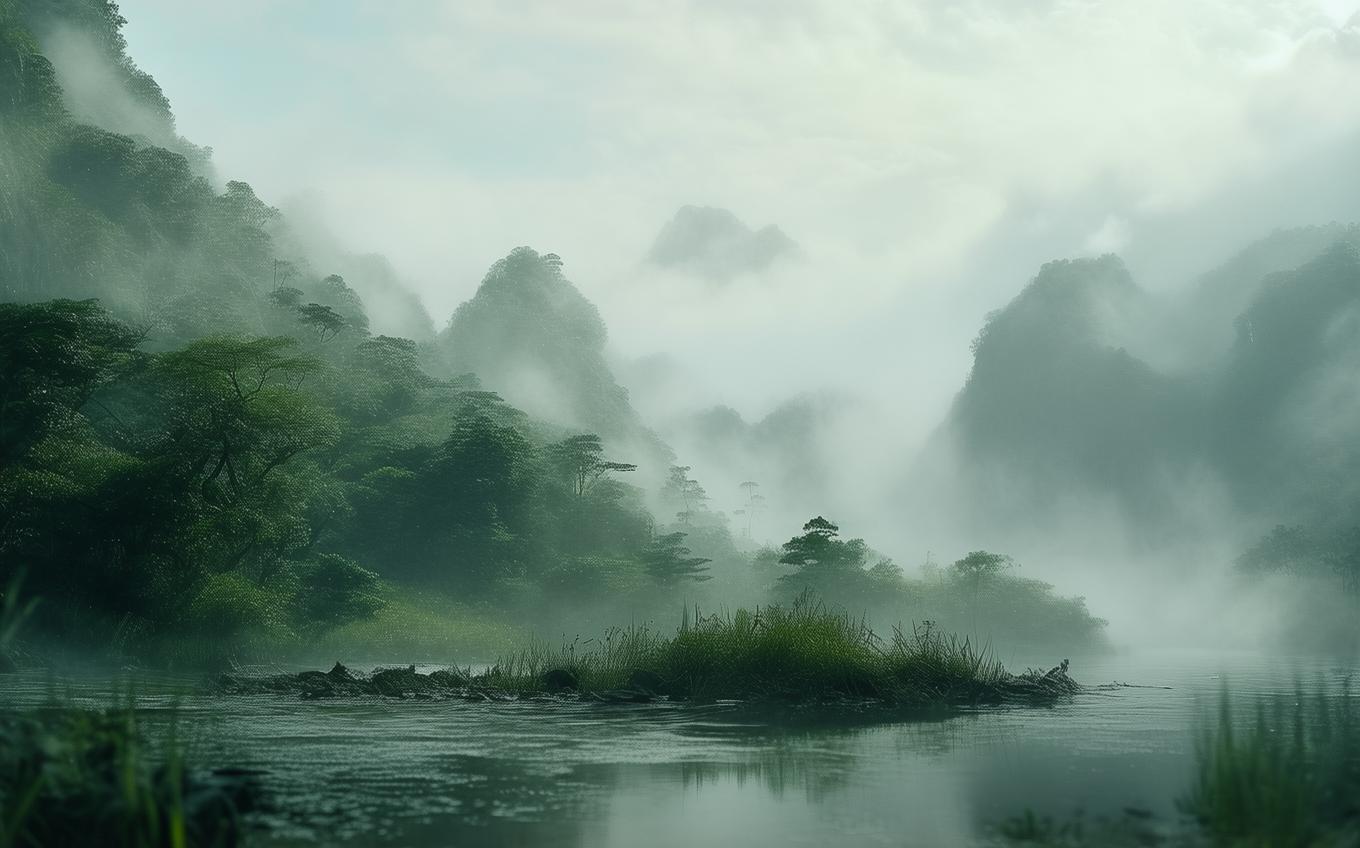
The poem "初年" (Chū Nián, "Early Year" or "The Beginning of the Year") is a short but exquisitely crafted quatrain that captures the liminal moment between winter and spring. In just twenty Chinese characters, Chen Shuda paints a vivid sensory portrait of seasonal transition — the first stirrings of warm wind, the lingering cold, the brittle branches not yet softened, and the slow, seemingly endless passage of time. The poem is a masterclass in economy and suggestion, embodying the classical Chinese aesthetic of yijing (意境, yìjìng) — the fusion of scene and emotion into a single, resonant atmosphere.
The Poem: Full Text and Translation
和风起天路,严气消冰井。
Hé fēng qǐ tiān lù, yán qì xiāo bīng jǐng.
A gentle wind rises on the path of heaven; the harsh air dissolves over the icy well.
索索枝未柔,厌厌漏犹永。
Suǒ suǒ zhī wèi róu, yàn yàn lòu yóu yǒng.
Rustling, the branches are not yet supple; languidly, the water-clock still drips on and on.
Line-by-Line Analysis
Line 1: 和风起天路 (Hé fēng qǐ tiān lù)
The poem opens with the character 和 (hé), meaning "gentle," "harmonious," or "mild." This is not the fierce wind of deep winter, nor the boisterous breeze of high spring — it is the first tentative breath of warmth, a wind that carries the promise of change. The phrase 天路 (tiān lù, "path of heaven" or "celestial road") is particularly evocative. In Chinese cosmology, the heavens were believed to be the source of weather and seasonal change. By describing the wind as rising from this celestial path, Chen Shuda elevates a simple meteorological observation into something almost sacred — the wind is not merely a local phenomenon but a messenger from the cosmic order.
The verb 起 (qǐ, "to rise") suggests movement and awakening. After the stillness of winter, something has begun to stir. The reader can almost feel the first soft current of air that signals the turning of the seasons.
Line 2: 严气消冰井 (Yán qì xiāo bīng jǐng)
Here we encounter the contrast that structures the entire poem. 严气 (yán qì) means "severe" or "harsh air" — the biting cold of winter. The verb 消 (xiāo) means "to dissolve," "to melt away," or "to dissipate." The harshness is not banished suddenly; it dissolves gradually, like ice turning to water.
The image of the 冰井 (bīng jǐng, "icy well" or "frozen well") is rich with cultural resonance. In ancient Chinese households, wells were central to daily life — sources of drinking water, washing water, and irrigation. A frozen well was a symbol of winter's grip on the most essential elements of human existence. The dissolution of ice around the well is therefore not just a natural observation but a deeply human one: the return of warmth to the very source of life.
Line 3: 索索枝未柔 (Suǒ suǒ zhī wèi róu)
The third line introduces sound and texture. 索索 (suǒ suǒ) is onomatopoeic, evoking the dry, rustling sound of bare branches rubbing against each other in the wind. This is not the lush whisper of leafy summer trees but the brittle, papery sound of winter-bare wood.
The phrase 未柔 (wèi róu, "not yet supple") is the crux of this line. The branches, though stirred by the gentle wind, have not yet regained their flexibility. The sap has not yet risen; the wood is still stiff with cold. This is the poem's most delicate observation — the recognition that the beginning of change is not the same as change itself. The wind may be warm, the ice may be melting, but the trees are not yet ready to believe in spring.
Line 4: 厌厌漏犹永 (Yàn yàn lòu yóu yǒng)
The final line shifts from the external world to the internal experience of time. 漏 (lòu) refers to the water clock (漏壶, lòuhú), an ancient Chinese timekeeping device that measured the passage of hours by the steady drip of water from one vessel to another. The water clock was a common image in classical Chinese poetry, often symbolizing the relentless, indifferent passage of time.
厌厌 (yàn yàn) is a reduplicative adjective meaning "languid," "listless," or "wearily prolonged." It describes both the sound of the water clock — each drip seeming to stretch out — and the emotional state of the speaker, who finds the passage of time almost unbearably slow. The final word 永 (yǒng, "long," "eternal") reinforces this sense of duration. The night — or the lingering winter — seems endless.
This line introduces a subtle human presence into the poem. Someone is listening to the water clock, lying awake, waiting. The first three lines describe the external world; this final line turns inward, revealing that the poem is not merely a nature observation but a meditation on waiting, on the subjective experience of time during a period of transition.
Themes and Symbolism
The Liminal Moment
The central theme of "初年" is the in-between — the threshold between winter and spring, between the old year and the new. The poem's title itself is ambiguous: 初年 can mean "early year," "the beginning of the year," or "youth" (one's early years). This ambiguity is deliberate, inviting readers to consider both the seasonal transition and the broader transitions of life.
What makes the poem remarkable is its honesty about this liminal state. The poet does not rush to celebrate the arrival of spring. Instead, he dwells in the uncertainty of the moment — the wind is warm but the branches are still stiff; the ice is melting but the nights are still long. This is not the triumphant arrival of spring but its hesitant, uncertain approach.
The Harmony of Opposites
The poem is built on a series of contrasts: warm wind versus harsh air, melting ice versus stiff branches, external change versus internal stasis. Yet these opposites are not presented as conflicts; they coexist in a delicate balance. This reflects the Chinese philosophical concept of yin and yang (阴阳, yīn yáng) — the idea that all phenomena contain their opposites and that change occurs through the gradual shifting of balance between complementary forces.
The Water Clock as Symbol
The water clock (漏, lòu) is a powerful symbol in Chinese poetry. It represents the objective, mechanical measurement of time — time that flows regardless of human feeling. By juxtaposing the water clock's steady drip with the speaker's perception of time as "languid" and "endless," Chen Shuda highlights the gap between objective time and subjective experience. This is a theme that resonates across cultures: time seems to move slowly when we are waiting, quickly when we are engaged, and the clock itself is indifferent to our experience.
Sound and Silence
The poem is remarkable for its auditory dimension. The onomatopoeic 索索 (suǒ suǒ) of the rustling branches and the implied drip of the water clock create a soundscape of quiet, subtle noises. These are not dramatic sounds but the barely perceptible stirrings of a world waking from winter. The overall effect is one of hushed anticipation — the silence before the fuller sounds of spring.
Cultural Context
The Tang Dynasty: A Golden Age of Poetry
Chen Shuda lived during the early Tang dynasty (618–907), a period often regarded as the golden age of Chinese poetry. The Tang dynasty was a time of relative political stability, economic prosperity, and cultural flowering. Poetry was not merely a private art form but a social institution — poems were exchanged at court gatherings, inscribed on walls, and used in diplomatic exchanges. The ability to compose poetry was considered essential for any educated person, and many of the greatest Tang poets were also government officials.
The Aesthetics of Restraint
"初年" exemplifies the classical Chinese aesthetic of hanxu (含蓄, hánxù) — "restraint" or "reserve." The poem does not state its emotions directly; it implies them through carefully chosen images. The speaker's feelings — of waiting, of impatience, of hope mixed with uncertainty — are never named. Instead, they are conveyed through the rustling branches, the dripping water clock, the slowly melting ice. This indirectness is a hallmark of classical Chinese poetry, which values suggestion over statement, implication over explanation.
Seasonal Poetry and the Chinese Calendar
Seasonal poetry occupies a central place in the Chinese literary tradition. The changing of seasons was not merely a natural phenomenon but a cosmic event, tied to the agricultural calendar, ritual observances, and philosophical reflection. The poem's title, 初年, connects it to the beginning of the lunar new year — a time of renewal, family gatherings, and hopes for the future. Yet Chen Shuda's treatment is notably subdued. Rather than celebrating the new year with festive imagery, he focuses on the quiet, uncertain moments before the full arrival of spring.
The Poet's Life and Perspective
Chen Shuda's biography adds another layer of meaning to the poem. Having witnessed the fall of his family's dynasty and the rise of two new ones, he was intimately familiar with transitions — with the uncertain periods between one era and the next. The poem's meditation on the threshold between winter and spring may reflect his own experience of living through historical change, of waiting to see what the new order would bring. The restraint of the poem — its refusal to celebrate prematurely — may reflect the caution of someone who has learned that change is not always straightforward and that the future is never guaranteed.
Conclusion
"初年" is a small poem with a large presence. In just twenty characters, Chen Shuda captures a moment of profound transition — the hesitant approach of spring, the slow dissolution of winter's grip, the subjective experience of time during a period of waiting. The poem's power lies in its restraint, its refusal to rush toward resolution, its willingness to dwell in the uncertainty of the in-between.
For modern readers, the poem offers a reminder that transitions are rarely clean or sudden. Change arrives gradually, unevenly — a warm wind here, a melting patch of ice there, while elsewhere the branches remain stiff and the nights remain long. The poem invites us to pay attention to these subtle signs, to listen for the quiet sounds of change, and to accept that waiting itself is a meaningful part of the process.
Chen Shuda's poem also reminds us of the enduring power of classical Chinese poetry to speak across centuries. Though written over a thousand years ago, its themes — the passage of time, the uncertainty of change, the relationship between the external world and internal experience — remain as relevant as ever. In its delicate balance of observation and emotion, sound and silence, movement and stillness, "初年" embodies the very essence of the Chinese poetic tradition: the art of saying much with very little.
This poem is a beautiful example of how classical Chinese poetry can capture profound emotional and philosophical truths through the simplest of natural images. For readers interested in exploring more Tang dynasty poetry, the works of Wang Wei (王维), Li Bai (李白), and Du Fu (杜甫) offer rich further reading.
Sources and Verification
- Verified text and attribution: 陈叔达, “初年” (Tang dynasty).
- Primary dataset: Chinese Poetry open corpus.
- Source record:
d30d32b3-3fcb-421a-b6fe-220633ce047d.
The Chinese source text and attribution are supplied from the verified record above. The English translation and commentary are educational explanations.
Comments (0)
No comments yet. Be the first to comment!