Introduction
Chen Shuda (陈叔达, Chén Shūdá) was a poet and statesman of the early Tang Dynasty (618–907 CE), a period often regarded as a golden age of Chinese poetry. Born into the Chen imperial family of the Southern Dynasties, Chen Shuda lived through the fall of the Sui Dynasty and served under the early Tang emperors. His unique position—a scion of a fallen royal house who found favor at a new court—infused his poetry with a subtle melancholy and a deep sensitivity to themes of displacement, beauty, and longing.
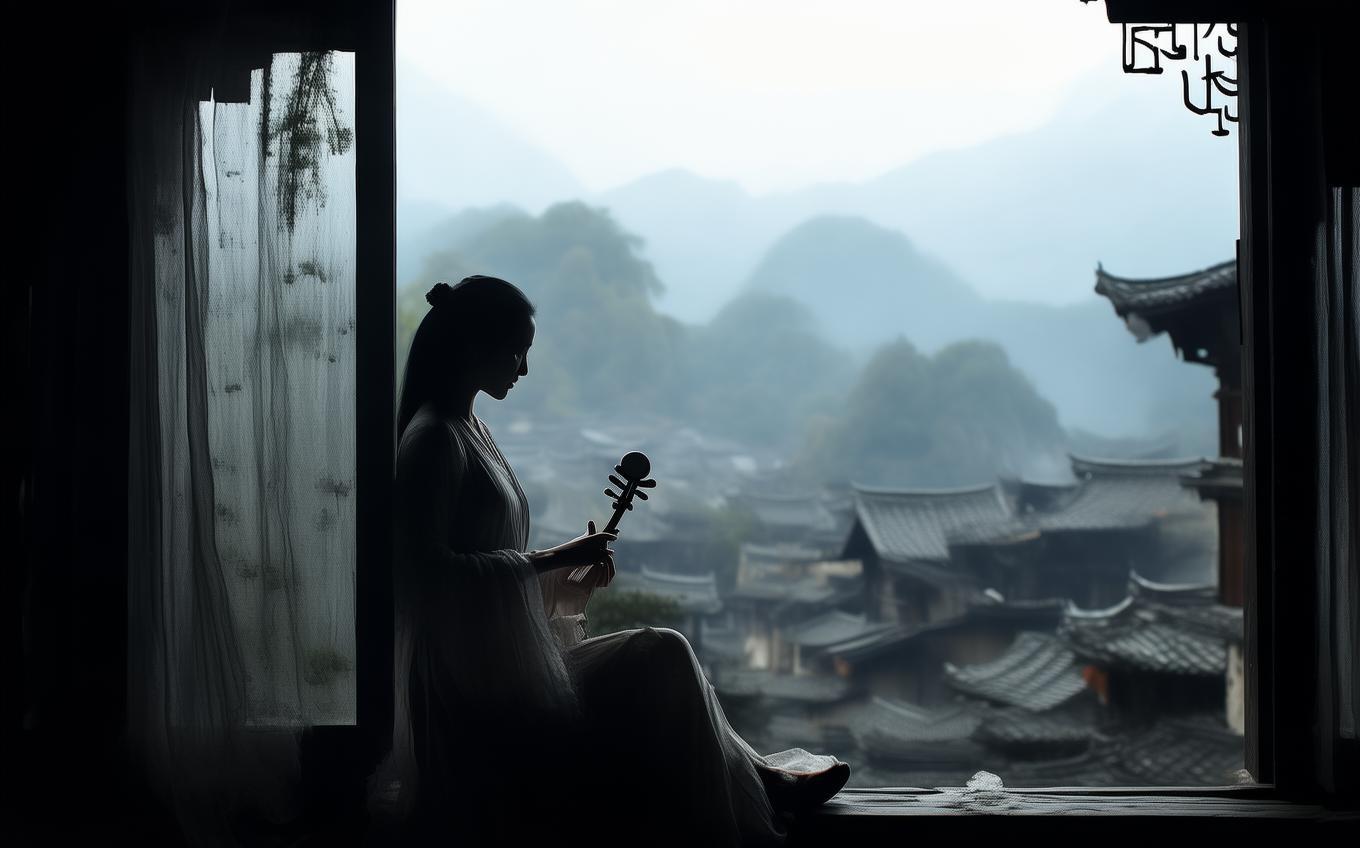
"听邻人琵琶" (Tīng Línrén Pípá, "Listening to a Neighbor Play the Pipa") is a short but richly layered poem that captures a moment of overheard music. In the Chinese literary tradition, the pipa (琵琶, a four-stringed lute) carries profound emotional weight: it is an instrument of both courtly refinement and frontier sorrow, capable of expressing the most delicate joy and the most wrenching homesickness. Chen Shuda's poem draws on this dual nature, weaving together imagery of imperial splendor, borderland exile, and the ephemeral beauty of music itself.
The Poem: Full Text and Translation
本是龙门桐,因妍入汉宫。
Běn shì Lóngmén tóng, yīn yán rù Hàn gōng.
Originally it was paulownia wood from Dragon Gate, / Because of its beauty it entered the Han palace.
香缘罗袖里,声逐朱弦中。
Xiāng yuán luó xiù lǐ, shēng zhú zhū xián zhōng.
Its fragrance follows from within silk sleeves, / Its sound pursues along the vermilion strings.
虽有相思韵,翻将入塞同。
Suī yǒu xiāngsī yùn, fān jiāng rù sài tóng.
Though it possesses the melody of mutual longing, / It turns instead to join the tune of entering the frontier.
关山临却月,花蘂散回风。
Guānshān lín què yuè, huāruǐ sàn huí fēng.
Mountain passes face the waning moon, / Flower stamens scatter in the whirling wind.
为将金谷引,添令曲未终。
Wèi jiāng Jīngǔ yǐn, tiān lìng qǔ wèi zhōng.
To serve as a prelude to the Golden Valley, / It extends so that the melody is not yet ended.
Line-by-Line Analysis
Lines 1–2: The Origin of the Instrument
本是龙门桐,因妍入汉宫。
The poem opens not with the sound of music, but with the origin of the instrument itself. The "paulownia wood from Dragon Gate" (龙门桐, Lóngmén tóng) is a reference to Mount Longmen, a place renowned in Chinese lore for producing the finest paulownia wood for making musical instruments—particularly the guqin (古琴), but by extension any fine stringed instrument. Paulownia wood is light, resonant, and prized for its acoustic properties. By invoking Dragon Gate, Chen Shuda immediately elevates the pipa from a mere object to something born of legendary material.
The phrase "因妍入汉宫" ("because of its beauty it entered the Han palace") adds another layer. The Han palace here is not necessarily a literal reference to the Han Dynasty (206 BCE–220 CE), but rather a poetic shorthand for the imperial court—the center of refinement, power, and culture. The wood's beauty (妍, yán) destined it for greatness. Yet there is a subtle poignancy here: the tree was uprooted from its natural mountain home to serve in a palace. This quiet tension between nature and artifice, between origin and destination, will echo throughout the poem.
Lines 3–4: The Sensory Experience
香缘罗袖里,声逐朱弦中。
The second couplet shifts to the immediate sensory experience of the performance. Chen Shuda pairs two senses: smell and sound. The "fragrance" (香, xiāng) emanates from "silk sleeves" (罗袖, luó xiù)—the flowing sleeves of the performer, likely a woman of the court or a skilled entertainer. In Chinese poetry, the fragrance of a woman's sleeves is a recurring motif suggesting intimacy, elegance, and the ephemeral nature of beauty. The scent seems to be carried along by the music itself, as if the performance were a fusion of all sensory pleasures.
The second line of the couplet, "声逐朱弦中" ("sound pursues along the vermilion strings"), focuses on the auditory dimension. The word 逐 (zhú, "to pursue" or "to chase") is particularly evocative—it suggests that the sound is not merely produced by the strings but actively follows them, as if the music has a life of its own, racing along the red silk strings. The color "vermilion" (朱, zhū) adds visual richness to the scene, completing a triad of sensory impressions: the red of the strings, the fragrance of the sleeves, the resonance of the notes.
Lines 5–6: The Emotional Turn
虽有相思韵,翻将入塞同。
Here the poem takes a decisive emotional turn. The phrase "相思韵" (xiāngsī yùn) refers to a melody of "mutual longing" or "lovesickness"—a theme deeply embedded in Chinese musical and poetic tradition. Songs of xiangsi typically express the ache of separated lovers, the yearning for a distant beloved, or the melancholy of unfulfilled desire. The reader (or listener) expects the music to dwell in this tender, intimate register.
But Chen Shuda subverts this expectation with the word 翻 (fān, "to turn over," "to reverse," or "instead"). The music, though it has the capacity for love songs, "turns instead to join the tune of entering the frontier" (入塞, rù sài). "Entering the frontier" evokes a completely different emotional landscape: the borderlands of the Chinese empire, where soldiers were stationed far from home, facing harsh conditions, nomadic incursions, and the constant threat of death. The tune "Ru Sai" (入塞) was, in fact, a known musical title in the Han and Tang periods, associated with the melancholy of soldiers marching to the frontier. The poem thus pivots from private, romantic longing to public, martial sorrow—from the boudoir to the battlefield.
Lines 7–8: Landscape of Desolation
关山临却月,花蘂散回风。
This couplet paints a vivid picture of the frontier landscape evoked by the music. "关山" (guānshān, "mountain passes") is a loaded term in Chinese poetry, appearing in countless poems about separation, exile, and military service. Mountain passes were the gateways to the dangerous borderlands, the last points of familiar territory before entering the unknown. The image of these passes "facing the waning moon" (却月, què yuè) is haunting: the moon is not full and bright but fading, its light insufficient to illuminate the dark mountains. The waning moon is a traditional symbol of decline, loneliness, and the passage of time.
The second image, "花蘂散回风" ("flower stamens scatter in the whirling wind"), introduces a note of fragility and destruction. Flower stamens (花蘂, huāruǐ) are the most delicate part of a blossom, the very essence of its reproductive life. That they are scattered by a "whirling wind" (回风, huí fēng) suggests a violent disruption of natural beauty. In the context of the frontier, this image may evoke the scattering of lives, the destruction of families, or the fragility of human existence in the face of vast, impersonal forces. The juxtaposition of the immovable mountains and the ephemeral flowers creates a powerful tension between permanence and transience.
Lines 9–10: The Unfinished Melody
为将金谷引,添令曲未终。
The final couplet introduces a new reference: "金谷" (Jīngǔ, "Golden Valley"). This is an allusion to the Golden Valley Garden (金谷园, Jīngǔ Yuán), the lavish estate of the Western Jin Dynasty (265–316 CE) aristocrat Shi Chong (石崇). Shi Chong was famous for his extravagant lifestyle, his vast wealth, and his patronage of the arts. The Golden Valley Garden became a byword for refined pleasure, artistic gatherings, and the height of aristocratic culture. However, Shi Chong's story ended in tragedy—he was executed, and his beloved concubine Lüzhu (绿珠) famously threw herself from a tower to her death rather than be taken by his enemies. The Golden Valley thus carries an undercurrent of doomed beauty.
The phrase "金谷引" (Jīngǔ yǐn) can be understood as "a prelude to the Golden Valley" or "the Golden Valley melody." The word 引 (yǐn) in musical terminology refers to a prelude or introductory piece. Chen Shuda seems to be saying that the music, having traversed the emotional landscape of the frontier, now serves as a prelude to something even grander—the world of the Golden Valley, with all its beauty and its implicit tragedy.
The final line, "添令曲未终" ("it extends so that the melody is not yet ended"), is deeply resonant. The music does not conclude; it lingers, extended by the performer's art. This open-endedness mirrors the poem's own structure: Chen Shuda offers no resolution, no final emotional verdict. The music continues, suspended between the frontier and the garden, between sorrow and beauty, between ending and continuation. In this suspension, the poem captures something essential about the experience of listening to music—the way it resists closure, the way it lingers in the mind long after the final note has faded.
Themes and Symbolism
The Duality of the Pipa
The pipa in this poem is not merely an instrument; it is a symbol of transformation and duality. It begins as a tree on a mythical mountain, becomes an object of imperial beauty, produces sounds of both love and war, and finally evokes both the desolation of the frontier and the doomed splendor of the Golden Valley. The pipa is a liminal object, bridging nature and culture, private emotion and public duty, life and death.
Music as Emotional Alchemy
Chen Shuda portrays music as a force capable of transforming one emotional register into another. The melody that "has the tune of mutual longing" turns "instead to join the tune of entering the frontier." Music is not a fixed expression of a single emotion but a fluid medium through which multiple, even contradictory, feelings can flow. This understanding of music aligns with the Chinese philosophical tradition, which often emphasizes the transformative power of art to move the human heart (感人心, gǎn rén xīn).
The Frontier as Existential Condition
The frontier (塞, sài) in Chinese poetry is more than a geographical location; it is an existential condition of separation, danger, and longing. The soldiers who "enter the frontier" leave behind everything familiar—home, family, love—to face an uncertain fate. By having the music turn toward the frontier, Chen Shuda universalizes the experience of loss: the listener, too, is transported to a place of desolation, even while sitting in the comfort of home.
The Golden Valley and Doomed Beauty
The allusion to the Golden Valley Garden adds a layer of tragic irony. Shi Chong's garden was a place of unparalleled beauty and refinement, yet it was built on the foundation of political intrigue and ended in bloodshed. The "prelude to the Golden Valley" suggests that beauty and tragedy are inextricably linked—that the most exquisite moments are often the most fleeting, and that the pursuit of pleasure is shadowed by the knowledge of its inevitable end.
The Waning Moon and Scattered Flowers
These two images—the waning moon and the scattered flower stamens—function as symbols of impermanence. The moon, in Chinese poetry, is a constant presence, yet its phases remind us that nothing remains the same. The waning moon specifically suggests decline and the approach of darkness. The scattered flowers, meanwhile, evoke the fragility of life and the violence of change. Together, they create a landscape of loss that the music both evokes and, paradoxically, makes beautiful.
Cultural Context
The Pipa in Tang Dynasty Culture
The Tang Dynasty was a period of extraordinary cultural exchange, and the pipa was one of the great beneficiaries of this cosmopolitanism. Originally derived from Central Asian instruments brought to China along the Silk Road, the pipa had become by the Tang period an instrument of both courtly refinement and popular entertainment. It was played by both men and women, by professional musicians and aristocratic amateurs, and its repertoire ranged from delicate love songs to stirring martial airs. The pipa's foreign origins gave it an exotic allure, while its integration into Chinese musical culture made it a vehicle for expressing distinctly Chinese emotions.
The "Ru Sai" Musical Tradition
The reference to "entering the frontier" (入塞, rù sài) is not merely a poetic image but a reference to an actual musical tradition. The "Ru Sai" melody was part of a larger category of frontier music (塞上曲, sàishàng qǔ) that emerged during the Han Dynasty and remained popular through the Tang. These melodies were associated with the experiences of soldiers stationed on the northern and western frontiers, and they carried connotations of homesickness, bravery, and the harshness of military life. By invoking this tradition, Chen Shuda taps into a deep well of collective emotion that his contemporary readers would have immediately recognized.
The Golden Valley Garden as Literary Allusion
The Golden Valley Garden (金谷园, Jīngǔ Yuán) was one of the most famous private gardens in Chinese history, and its name became a literary shorthand for aristocratic luxury and its tragic consequences. Shi Chong, its owner, was a man of immense wealth and refined taste, but his extravagance made him enemies, and he was eventually executed on charges of treason. His concubine Lüzhu's suicide—throwing herself from a tower to avoid being taken by Shi Chong's enemies—became one of the most famous stories of loyalty and tragic love in Chinese literature. By alluding to the Golden Valley, Chen Shuda invokes this entire complex of associations: beauty, wealth, refinement, loyalty, and doom.
Early Tang Poetry and the Aesthetics of Restraint
Chen Shuda's poem exemplifies the aesthetic values of early Tang poetry, which prized economy of expression, subtle emotional modulation, and the skillful use of allusion. Unlike the later High Tang poets, who often favored grand, sweeping gestures, early Tang poets like Chen Shuda tended toward a more restrained, courtly style. Every word in "听邻人琵琶" carries weight; there is no wasted motion. The poem's power lies in what it leaves unsaid—the unspoken sorrow behind the beautiful music, the unstated tragedy behind the Golden Valley allusion, the unresolved tension of the unfinished melody.
Conclusion
"听邻人琵琶" is a masterful example of how a short poem can contain multitudes. In just ten lines, Chen Shuda takes the reader on a journey from a mythical mountain to an imperial palace, from the intimate fragrance of silk sleeves to the desolate mountain passes of the frontier, from the refined pleasures of the Golden Valley to the haunting suspension of an unfinished melody. The poem is about listening to music, but it is also about the nature of beauty, the inevitability of loss, and the power of art to hold contradictory emotions in a single, resonant moment.
What makes this poem enduringly appealing is its refusal to offer easy resolutions. The music does not end; the emotions do not resolve; the beauty does not triumph over tragedy, nor does tragedy overwhelm beauty. Instead, Chen Shuda captures the experience of being moved by art—the way a melody can transport us to places we have never been, evoke feelings we did not know we had, and leave us suspended between joy and sorrow, past and present, self and other.
For modern readers, the poem offers a reminder of the universality of music and the emotions it evokes. Though written over a thousand years ago, its depiction of the transformative power of art remains as relevant as ever. The pipa may have changed over the centuries, but the human capacity to be moved by beauty—and to find in that beauty a reflection of our own deepest longings—has not.
The music continues, the melody unfinished, and we are left listening, still.
Sources and Verification
- Verified text and attribution: 陈叔达, “听邻人琵琶” (Tang dynasty).
- Primary dataset: Chinese Poetry open corpus.
- Source record:
da6fb81c-3737-4c6a-9762-b278d6148a14.
The Chinese source text and attribution are supplied from the verified record above. The English translation and commentary are educational explanations.
Comments (0)
No comments yet. Be the first to comment!