Introduction
陈叔达 (Chén Shūdá, c. 572–635) was a poet and statesman of the early Tang Dynasty, a period often celebrated as a golden age of Chinese poetry. Born into the Chen imperial family of the Southern Dynasties, he witnessed the fall of his family's kingdom and eventually served the Sui and then the Tang court. His life bridged a turbulent era of political transition, and his poetry often reflects the refined aesthetic sensibilities of the southern court tradition while embracing the fresh, expansive spirit of the newly unified Tang Empire.
"春首" (Chūn Shǒu), meaning "The Beginning of Spring" or "Early Spring," is a short landscape poem (绝句, juéjù) that captures the delicate moment when winter yields to spring. Though brief—just four lines of five characters each—the poem is a masterclass in visual imagery and sensory suggestion. It exemplifies the classical Chinese poetic ideal of "寓情于景" (yù qíng yú jǐng), or "entrusting emotion to scenery," where the poet's inner feelings are conveyed entirely through the external landscape without direct statement. In the broader canon of Chinese literature, this poem represents the early Tang refinement of nature poetry, bridging the ornate palace style of the Six Dynasties and the more expansive naturalism of High Tang masters like Wang Wei and Li Bai.
The Poem: Full Text and Translation
雪花联玉树,冰彩散瑶池。
xuě huā lián yù shù, bīng cǎi sàn yáo chí.
Snowflakes cling to the jade-like trees; icy radiance scatters across the jeweled pond.
翔禽遥出没,积翠远参差。
xiáng qín yáo chū mò, jī cuì yuǎn cēn cī.
Soaring birds appear and vanish in the distance; accumulated greenery stretches far in uneven layers.
Line-by-Line Analysis
Line 1: 雪花联玉树 (xuě huā lián yù shù)
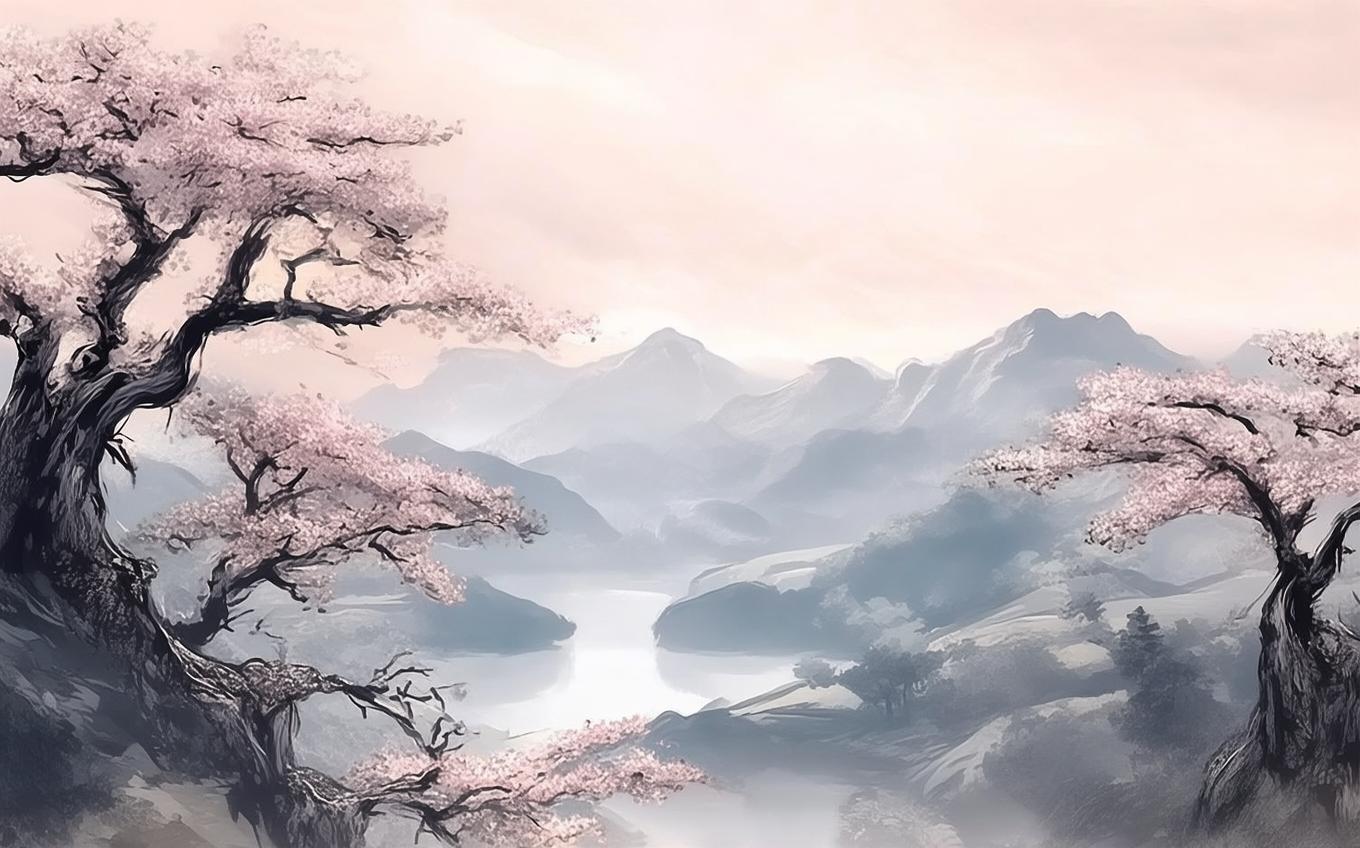
The poem opens with a striking visual: snowflakes (雪花, xuě huā) gently attaching themselves to trees that are already described as "jade" (玉树, yù shù). The character 联 (lián) means "to join," "to connect," or "to cling to," suggesting an intimate, almost affectionate union between the falling snow and the waiting branches. The image of "jade trees" is doubly meaningful: it can refer to trees coated in ice and frost that gleam like precious stone, but it also carries rich cultural connotations. In Chinese tradition, jade (玉, yù) symbolizes purity, nobility, and permanence. By calling the snow-covered trees "jade trees," the poet elevates a common winter scene into something almost mythical—reminiscent of the legendary 玉树 (yù shù) said to grow in the celestial realms of Daoist immortals.
Line 2: 冰彩散瑶池 (bīng cǎi sàn yáo chí)
The second line shifts focus from the trees to the water. 冰彩 (bīng cǎi) refers to the "icy colors" or "glittering radiance of ice"—the shimmering, prismatic quality of frozen water catching the light. The verb 散 (sàn) means "to scatter" or "to disperse," evoking a sense of light breaking apart and spreading across the surface. The pond is called 瑶池 (yáo chí), literally "the Jade Pond" or "Jasper Lake," which in Chinese mythology is the dwelling place of 西王母 (Xī Wáng Mǔ), the Queen Mother of the West, a powerful Daoist deity. By using this mythological name for what is presumably an ordinary garden pond, the poet transforms the scene into a heavenly realm. The word 瑶 (yáo) itself denotes a precious gem, reinforcing the sense of otherworldly beauty.
Line 3: 翔禽遥出没 (xiáng qín yáo chū mò)
The third line introduces movement and life into the frozen landscape. 翔禽 (xiáng qín) means "soaring birds"—birds in flight, their wings spread as they glide through the air. The adverb 遥 (yáo), "distantly" or "far away," places these birds at a significant remove from the viewer. The compound 出没 (chū mò) is particularly evocative: it means "to appear and disappear," composed of 出 (chū, "to go out" or "to emerge") and 没 (mò, "to sink" or "to vanish"). This creates a rhythm of visibility and invisibility, as the birds dip and rise against the pale winter sky, sometimes visible, sometimes lost in clouds or mist. The image suggests both the freedom of flight and the vastness of the space the birds inhabit.
Line 4: 积翠远参差 (jī cuì yuǎn cēn cī)
The final line returns to stillness but now focuses on color and texture. 积翠 (jī cuì) literally means "accumulated green" or "piled-up verdure," referring to the layered foliage of evergreen trees—pines, cypresses, and other plants that retain their color through winter. The word 积 (jī) implies a buildup over time, suggesting density and richness. 远 (yuǎn) again emphasizes distance, extending the scene to the horizon. 参差 (cēn cī) is a delightful onomatopoeic compound meaning "uneven," "irregular," or "ragged"—it describes the jagged, varying heights of distant trees and mountains against the sky. The word itself, with its repeated initial consonant sounds, mimics the visual rhythm of a jagged skyline. This closing image grounds the poem in the tangible world while simultaneously opening it outward to vast distances.
Themes and Symbolism
The Interplay of Winter and Spring
The poem's title, "春首" (Chūn Shǒu), explicitly frames the scene as the very beginning of spring. Yet the imagery is predominantly wintry—snow, ice, frozen ponds. This tension is deliberate and meaningful. The snow that clings to the trees is the last snow of the season, not the first; the "accumulated green" of the evergreens hints at the persistence of life beneath the frost. The poet captures that liminal moment when winter has not fully released its grip but spring's promise is already stirring. This threshold state—neither fully one season nor the other—mirrors the human experience of transition, hope, and anticipation.
The Heavenly and the Earthly
Throughout the poem, Chen Shuda employs celestial imagery: jade trees, the Jasper Pond of the Queen Mother of the West, soaring birds that vanish into the distance. These references elevate a simple landscape into a vision of paradise. In Daoist thought, the 瑶池 (yáo chí) represents a realm of immortality and eternal spring, far removed from the mortal world's decay. By overlaying this mythological geography onto a real scene, the poet suggests that paradise is not elsewhere but can be glimpsed here and now, in the right moment, through the right eyes.
Distance and Vastness
The repeated use of 遥 (yáo) and 远 (yuǎn)—both meaning "distant"—creates a sense of expansive space. The birds are far away; the green mountains recede to the horizon. This vastness is characteristic of Tang Dynasty poetry, which often expresses a cosmic consciousness, a sense of the individual's smallness within the grand sweep of nature. The poet does not lament this smallness but seems to revel in it, finding beauty in the very boundlessness that dwarfs him.
Symbolism of Key Images
- Jade (玉/瑶): Purity, nobility, immortality, and artistic perfection. The double appearance of jade imagery (玉树 and 瑶池) creates a frame of preciousness around the entire scene.
- Snow and Ice: Transience and beauty, but also clarity and coldness. Snow that clings to branches suggests the fragile, temporary nature of beauty.
- Soaring Birds: Freedom, transcendence, the movement of the spirit. Their appearing and disappearing mirrors the elusive nature of enlightenment or inspiration.
- Accumulated Green: Endurance, resilience, the persistence of life. The evergreens stand as quiet witnesses to the changing seasons, unchanging in their essential nature.
Cultural Context
The early Tang Dynasty (early 7th century) was a period of consolidation and cultural flowering. The empire had recently been reunified after nearly four centuries of division between northern and southern dynasties. This reunification brought together the literary traditions of both regions: the refined, ornate style of the southern courts and the more vigorous, rugged sensibility of the north. Chen Shuda, as a scion of the southern Chen royal family serving the Tang court, embodied this synthesis in both his life and his poetry.
The poem reflects several key Chinese cultural and philosophical values:
Harmony with Nature: The poem does not impose human emotion onto the landscape; rather, it allows the landscape to speak for itself. This reflects the Daoist principle of 无为 (wú wéi), "non-action" or "effortless action"—the idea that one should align with the natural flow of things rather than struggle against it.
The Aesthetics of Emptiness: Classical Chinese landscape painting and poetry both value 留白 (liú bái), "leaving blank space." The vast distances in the poem—the far-off birds, the remote green mountains—function like the empty spaces in a painting, inviting the reader's imagination to complete the picture.
The Microcosm-Macrocosm Relationship: A single pond becomes the Jasper Lake of the immortals; ordinary trees become jade. This transformation reflects the Chinese philosophical view that the entire cosmos is reflected in every small thing, that the transcendent is immanent in the mundane.
Seasonal Awareness: In Chinese culture, the observation of seasonal changes (物候, wù hòu) is not merely aesthetic but philosophical. The seasons embody the cyclical nature of existence, the eternal return that characterizes both the natural world and human life. To notice the first stirrings of spring is to participate in this cosmic rhythm.
Conclusion
"春首" by 陈叔达 is a small gem of early Tang poetry—compact in form but expansive in implication. In just twenty Chinese characters, the poet constructs a complete world: snow-kissed trees gleaming like jade, a frozen pond shimmering with icy light, distant birds wheeling through vast skies, and green mountains layered to the horizon. Each image is crisp and clear, yet together they create a dreamlike atmosphere that hovers between the real and the ideal.
The poem's enduring appeal lies in its perfect balance of precision and mystery. We can see every detail clearly, yet the overall effect is one of profound stillness and wonder. For modern readers, especially those far removed from the landscapes of ancient China, the poem offers an invitation: to slow down, to look closely, and to find the heavenly within the everyday. As we face our own transitions—our own thresholds between seasons of life—Chen Shuda's vision of early spring reminds us that beauty resides precisely in moments of change, in the delicate interval between what was and what will be.
More than thirteen centuries after it was written, this brief poem still has the power to transport us to that distant pond, to stand beside the poet in silence, watching snow cling to jade trees and birds vanish into the vast, green distance.
Sources and Verification
- Verified text and attribution: 陈叔达, “春首” (Tang dynasty).
- Primary dataset: Chinese Poetry open corpus.
- Source record:
883d2200-4f5e-4961-9844-e33ec60c592c.
The Chinese source text and attribution are supplied from the verified record above. The English translation and commentary are educational explanations.
Comments (0)
No comments yet. Be the first to comment!