Introduction
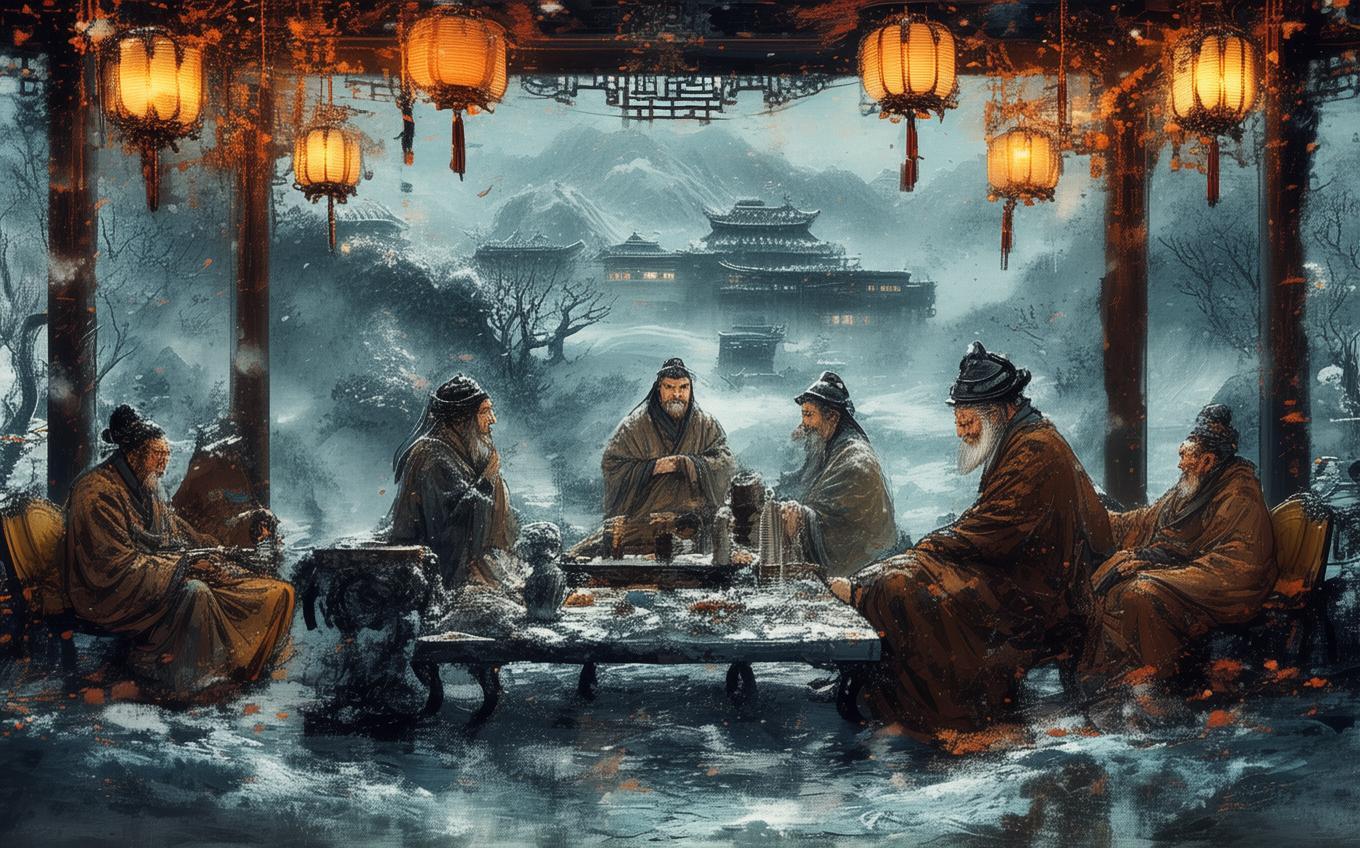
于志宁 (Yu Zhining, 588–665 CE) was a prominent statesman and literary figure of the early Tang Dynasty. Serving under Emperor Taizong and later Emperor Gaozong, Yu Zhining was renowned not only for his political acumen but also for his refined literary talent. He was part of the vibrant cultural milieu that characterized the early Tang court—a period often celebrated as a golden age of Chinese poetry, when literary gatherings, poetic competitions, and elegant banquets were central to courtly life.
The poem presented here, 冬日宴群公于宅各赋一字得杯 ("A Winter Banquet at My Residence for Various Lords, Each Composing on an Assigned Character, I Received 'Cup'"), belongs to a distinctive genre of Chinese poetry known as "assigned-character poetry" (赋得诗). In such gatherings, each guest would draw or be assigned a single Chinese character, and they would compose a poem incorporating that character as a thematic or rhyming element. Yu Zhining drew the character 杯 (bēi, "cup" or "goblet"), which perfectly suited the convivial occasion. This poem is significant not only for its elegant craftsmanship but also for the window it opens onto the sophisticated social and literary practices of Tang aristocratic culture—a world where poetry was not merely an art form but a living social currency.
The Poem: Full Text and Translation
陋巷朱轩拥,衡门缇骑来。
Lòu xiàng zhū xuān yōng, héng mén tí qí lái.
In this humble lane, vermilion carriages now crowd; at my simple gate, crimson-clad riders arrive.
俱裁七步咏,同倾三雅杯。
Jù cái qī bù yǒng, tóng qīng sān yǎ bēi.
All compose verses with the speed of the Seven Steps; together we tilt the Three Elegant Cups.
色动迎春柳,花发犯寒梅。
Sè dòng yíng chūn liǔ, huā fā fàn hán méi.
Colors stir in the willows that welcome spring; blossoms burst forth on plum trees that brave the cold.
宾筵未半醉,骊歌不用催。
Bīn yán wèi bàn zuì, lí gē bù yòng cuī.
Before the banquet's guests are even half drunk, the farewell song needs no urging to begin.
Line-by-Line Analysis
Line 1: 陋巷朱轩拥,衡门缇骑来
The poem opens with a striking juxtaposition. 陋巷 (lòu xiàng, "humble lane") and 衡门 (héng mén, "simple gate" or "crossbar gate") evoke modesty and simplicity—images drawn from classical texts describing the dwellings of virtuous scholars who live in honorable poverty. Yet these humble spaces are suddenly filled with 朱轩 (zhū xuān, "vermilion carriages") and 缇骑 (tí qí, "crimson-clad riders," originally referring to the imperial guard). The color red (朱 and 缇) was associated with nobility and high office in ancient China, as sumptuary laws restricted the use of certain colors and materials to the upper classes.
This opening couplet serves a dual purpose. First, it is a gesture of self-deprecation—a conventional modesty topos in Chinese poetry where the host humbles his own dwelling while elevating his guests. Second, it celebrates the arrival of distinguished visitors, transforming the "humble lane" into a place of honor. The contrast between humble and exalted creates a dynamic tension that sets the stage for the festive gathering.
Line 2: 俱裁七步咏,同倾三雅杯
This couplet is rich with literary and cultural allusions. The phrase 七步咏 (qī bù yǒng, "Seven Steps verse") refers to the famous story of 曹植 (Cao Zhi, 192–232 CE), the gifted poet-prince of the Three Kingdoms period. According to legend, Cao Zhi's jealous elder brother, Emperor Cao Pi, demanded that he compose a poem within seven paces or face execution. Cao Zhi produced the celebrated "Quatrain of Seven Steps" (七步诗), comparing the brothers to beanstalks and beans—the stalk burning to cook the beans, a metaphor for fratricidal cruelty. By invoking this allusion, Yu Zhining praises his guests' poetic abilities, suggesting they can compose verses with Cao Zhi's legendary speed and brilliance.
The second half of the couplet, 三雅杯 (sān yǎ bēi, "Three Elegant Cups"), refers to a tradition attributed to 刘表 (Liu Biao), a warlord of the late Han Dynasty, who reportedly had three types of wine vessels of different sizes: the 伯雅 (Boya), 仲雅 (Zhongya), and 季雅 (Jiya), corresponding to large, medium, and small cups respectively. The "Three Elegant Cups" thus represent refined drinking culture—a graduated system that allowed guests to drink according to their capacity while maintaining decorum. The verb 倾 (qīng, "to tilt" or "to drain") suggests wholehearted enjoyment, as the guests empty their cups together in a spirit of camaraderie.
Line 3: 色动迎春柳,花发犯寒梅
Here the poet shifts from the indoor scene to the natural world outside, creating a seasonal frame for the gathering. The 迎春柳 (yíng chūn liǔ, "willows that welcome spring") are beginning to show color—the tender green shoots that herald the changing season. The willow is one of the most beloved trees in Chinese poetry, associated with spring, renewal, and also with parting (since 柳 liǔ is a homophone of 留 liú, "to stay").
The second image, 犯寒梅 (fàn hán méi, "plum blossoms that brave the cold"), introduces the plum blossom—perhaps the most symbolically charged flower in Chinese culture. The verb 犯 (fàn) means "to defy" or "to brave," emphasizing the plum's courage in blooming while winter still holds sway. The plum blossom (梅花 méihuā) represents resilience, purity, and moral integrity in adversity—it blooms in the harshest cold, before all other flowers, announcing the coming of spring. By pairing the willow and the plum, the poet captures a liminal moment: winter is not yet gone, but spring is already stirring. This natural imagery mirrors the human gathering—warmth and vitality flourishing despite the cold season.
Line 4: 宾筵未半醉,骊歌不用催
The final couplet introduces a note of poignancy. 骊歌 (lí gē, "farewell song") refers to a song of parting. The term originates from the 骊驹 (lí jū, "black colt"), a farewell song mentioned in the Book of Han. In traditional Chinese banquets, the singing of the farewell song signaled the end of the gathering. The poet observes that the guests are not yet half drunk—the banquet is still in full swing—yet the farewell song already "needs no urging" (不用催). This paradoxical statement suggests that the awareness of impending departure hovers over the festivities, lending the joy a bittersweet quality.
This line can be read in two ways. On one hand, it may simply mean that the guests, knowing the song will come, are prepared for it—there is no need to rush or force the conclusion. On the other hand, it may express a deeper philosophical acceptance: all gatherings must end, all joys are fleeting, and the wise person embraces this truth without resistance. The phrase 不用催 ("needs no urging") carries a sense of inevitability met with equanimity.
Themes and Symbolism
The Joy of Literary Fellowship
The poem's central theme is the celebration of intellectual and artistic community. The gathering described is not merely a drinking party but a literary salon where poetry composition is the primary entertainment. The allusion to Cao Zhi's Seven Steps elevates this activity to a near-mythical level, suggesting that the guests possess extraordinary talent. In Tang Dynasty China, such gatherings were not frivolous diversions but essential venues for cultural production, political networking, and the cultivation of refined taste.
The Aesthetics of Modesty
The opening line's contrast between the humble dwelling and the distinguished guests reflects a deeply ingrained Chinese cultural value: the virtue of humility. By describing his home as a "humble lane" and "simple gate," the host performs a gesture of self-effacement that paradoxically enhances his own virtue. This modesty topos appears throughout Chinese literature, from the Analects of Confucius (who praised the scholar who "eats coarse food, drinks water, and uses his bent arm as a pillow") to the works of countless poets who described their dwellings in self-deprecating terms.
Nature as Moral Metaphor
The third line's imagery of willows and plum blossoms is not merely decorative. In Chinese poetics, natural imagery nearly always carries symbolic weight. The plum blossom, in particular, is one of the "Three Friends of Winter" (岁寒三友: pine, bamboo, and plum), representing endurance and moral fortitude. By invoking the plum that "braves the cold," the poet may be subtly complimenting his guests—suggesting that they, like the plum, possess the strength to flourish in adversity. The willow's association with both spring and parting also foreshadows the farewell theme of the final couplet.
The Transience of Joy
The poem's conclusion introduces a gentle melancholy that tempers the festive mood. The awareness that the farewell song will come—indeed, that it "needs no urging"—acknowledges the impermanence of all human gatherings. This theme resonates deeply with Chinese philosophical traditions, particularly Daoism and Buddhism, which emphasize the transient nature of all phenomena. Yet the poem does not lament this transience; instead, it accepts it with grace, finding beauty in the very fleetingness of the moment.
The Symbolism of the Cup
As the assigned character for this poem, 杯 (bēi, "cup") serves as the poem's conceptual anchor. The cup symbolizes conviviality, shared experience, and the pleasures of the table. But it also carries deeper resonances: the cup is a vessel that is filled and emptied, mirroring the cycle of gathering and parting, fullness and emptiness that defines human existence. The "Three Elegant Cups" suggest a graduated approach to pleasure—enjoyment tempered by refinement and restraint.
Cultural Context
The Tang Dynasty Literary Salon
The early Tang Dynasty (618–907 CE) was a period of extraordinary cultural flourishing. The reunification of China under the Tang after centuries of division created conditions for a renaissance in the arts, particularly poetry. The imperial court actively patronized literature, and poetry composition became an essential skill for any aspiring official. The civil service examination system, which tested candidates on their literary abilities, further elevated the status of poetry in society.
Within this context, the literary salon (文会 or 诗会) emerged as a central institution of cultural life. Nobles and high officials would host gatherings where guests composed poetry on assigned themes, competed in literary games, and displayed their erudition through allusions and wordplay. The "assigned character" format (赋得) was a popular variation, testing a poet's ability to incorporate a specific character into a coherent and elegant composition. These gatherings served multiple functions: they were venues for artistic expression, opportunities for social networking, and displays of cultural capital that reinforced the host's status and the guests' prestige.
The Virtue of Humility in Chinese Culture
The poem's opening self-deprecation reflects a fundamental Chinese cultural value: the importance of humility (谦逊). In Confucian ethics, the superior person (君子 jūnzǐ) is characterized by modesty and self-effacement. This value is expressed in countless ways in Chinese social life—from the custom of hosts describing their homes as "humble abodes" (寒舍) to the practice of downplaying one's own achievements while praising others'. Yu Zhining's description of his residence as a "humble lane" is thus not a literal description but a ritualized performance of virtue that paradoxically enhances his standing.
The Symbolism of the Plum Blossom
The plum blossom holds a unique place in Chinese culture. As one of the first flowers to bloom—often while snow still covers the ground—it symbolizes resilience, hope, and the triumph of life over adversity. The plum's ability to "brave the cold" (犯寒) made it a natural metaphor for the virtuous person who maintains integrity in difficult times. This symbolism was particularly resonant during the Tang Dynasty, when the plum became a favorite subject for poets and painters. The great Tang poet 王维 (Wang Wei) and the Song Dynasty recluse 林逋 (Lin Bu) would later immortalize the plum in their works, but Yu Zhining's usage here shows that the flower's symbolic power was already well established by the early Tang.
The Farewell Song Tradition
The 骊歌 (lí gē, "farewell song") has deep roots in Chinese tradition. The term originates from the Book of Han, which records a song called "骊驹" ("Black Colt") that was sung at the end of banquets. Over time, 骊歌 became a general term for any song of parting. In Chinese culture, farewells are highly ritualized moments, often accompanied by poetry, song, and the exchange of written verses. The Tang Dynasty produced an enormous body of farewell poetry, as officials and scholars were frequently posted to distant regions and friends were often separated for years at a time. The awareness of parting was thus a constant presence in Tang social life, lending a bittersweet undertone to even the most joyful gatherings.
Conclusion
于志宁's "冬日宴群公于宅各赋一字得杯" is a masterful example of Tang Dynasty occasional poetry—verse composed for a specific social occasion that nevertheless transcends its immediate context to touch on universal themes. Through its elegant allusions, refined imagery, and subtle emotional shifts, the poem captures the essence of a sophisticated literary culture that valued both artistic excellence and human connection.
The poem's enduring appeal lies in its delicate balance of joy and melancholy, celebration and acceptance. The festive gathering, the brilliant conversation, the shared cups of wine—all are rendered more precious by the awareness that they cannot last. The plum blossom braving the cold, the willow stirring with spring's promise, the farewell song that "needs no urging"—these images remind us that beauty and transience are inseparable, and that the wisest response to life's fleeting joys is to embrace them fully while they last.
For modern readers, this poem offers a window into a world where poetry was not merely a private art but a living social practice—where friends gathered to compose verses, share wine, and celebrate the bonds of culture and friendship. In an age of digital communication and virtual gatherings, the poem's vision of embodied community, where people come together in physical space to create and share beauty, carries a special resonance. It reminds us that the cup of fellowship, when raised among friends, remains one of humanity's most enduring sources of joy.
Sources and Verification
- Verified text and attribution: 于志宁, “冬日宴群公于宅各赋一字得杯” (Tang dynasty).
- Primary dataset: Chinese Poetry open corpus.
- Source record:
2d36a855-49b6-41d7-8fc7-3c83e20031e2.
The Chinese source text and attribution are supplied from the verified record above. The English translation and commentary are educational explanations.
Comments (0)
No comments yet. Be the first to comment!