Introduction
Du Zhenglun (杜正伦) was a prominent scholar-official of the early Tang Dynasty, serving during the reign of Emperor Taizong (唐太宗), one of China's most celebrated rulers. The Tang Dynasty (618–907 CE) is often regarded as a golden age of Chinese poetry, and court poetry—composed at imperial banquets and ceremonies—flourished during this period. "玄武门侍宴" (Attending a Banquet at the Xuanwu Gate) is a quintessential example of yingzhi shi (应制诗), or "poems composed at imperial command," in which courtiers demonstrated their literary skill while praising the emperor and the harmony of his reign.
The Xuanwu Gate (玄武门, "Gate of the Dark Warrior") holds particular historical significance in Tang history. It was at this very gate in 626 CE that Li Shimin (李世民), the future Emperor Taizong, staged a coup against his brothers to secure the throne. By the time Du Zhenglun composed this poem, the gate had become a symbol of imperial power and the emperor's authority. The poem thus carries layers of meaning: it is at once a celebration of a lavish imperial banquet, a meditation on the poet's humble place in the grand scheme of things, and a subtle acknowledgment of mortality and the passage of time.
The Poem: Full Text and Translation
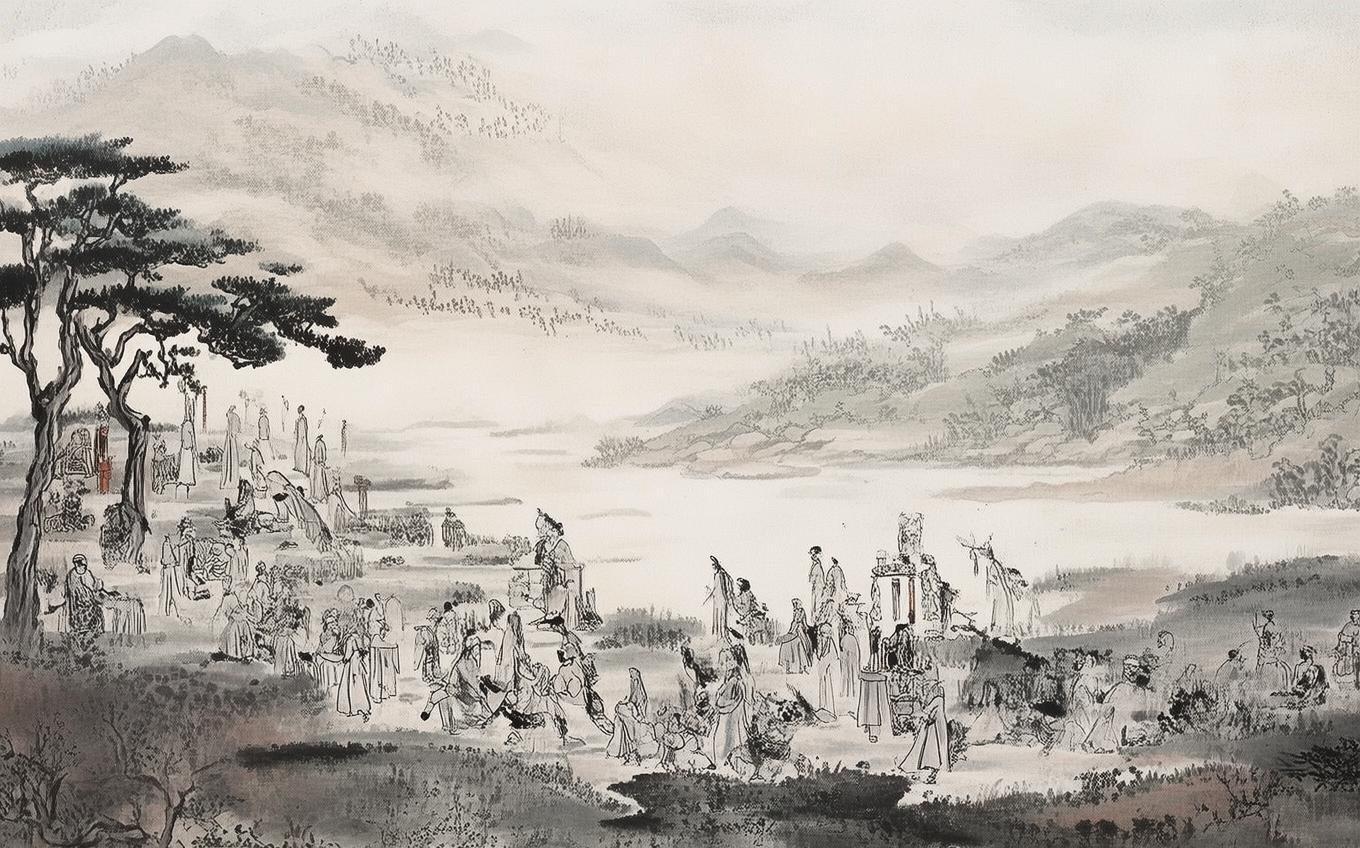
大君端扆暇,睿赏狎林泉。
Dà jūn duān yǐ xiá, ruì shǎng xiá lín quán.
The great sovereign, at leisure from his throne, graciously enjoys the woods and springs.
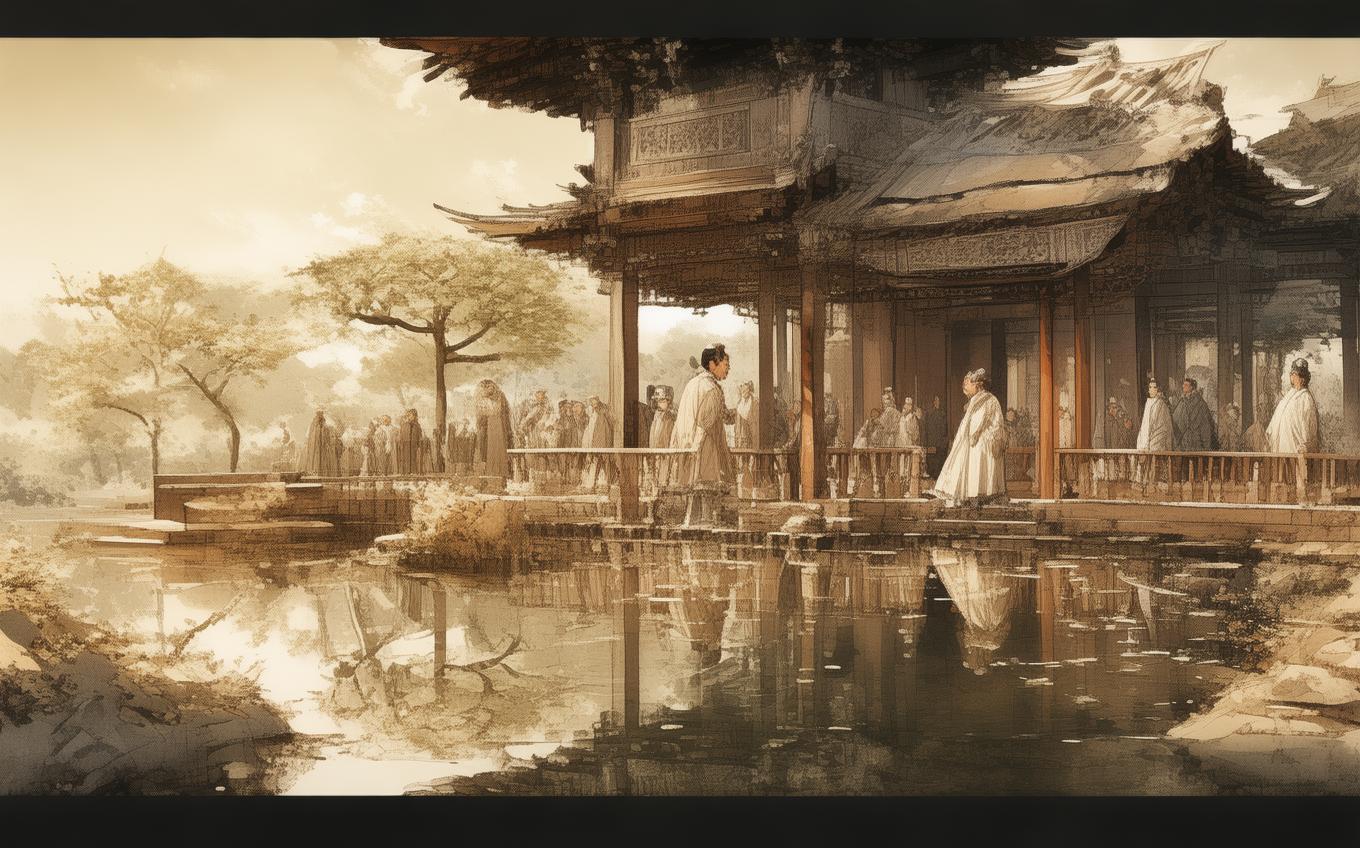
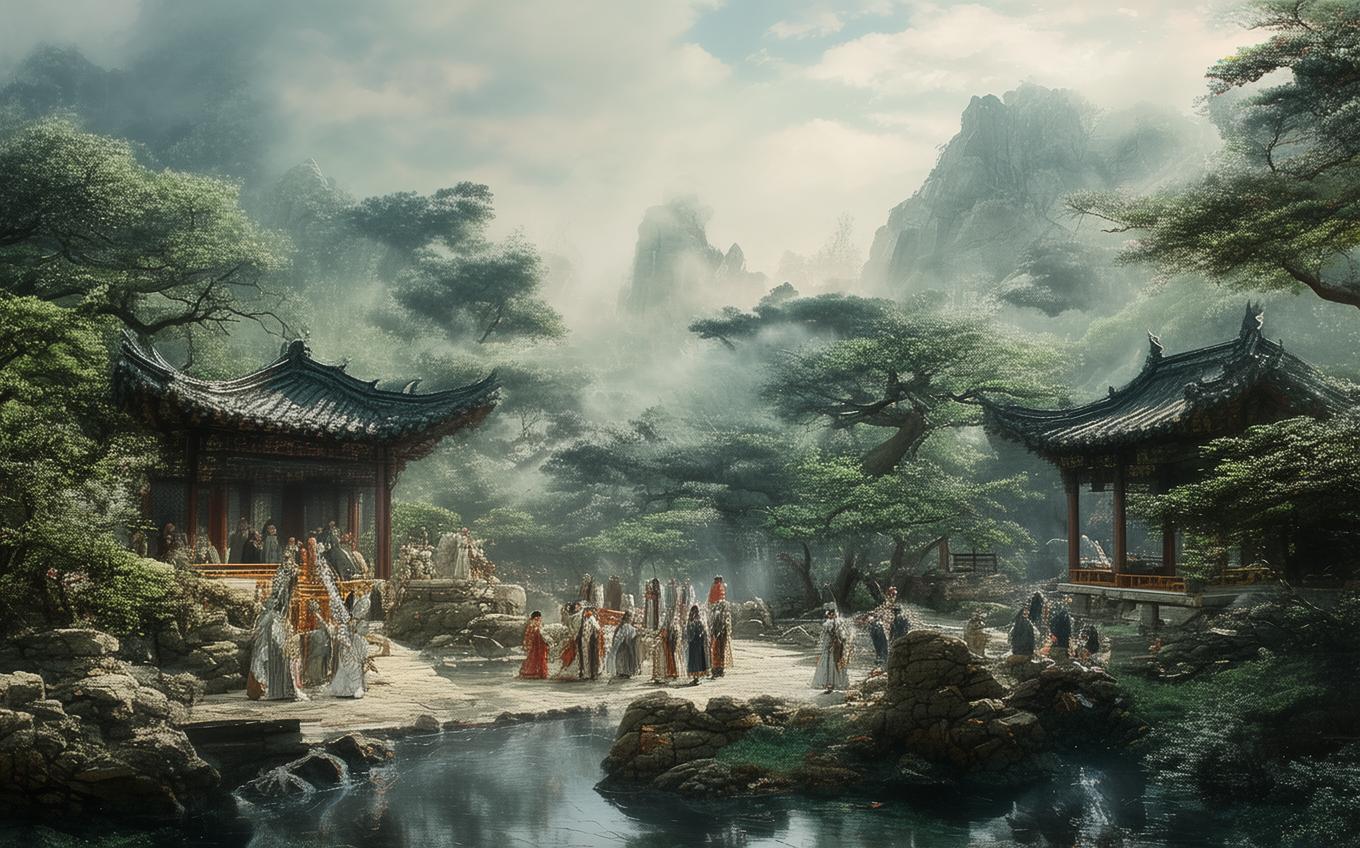
开轩临禁籞,藉野列芳筵。
Kāi xuān lín jìn yù, jiè yě liè fāng yán.
Windows are opened facing the imperial park; upon the wild ground a fragrant banquet is spread.
参差歌管飏,容裔羽旗悬。
Cēn cī gē guǎn yáng, róng yì yǔ qí xuán.
Songs and pipes rise in irregular harmony; feathered banners hang in graceful array.
玉池流若醴,云阁聚非烟。
Yù chí liú ruò lǐ, yún gé jù fēi yān.
The jade pond flows like sweet wine; the cloud-pavilion gathers what is no ordinary mist.
湛露晞尧日,熏风入舜弦。
Zhàn lù xī Yáo rì, xūn fēng rù Shùn xián.
Heavy dew dries beneath a Yao-like sun; the gentle breeze enters the strings of Shun.
大德侔玄造,微物荷陶甄。
Dà dé móu xuán zào, wēi wù hé táo zhēn.
Your great virtue equals the mysterious Creator; even tiny creatures bear the shaping of your kiln.
谬陪瑶水宴,仍厕栢梁篇。
Miù péi Yáo shuǐ yàn, réng cè Bǎi liáng piān.
Unworthily I attend the banquet by the jade waters, and still find myself among the verses of the Cypress Beam.
阚名徒上月,邹辩讵谈天。
Kàn míng tú shàng yuè, Zōu biàn jù tán tiān.
Kan's fame merely climbed to the moon; Zou's eloquence could hardly speak of Heaven.
既喜光华旦,还伤迟暮年。
Jì xǐ guāng huá dàn, hái shāng chí mù nián.
Though I rejoice in this glorious morning, I also grieve that my years grow late.
犹冀升中日,簪裾奉肃然。
Yóu jì shēng zhōng rì, zān jū fèng sù rán.
Still I hope, on the day the sun reaches its zenith, to serve with reverent dignity in cap and robes.
Line-by-Line Analysis
Lines 1–2: The Emperor at Leisure
The poem opens by establishing the occasion: the emperor, referred to as 大君 (dà jūn, "great sovereign"), has set aside the formal duties of the throne (端扆, duān yǐ, referring to the screen behind the imperial throne) to enjoy the natural beauty of woods and springs. The phrase 睿赏 (ruì shǎng, "wise appreciation") is a standard honorific used to describe imperial enjoyment, implying that even the emperor's leisure is governed by wisdom. This opening establishes the poem's fundamental tension: the emperor descends from his elevated position to enjoy nature, and the poet is privileged to witness this harmonious union of imperial power and natural beauty.
Lines 3–4: The Banquet Scene
The poet describes the physical setting: windows opened to face the imperial park (禁籞, jìn yù), and a fragrant banquet spread directly on the wild ground. This juxtaposition of the cultivated (the imperial park, the elaborate feast) with the wild (藉野, jiè yě, "upon the wild ground") suggests the Tang ideal of harmony between human civilization and the natural world. The "fragrant banquet" (芳筵, fāng yán) evokes both literal culinary delights and the metaphorical sweetness of the occasion.
Lines 5–6: Music and Banners
The auditory and visual splendor of the scene is conveyed through the "irregular harmony" (参差, cēn cī) of songs and pipes—a phrase that suggests both the complexity and the beauty of the music—and the "feathered banners" (羽旗, yǔ qí) that hang in graceful array. The word 容裔 (róng yì) describes a floating, undulating movement, giving the banners a life-like quality. Together, these images create a sense of refined festivity befitting an imperial occasion.
Lines 7–8: Transcendent Waters and Clouds
The imagery becomes increasingly transcendent. The jade pond flows like sweet wine (醴, lǐ), suggesting that the very waters of the imperial garden are transformed into something precious and intoxicating. The "cloud-pavilion" (云阁, yún gé) gathers "what is no ordinary mist" (非烟, fēi yān)—a phrase that alludes to the auspicious vapors said to accompany the presence of a sage ruler. In Chinese tradition, certain atmospheric phenomena were interpreted as signs of Heaven's approval, and the poet here suggests that the emperor's virtue has summoned these celestial portents.
Lines 9–10: Allusions to Sage Kings
These lines introduce explicit historical and mythological references. Yao (尧) and Shun (舜) were legendary sage kings of ancient China, paragons of virtue and good governance. The "Yao-like sun" (尧日, Yáo rì) that dries the heavy dew suggests that the current emperor radiates the same benevolent warmth as the ancient sage. The "gentle breeze" (熏风, xūn fēng) entering "the strings of Shun" (舜弦, Shùn xián) references the legend that Shun played a five-stringed zither while singing of the south wind that nourishes his people. By comparing the reigning emperor to these legendary figures, the poet employs the highest form of courtly flattery, placing the current reign within a lineage of idealized rulership.
Lines 11–12: The Emperor's Cosmic Virtue
The poet elevates his praise to cosmic proportions. The emperor's "great virtue" (大德, dà dé) is said to equal the "mysterious Creator" (玄造, xuán zào), the ultimate force of creation in Daoist cosmology. The second half of the couplet introduces a note of humility: even "tiny creatures" (微物, wēi wù)—a category that includes the poet himself—"bear the shaping of your kiln" (荷陶甄, hé táo zhēn). The metaphor of the potter's kiln is significant: just as a potter shapes clay, the emperor's transformative virtue shapes all beings under his rule. The poet acknowledges himself as one of these humble vessels, molded by imperial grace.
Lines 13–14: Humility and Literary Allusion
The poet's self-deprecation deepens. He describes himself as "unworthily" (谬, miù) attending the "banquet by the jade waters" (瑶水宴, Yáo shuǐ yàn), an allusion to the mythical Queen Mother of the West's banquet at the Jade Pool, where immortals gathered. The second reference is to the "Cypress Beam" (栢梁, Bǎi liáng), a famous literary gathering at the Cypress Beam Terrace during the Han Dynasty, where Emperor Wu and his courtiers composed linked verses. By placing himself among these august traditions, the poet simultaneously honors the occasion and questions his own worthiness to participate.
Lines 15–16: Rhetorical Humility
The allusions continue with references to Kan (阚) and Zou (邹). Kan Ze (阚泽) was a figure known for his learning, while Zou Yan (邹衍) was a famous Warring States philosopher renowned for his eloquence and cosmological theories. The poet claims that even these legendary figures' achievements—Kan's fame "climbing to the moon" and Zou's "eloquence about Heaven"—pale in comparison to the current occasion. This is a sophisticated form of humility: by saying that even the greatest minds of the past could not adequately praise the emperor, the poet implies that his own efforts are necessarily inadequate.
Lines 17–18: Joy and Melancholy
The poem takes a poignant turn. The poet expresses simultaneous joy and sorrow: joy at witnessing this "glorious morning" (光华旦, guāng huá dàn)—a phrase that refers both to the literal morning of the banquet and metaphorically to the flourishing of the empire—and sorrow that his own years grow late (迟暮, chí mù). This emotional complexity elevates the poem beyond mere courtly flattery. The poet is aware that while the dynasty may be ascending, his own life is in its decline. This awareness of mortality, placed within the context of imperial splendor, gives the poem a bittersweet quality.
Lines 19–20: Hope and Reverence
The poem concludes with a note of hope and continued devotion. The "day the sun reaches its zenith" (升中日, shēng zhōng rì) refers to the moment of the empire's greatest glory. The poet expresses his wish to still be present at that time, serving with "reverent dignity in cap and robes" (簪裾奉肃然, zān jū fèng sù rán). The cap and robes are the formal attire of a court official, symbolizing the poet's commitment to his role despite his advancing years. The final image is one of steadfast loyalty and hope—a fitting conclusion to a poem that balances praise, humility, and personal reflection.
Themes and Symbolism
The Harmony of Nature and Imperial Power
One of the poem's central themes is the harmonious relationship between the natural world and the emperor's rule. The banquet takes place outdoors, with the imperial park blending into the wild landscape. The jade pond flows like wine, and auspicious mists gather around the cloud-pavilion. In Chinese political philosophy, a virtuous ruler was believed to maintain cosmic harmony, and natural phenomena—favorable weather, auspicious signs—were interpreted as evidence of Heaven's approval. The poem's natural imagery thus serves a political function: it testifies to the emperor's virtue and the flourishing of his reign.
The Ideal of the Sage King
The allusions to Yao and Shun place the current emperor within a lineage of legendary sage rulers. This is a common trope in Tang court poetry, but it carries particular weight in the context of the early Tang Dynasty. Emperor Taizong had come to power through violence—the Xuanwu Gate Incident—and was deeply concerned with legitimizing his rule. Poetry that compared him to the sage kings of antiquity served this legitimizing function, reinforcing the idea that his reign represented a return to the golden age of Chinese governance.
Humility and Self-Deprecation
Throughout the poem, the poet emphasizes his own unworthiness. He is a "tiny creature" shaped by the emperor's kiln; he "unworthily" attends the banquet; even the greatest minds of the past could not adequately praise the occasion. This humility is both a social convention and a rhetorical strategy. By lowering himself, the poet elevates the emperor; by acknowledging the inadequacy of his words, he paradoxically demonstrates his literary skill.
Mortality and the Passage of Time
The poem's most poignant theme emerges in its final lines. The poet's joy at the empire's flourishing is tempered by his awareness of his own mortality. The "glorious morning" of the dynasty contrasts with the poet's "late years." This juxtaposition of imperial permanence and personal transience is a recurring theme in Chinese poetry, reflecting a deep awareness of the human condition within the larger sweep of history.
Key Symbols
- The Jade Pond (玉池, yù chí): Symbolizes purity, preciousness, and the transcendent quality of the imperial garden. It also evokes the mythical Jade Pool of the Queen Mother of the West, suggesting that the banquet is a gathering of immortals.
- The Cloud Pavilion (云阁, yún gé): Represents the elevated status of the imperial court, reaching toward Heaven itself.
- The Kiln (陶甄, táo zhēn): A metaphor for the emperor's transformative power, shaping his subjects as a potter shapes clay.
- The Sun (日, rì): Symbolizes the emperor, whose virtue radiates like the sun, drying the dew and illuminating the empire.
- Cap and Robes (簪裾, zān jū): Represent the poet's official identity and his commitment to service.
Cultural Context
The Xuanwu Gate and Tang Court Culture
The Xuanwu Gate holds a unique place in Tang history. It was here, in 626 CE, that Li Shimin ambushed and killed his brothers, eliminating his rivals for the throne and forcing his father to abdicate. Despite—or perhaps because of—this violent beginning, Emperor Taizong became one of China's most celebrated rulers, presiding over a period of stability, prosperity, and cultural flourishing known as the "Reign of Zhenguan" (贞观之治). The gate, once a site of bloodshed, became a symbol of imperial authority and the emperor's ability to maintain order.
Court banquets at the Xuanwu Gate were occasions for displaying this authority through cultural means. Poetry composition was an essential part of these gatherings, with courtiers expected to demonstrate their literary skill while praising the emperor and the harmony of his reign. Du Zhenglun's poem is a masterful example of this genre, skillfully balancing the demands of courtly flattery with genuine artistic expression.
The Genre of Yingzhi Poetry
Yingzhi shi (应制诗), or "poems composed at imperial command," was a well-established genre by the Tang Dynasty. These poems followed certain conventions: they typically opened with a description of the occasion, praised the emperor through historical and mythological allusions, expressed the poet's humility, and concluded with wishes for the emperor's longevity and the empire's prosperity. While these conventions could produce formulaic verse, the best yingzhi poems—such as this one—transcended their genre through skillful imagery, emotional depth, and genuine engagement with the occasion.
Confucian Values and the Role of the Scholar-Official
The poem reflects core Confucian values: loyalty to the ruler, humility in one's own achievements, and dedication to service. The scholar-official's role was to advise the emperor and contribute to good governance, and poetry was one of the primary means through which this relationship was expressed. By composing this poem, Du Zhenglun was not merely flattering the emperor; he was participating in the ritual maintenance of the imperial order, using his literary skill to reinforce the values that sustained the dynasty.
The Influence of Daoism
The poem also incorporates Daoist elements, particularly in its references to the "mysterious Creator" (玄造, xuán zào) and the transformative power of the kiln. The Tang Dynasty was a period of religious pluralism, with Daoism enjoying particular favor because the imperial family claimed descent from Laozi (老子), the legendary founder of Daoism. The poem's cosmic imagery—the auspicious mists, the jade pond, the celestial portents—draws on Daoist vocabulary to suggest that the emperor's rule is aligned with the fundamental forces of the universe.
Conclusion
"玄武门侍宴" by Du Zhenglun is a remarkable example of Tang court poetry, demonstrating how a skilled poet could work within the conventions of the yingzhi genre to create something of lasting artistic value. The poem operates on multiple levels: it is a vivid description of an imperial banquet, a sophisticated exercise in courtly flattery, a meditation on the relationship between ruler and subject, and a poignant reflection on mortality and the passage of time.
What makes this poem enduringly appealing is its emotional honesty. Beneath the layers of allusion and convention, we sense a real human being—grateful for the privilege of attending the banquet, aware of his own inadequacy, joyful at the empire's flourishing, and sorrowful at the approach of his own decline. This combination of public duty and private feeling gives the poem a depth that transcends its immediate occasion.
For modern readers, the poem offers a window into the world of Tang court culture, where poetry was not merely an art form but an essential tool of political and social life. It also reminds us of the universal human experiences that connect us across time: the joy of celebration, the awareness of mortality, and the hope that our contributions, however humble, will endure. In its graceful fusion of the personal and the political, the natural and the cosmic, "玄武门侍宴" exemplifies the richness and complexity of classical Chinese poetry at its finest.
Sources and Verification
- Verified text and attribution: 杜正伦, “玄武门侍宴” (Tang dynasty).
- Primary dataset: Chinese Poetry open corpus.
- Source record:
278abb55-9c5e-4456-a748-64639a55ad7e.
The Chinese source text and attribution are supplied from the verified record above. The English translation and commentary are educational explanations.
Comments (0)
No comments yet. Be the first to comment!