Introduction
Liu Xiaosun (刘孝孙) was a poet of the early Tang Dynasty (618–907 CE), a period often celebrated as a golden age of Chinese poetry. While he may not be as widely known today as Li Bai or Du Fu, his surviving works offer valuable glimpses into the elegant social gatherings and literary culture of the Tang elite. This particular poem, "冬日宴于庶子宅各赋一字得鲜" (A Winter Banquet at the Residence of the Junior Mentor, Each Composing on an Assigned Character, I Received "Fresh"), belongs to a distinctive genre of Chinese poetry: the "assigned character" poem.
In such gatherings, each guest would be given a single character as a rhyme or thematic prompt, and would then compose a poem incorporating that character. The character assigned here is 鲜 (xiān), meaning "fresh," "bright," or "vivid." This social context is essential to understanding the poem — it is both an occasional piece celebrating friendship and a display of literary wit and skill.
The Poem: Full Text and Translation
解襟游胜地,披云促宴筵。
jiě jīn yóu shèng dì, pī yún cù yàn yán.
Loosening my collar, I wander through this scenic place; parting the clouds, we hasten the banquet mats.
清文振笔妙,高论写言泉。
qīng wén zhèn bǐ miào, gāo lùn xiě yán quán.
Pure prose flourishes with marvelous brushwork; lofty discourse pours forth like a spring of words.
冻柳含风落,寒梅照日鲜。
dòng liǔ hán fēng luò, hán méi zhào rì xiān.
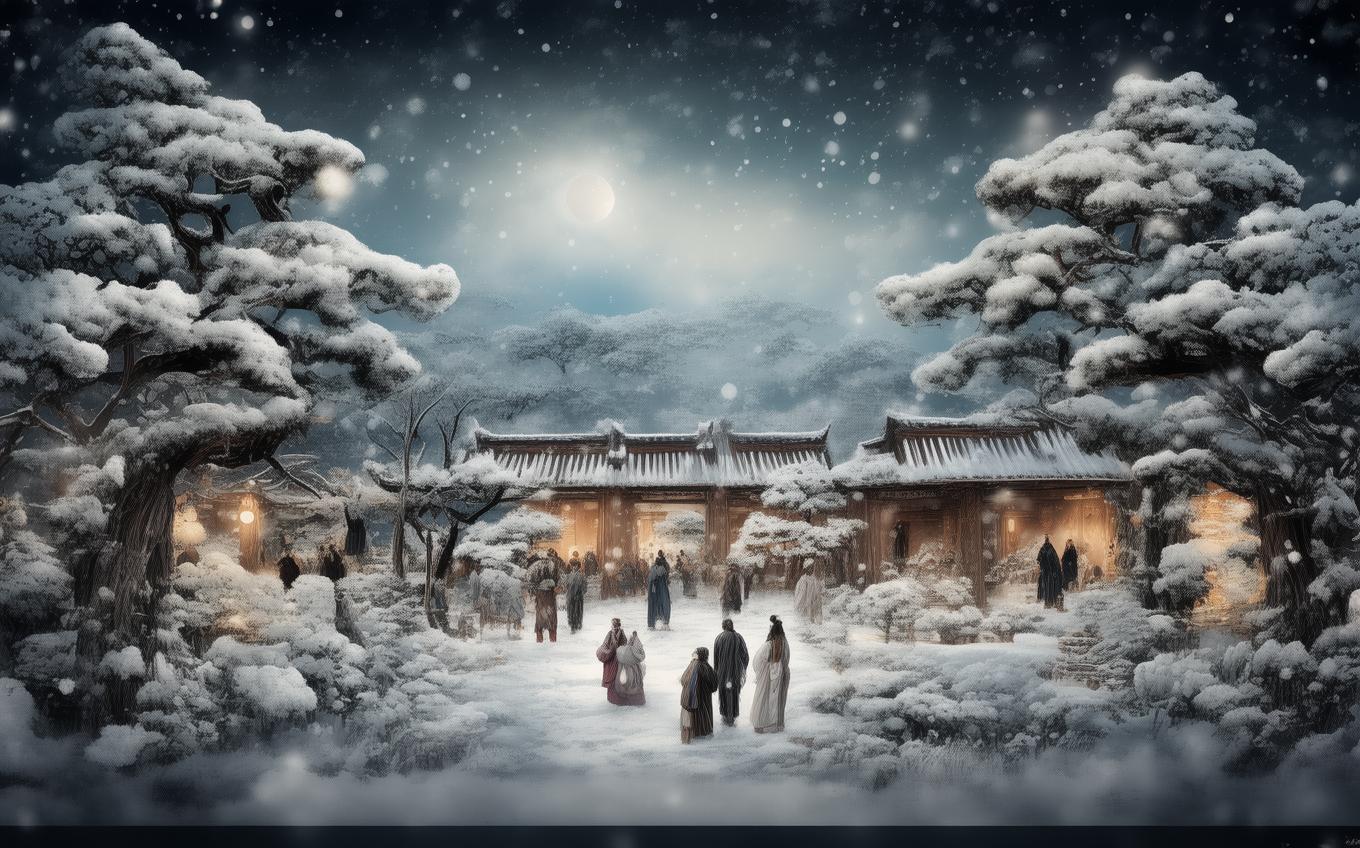
Frozen willows shed their leaves in the wind; cold plum blossoms, lit by the sun, glow fresh and bright.
骊歌虽欲奏,归驾且留连。
lí gē suī yù zòu, guī jià qiě liú lián.
Though the farewell song is about to be played, the returning carriage lingers, reluctant to depart.
Line-by-Line Analysis
解襟游胜地,披云促宴筵。
The poem opens with a gesture of ease and openness: "解襟" (jiě jīn) — loosening one's collar or opening one's robe — suggests both physical comfort and emotional openness. The poet describes arriving at a beautiful location ("胜地," scenic place) and preparing for a banquet. The phrase "披云" (pī yún), literally "parting the clouds," is particularly evocative. It could be read literally as clouds dispersing to reveal the gathering, or metaphorically as the lifting of worldly concerns to allow for pure enjoyment. The verb "促" (cù), meaning "to hasten" or "urge," conveys the eager anticipation of the feast and the warm hospitality of the host.
清文振笔妙,高论写言泉。
This couplet celebrates the intellectual and artistic atmosphere of the gathering. "清文" (qīng wén) refers to pure, refined writing; "振笔" (zhèn bǐ) means to wield the brush with vigor; "妙" (miào) denotes marvelous skill. The second half, "高论写言泉," describes elevated conversation flowing like a spring ("泉," quán). This is a beautiful metaphor: words are not merely spoken but "written" (写, xiě) as if inscribed upon the air, and they gush forth with the natural abundance of a mountain spring. The line captures the ideal of Tang literati gatherings — not merely eating and drinking, but engaging in refined literary and philosophical exchange.
冻柳含风落,寒梅照日鲜。
Here the poem shifts from the human scene to the natural world, and this is where the assigned character 鲜 (xiān) makes its appearance. The first half paints a bleak winter picture: "冻柳" (dòng liǔ), frozen willows, their leaves falling in the wind. The willow, often associated with parting and melancholy in Chinese poetry, here appears withered and bare. But the second half offers a striking contrast: "寒梅" (hán méi), the cold plum blossom, illuminated by sunlight, appears "鲜" — fresh, bright, vivid.
This juxtaposition is masterful. The plum blossom is one of the most revered symbols in Chinese culture, blooming in the depths of winter when all other flowers have died. By pairing the withered willow with the radiant plum, Liu Xiaosun not only fulfills his assigned character but also creates a profound meditation on resilience and beauty in adversity. The plum blossom "照日" (zhào rì), lit by the sun, becomes a beacon of vitality in the frozen landscape.
骊歌虽欲奏,归驾且留连。
The final couplet introduces the theme of parting. "骊歌" (lí gē) refers to the "Song of the Black Horse," a traditional farewell song from ancient times. The poet acknowledges that the time for departure is approaching — the farewell song is about to be played — yet "归驾" (guī jià), the returning carriage, lingers ("留连," liú lián). This reluctance to leave speaks to the warmth of the friendship and the joy of the gathering. The word "且" (qiě), meaning "for now" or "temporarily," adds a gentle, wistful quality: the guests know they must eventually go, but they choose to delay the inevitable.
Themes and Symbolism
The Joy of Friendship and Literary Gathering
The poem's primary theme is the celebration of intellectual companionship. The banquet is not merely a social event but a meeting of minds, where "pure prose" and "lofty discourse" flow as freely as wine. This reflects a core value of Tang literati culture: the belief that true pleasure lies in the exchange of ideas among kindred spirits.
Nature as Mirror and Symbol
The natural imagery serves multiple purposes. The frozen willow and the radiant plum blossom are not merely decorative; they embody the poem's emotional arc. The willow, traditionally associated with parting and sorrow, foreshadows the farewell to come. The plum blossom, with its assigned character 鲜, represents the vitality of the present moment — the warmth of friendship that defies the winter cold.
The Plum Blossom (梅, méi)
In Chinese culture, the plum blossom holds a special place as one of the "Four Gentlemen" (四君子, sì jūnzǐ) of Chinese art, alongside the orchid, bamboo, and chrysanthemum. It symbolizes perseverance, purity, and hope, blooming in the harshest conditions. By using the plum blossom to fulfill his assigned character, Liu Xiaosun elevates the poem from mere social verse to something more profound: a reminder that beauty and vitality can flourish even in adversity.
The Poetics of Parting
The final couplet touches on the universal human experience of not wanting a joyful moment to end. The "farewell song" (骊歌) is a reminder of mortality and the passage of time, but the lingering carriage represents the human desire to hold onto precious moments. This tension between impermanence and attachment is a recurring theme in Chinese poetry.
Cultural Context
The Tang Dynasty Literary Gathering
The Tang Dynasty was a period of unprecedented cultural flourishing in China. Poetry was not merely a private pursuit but a social institution. Literary gatherings, known as "雅集" (yǎ jí), were common among the educated elite. Guests would compose poetry on set themes, often with assigned rhymes or characters, as a form of intellectual entertainment and mutual appreciation.
The specific setting of this poem — "庶子宅" (shù zǐ zhái), the residence of the Junior Mentor — refers to an official position in the Tang court. The host was likely a government official who invited fellow literati to his home for a winter banquet. The phrase "各赋一字" (gè fù yī zì), "each composing on an assigned character," indicates that this was a structured poetic game, a test of wit and skill.
The Aesthetics of Constraint
To modern readers, the idea of composing poetry under such constraints might seem limiting. But in the Chinese literary tradition, constraint was seen as a spur to creativity. The assigned character 鲜 (xiān) forced the poet to think carefully about how to incorporate it naturally and meaningfully. Liu Xiaosun's solution — using it to describe the sunlit plum blossom — is a masterful demonstration of how poetic genius can transform limitation into inspiration.
Daoist and Confucian Undercurrents
The poem subtly reflects both Daoist and Confucian values. The Daoist influence is evident in the appreciation of nature and the desire for spontaneous, unforced enjoyment ("解襟" suggests letting go of social formality). The Confucian influence appears in the emphasis on refined discourse and the cultivation of virtue through literary practice. This synthesis of philosophical traditions is characteristic of Tang literati culture.
Conclusion
"冬日宴于庶子宅各赋一字得鲜" is a small gem of Tang Dynasty occasional poetry. On the surface, it is a simple record of a winter banquet among friends. But beneath this surface lies a rich tapestry of imagery, symbolism, and cultural meaning. The contrast between the frozen willow and the radiant plum blossom encapsulates the poem's central insight: that beauty, friendship, and intellectual vitality can flourish even in the coldest seasons of life.
The poem's enduring appeal lies in its ability to capture a universal human experience — the bittersweet joy of a gathering that must eventually end. The lingering carriage, reluctant to depart, speaks to something deep in the human heart: our desire to hold onto moments of warmth and connection, even as we know they cannot last. In this sense, Liu Xiaosun's poem, composed over a thousand years ago at a winter banquet in Chang'an, still resonates with readers today, reminding us to cherish the "fresh" moments of beauty and friendship that illuminate our lives.
Sources and Verification
- Verified text and attribution: 刘孝孙, “冬日宴于庶子宅各赋一字得鲜” (Tang dynasty).
- Primary dataset: Chinese Poetry open corpus.
- Source record:
59005266-3c8a-486e-afae-43f553681f8b.
The Chinese source text and attribution are supplied from the verified record above. The English translation and commentary are educational explanations.

Comments (0)
No comments yet. Be the first to comment!